Weather Hazards & Safe Design Builder
Explore seven types of weather hazards, learn what makes them dangerous, and discover how to stay safe. Then design your own shelter and test it against real weather challenges!
Weather Safety Guide
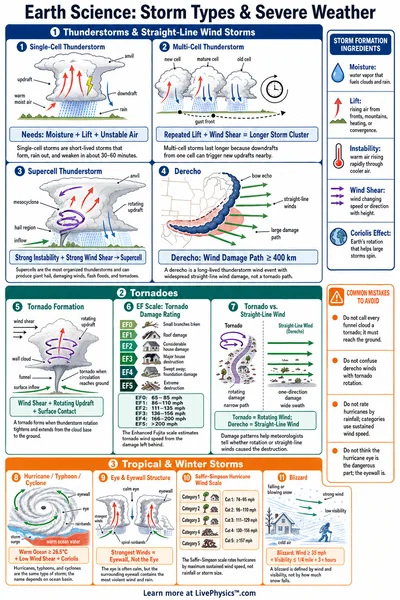
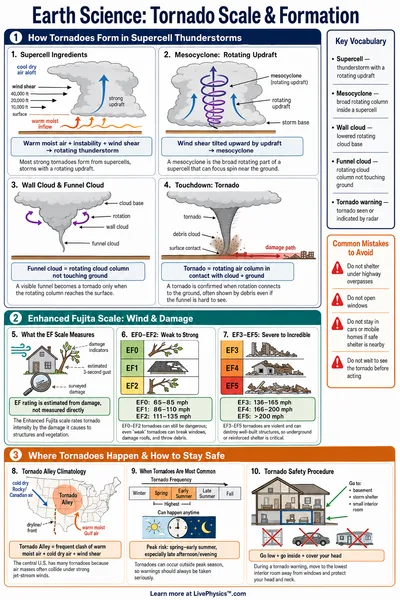
Types of Severe Weather
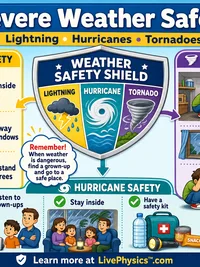
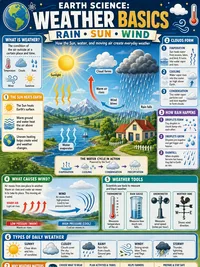
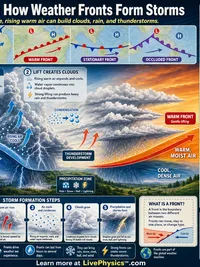
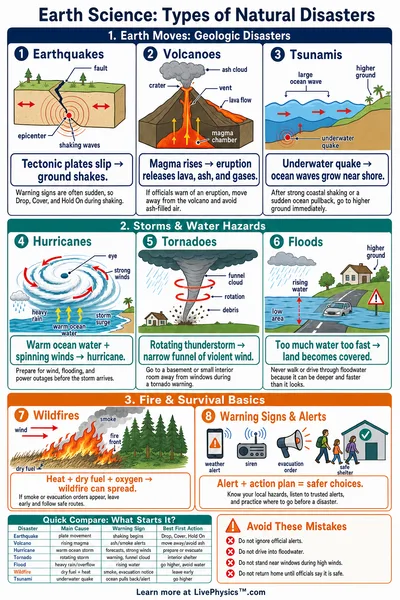
Severe weather includes any dangerous weather event that can cause damage or put people at risk. The main types are
- Thunderstorms bring lightning, hail, and heavy rain
- Tornadoes are spinning funnels of extreme wind
- Hurricanes are massive ocean storms with flooding and wind
- Blizzards bring heavy snow, ice, and bitter cold
- Wildfires spread fast through dry forests and grasslands
How Buildings Protect Us
Engineers design buildings to resist different weather hazards. The right choices depend on the local climate
- Sloped roofs shed rain and snow
- Concrete walls resist wind and flood
- Raised foundations keep homes above floodwater
- Storm shutters protect windows from flying debris
- Insulation keeps buildings warm in cold or cool in heat
Emergency Preparedness
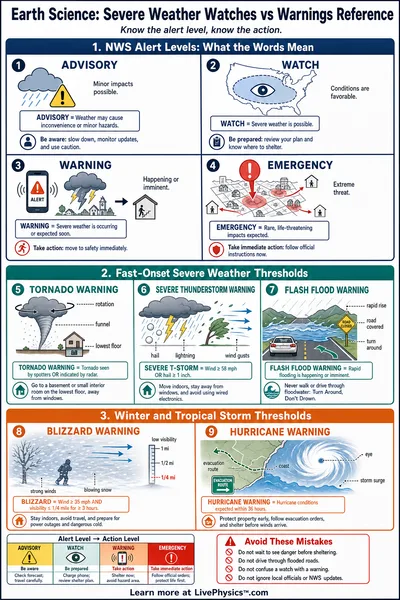
Being prepared for severe weather can save lives. Every family should have
- A plan for where to go during each type of weather emergency
- An emergency kit with water, food, flashlight, and first aid
- A way to receive weather warnings (radio, phone alerts)
- Practice drills so everyone knows what to do
Science Standards (NGSS)
This tool supports the Next Generation Science Standards for elementary Earth science
- 3-ESS3-1 Make a claim about the merit of a design solution that reduces the impacts of weather-related hazards
- K-ESS3-2 Ask questions about what plants and animals need to survive
- 4-ESS3-2 Generate and compare multiple solutions to reduce the impacts of natural processes on humans
Related Content
Related Tools
Earthquake Magnitude Calculator
Four modes, magnitude scales (Richter Mₗ, moment magnitude M𝑤, energy), energy comparison (each step = 31.6× more energy, logarithmic bar chart), Modified Mercalli Intensity I-XII with descriptions, and Richter magnitude from seismograph amplitude. Presets include Minor M3 through Great M8, 1906 San Francisco M7.9, and 2011 Japan M9.1.
Carbon Footprint Calculator
Estimate annual CO₂ emissions from transportation (car miles, fuel type, flights), home energy (electricity, heating, AC), diet (meat consumption, food waste), and lifestyle (shopping, recycling). Pie chart breakdown, country comparison bar chart, trees-to-offset and equivalent-driving metrics. Five presets, Average American, Eco-Conscious, Heavy Commuter, Frequent Flyer, Work from Home.
Star Lifecycle Visualizer
Three modes: interactive HR diagram with 23 real stars (click to see properties), stellar evolution pathway from nebula to end state (white dwarf, neutron star, or black hole based on initial mass), and star properties calculator (luminosity L∝M^3.5, radius, lifetime t∝M^-2.5, apparent magnitude). Six presets: Sun, Red Dwarf (0.3 M☉), Sirius A (2 M☉), Blue Giant (20 M☉), Betelgeuse (15 M☉), Supergiant (50 M☉). Includes spectral class colour strip and SVG star visualization.
H-R Diagram Explorer
Three modes, plot a single star on the Hertzsprung-Russell diagram from temperature, radius, and mass (Stefan-Boltzmann luminosity, spectral class O-M, absolute magnitude, HR region); compare multiple stars side by side; and browse the spectral atlas with typical properties for each class. 23 reference stars plotted, 6 presets from Proxima Centauri to Rigel.
Related Labs
Weather Hazards & Safe Design Lab
Test building designs against weather hazards, apply the engineering design cycle, and discover which protection features reduce storm damage
Weather Watcher & Clothing Lab
Test outfits against sunny, rainy, snowy, cloudy, and windy weather. Record correct, missed, and wrong choices to find which clothes work in which weather. Grades K-1.
Simple Weather Station Lab
Log daily weather observations over two simulated weeks. Record temperature, cloud cover, wind, and precipitation, then identify patterns across the 14-day period.
River Flood Hydrograph Lab
Adjust rainfall intensity, storm duration, watershed area, slope, soil saturation, and urbanization, then watch the flood hydrograph respond. Compare a developed watershed against its natural baseline to see how impervious surfaces raise peak discharge and shorten lag time, using the Rational Method Q = C i A.