American Revolution Lab
Explore the causes, events, and outcomes of the American Revolution (1763-1789). Analyze British and Colonial perspectives, trace the key battles and turning points, and evaluate how the Revolution affected five different groups of people.
Controls
Instructions Expand each cause to read about it from both the British and Colonial perspectives. Then rate how important you think each cause was in sparking the Revolution (1 = minor factor, 5 = critical driver).
Data Table
(0 rows)| # | Cause / Event | Description | British Perspective | Colonial Perspective | Importance (1-5) |
|---|
Reference Guide
Causes of the Revolution
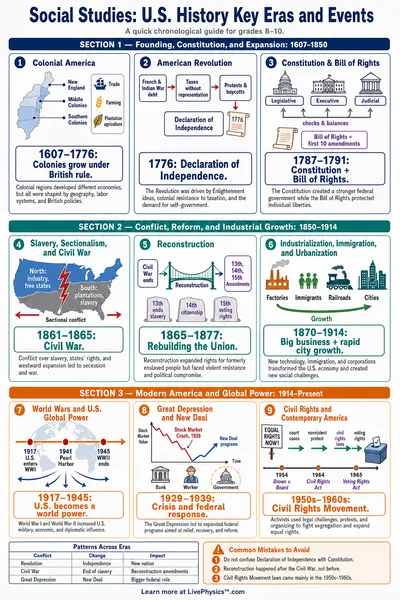
The American Revolution grew from a series of political and economic conflicts between Britain and its thirteen colonies following the Seven Years' War (1756-1763). Britain needed revenue to pay war debts and stationed troops in the colonies.
Colonists objected to taxation without legislative representation, the quartering of soldiers in private homes, and restrictions on westward settlement. Each new law passed by Parliament intensified resistance and pushed moderate colonists toward supporting independence.
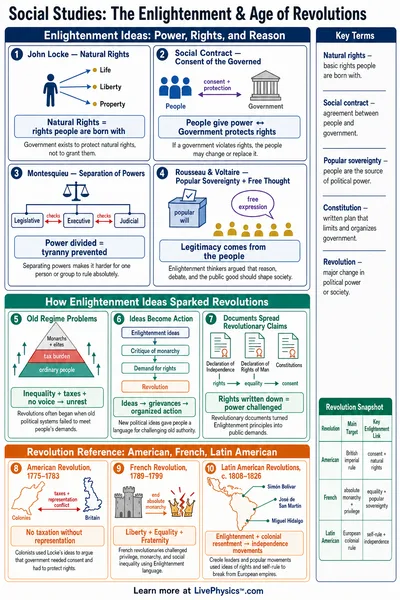
The Enlightenment philosophy of John Locke provided colonists with a framework, governments derive power from the consent of the governed, and citizens have a right to resist government that violates their natural rights to life, liberty, and property.
Key Battles and Events
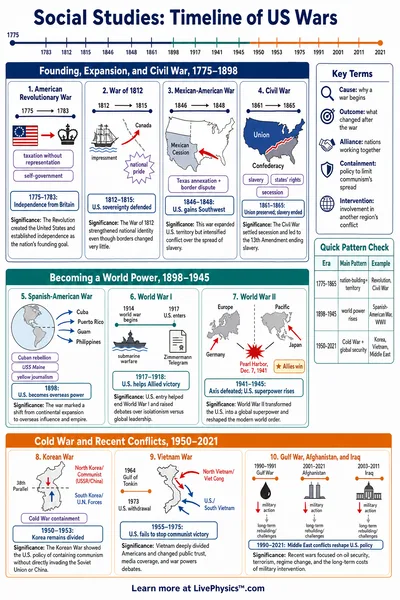
The armed conflict began at Lexington and Concord in April 1775. The Continental Army under George Washington faced early defeats but kept the fight alive through the brutal winter at Valley Forge (1777-1778).
France entered the war as a U.S. ally in 1778 after the American victory at Saratoga, providing troops, ships, and money that proved decisive. The combined Franco-American force trapped British General Cornwallis at Yorktown, Virginia, in 1781.
The Treaty of Paris (1783) formally ended the war, with Britain recognizing U.S. independence and ceding territory east of the Mississippi River. The Constitution followed in 1787, creating the framework of American government still in use today.
Enlightenment Ideas
The Declaration of Independence draws heavily on Enlightenment philosophy. Thomas Jefferson adapted John Locke's theory of natural rights (life, liberty, property) into "life, liberty, and the pursuit of happiness."
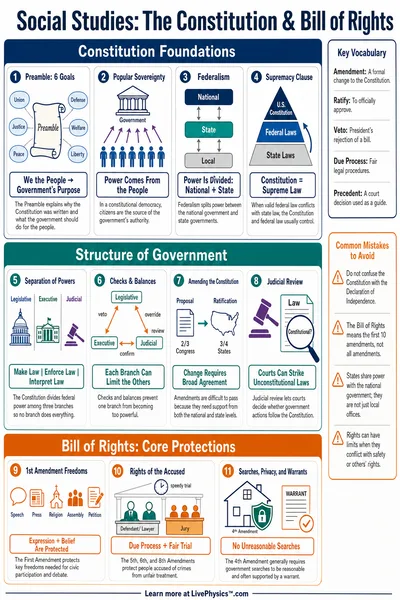
Jean-Jacques Rousseau's concept of the social contract argued that political authority rests on an agreement among citizens, not divine right. Baron de Montesquieu's ideas about separation of powers shaped the Constitution's three-branch system.
The claim that all men were created equal conflicted with slavery in the new republic. The Revolution planted the intellectual seeds of future reform movements, including abolitionism and women's suffrage.
Outcomes and Legacies
The Revolution's outcomes were unequal. White male Patriot colonists gained self-governance and expanded political rights. Loyalists faced persecution and exile. Enslaved people remained enslaved; slavery was written into the Constitution via the Three-Fifths Compromise.
Native Americans lost their most important protector when Britain was defeated. The new United States rapidly expanded westward, displacing Native nations that had lived on those lands for centuries. Women did not gain formal political rights, though New Jersey briefly allowed propertied women to vote before rescinding it.
The Revolution's long-term legacy is the tension it created, a nation founded on universal ideals that applied them selectively. Each generation has had to wrestle with how to extend those ideals more fully to all people.