Civil Rights Movement Lab
Explore the American Civil Rights Movement through 10 key events from 1954 to 1965. Analyze causes and effects, identify the people involved, and build a causal chain showing how protests and legal action led to landmark legislation.
Controls
View Mode
Event Types
Chronological Timeline (1954-1965)
Select an event to explore it
Click any event in the timeline or causal chain to see its full details, key people, and impact.
Data Table
(0 rows)| # | Event | Year | Type | Key People | Impact | Connection to Next Event |
|---|
Reference Guide
The Civil Rights Movement
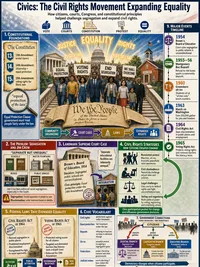
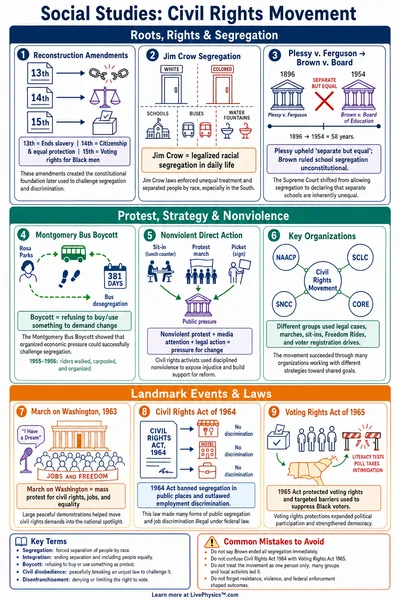
The American Civil Rights Movement (1954-1968) was a sustained campaign to end racial segregation and discrimination against Black Americans and to secure federal protection of their constitutional rights.
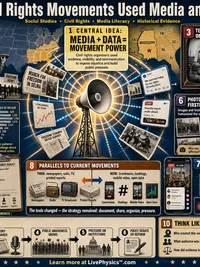
The movement employed a range of tactics including legal challenges in the courts, nonviolent direct action protests, economic boycotts, and mass demonstrations. Each strategy reinforced the others, creating pressure at the local, state, and federal levels simultaneously.
The movement achieved two landmark legislative victories, the Civil Rights Act of 1964 and the Voting Rights Act of 1965, which transformed American law and ended the legal framework of racial segregation known as Jim Crow.
Non-Violent Protest Strategies
Dr. Martin Luther King Jr. and other leaders drew on the philosophy of nonviolent resistance developed by Mahatma Gandhi to shape the movement's tactics.
- Economic boycotts targeted businesses that enforced segregation, hitting them financially.
- Sit-ins occupied segregated spaces, forcing confrontation without violence.
- Freedom Rides tested enforcement of desegregation rulings in interstate travel.
- Mass marches demonstrated scale of support and generated media coverage that shaped public opinion nationwide.
Key Legislation
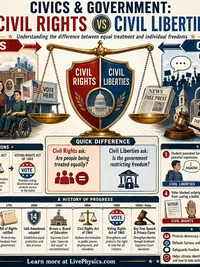
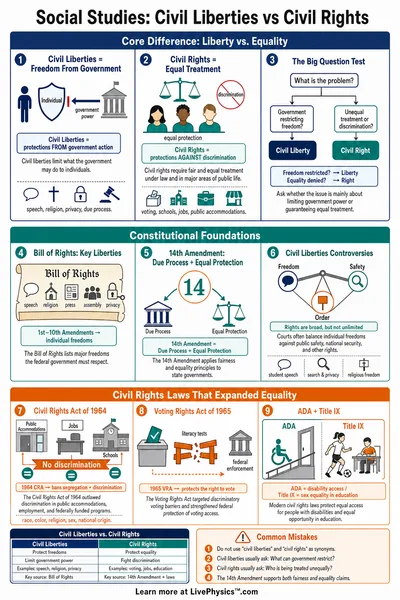
Civil Rights Act of 1964 - Prohibited discrimination based on race, color, religion, sex, or national origin in employment and public accommodations such as hotels, restaurants, and theaters. Established the Equal Employment Opportunity Commission (EEOC).
Voting Rights Act of 1965 - Banned discriminatory voting practices including literacy tests and poll taxes. Authorized federal oversight of elections in states with a history of discrimination. Within three years, Black voter registration in the South increased by over one million.
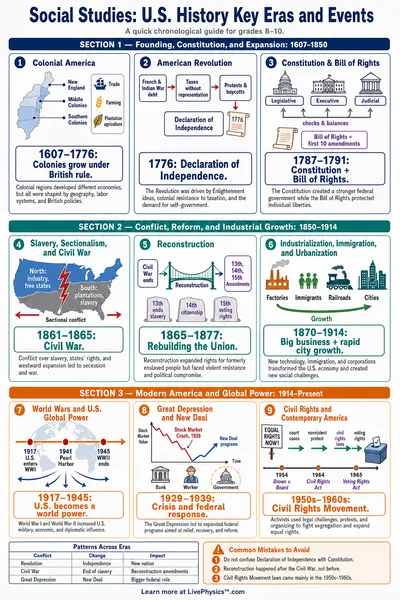
Both laws represented federal enforcement of rights that had existed on paper since the Reconstruction Amendments (13th, 14th, 15th) but had been systematically denied for nearly a century.
Key Figures
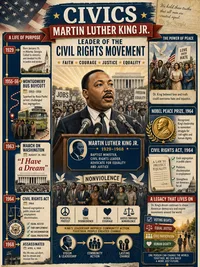
- Martin Luther King Jr. - Baptist minister and president of the Southern Christian Leadership Conference (SCLC); the movement's most prominent spokesperson and advocate for nonviolent resistance.
- Rosa Parks - NAACP secretary whose arrest for refusing to give up her bus seat sparked the Montgomery Bus Boycott.
- John Lewis - SNCC chairman who led the Freedom Rides and was beaten on Bloody Sunday at the Edmund Pettus Bridge in Selma.
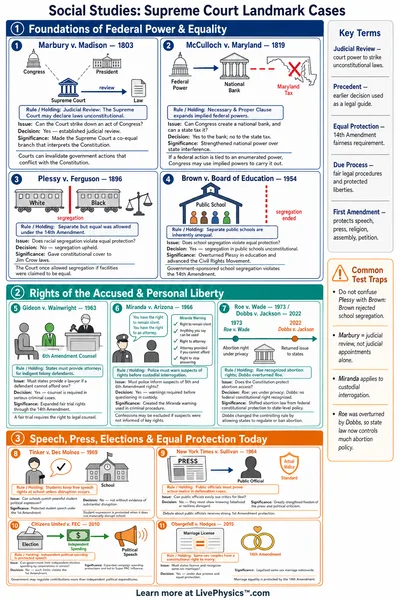
- Thurgood Marshall - NAACP Legal Defense Fund attorney who argued and won Brown v. Board of Education; later became the first Black Supreme Court Justice.