Ancient Civilizations Comparison Lab
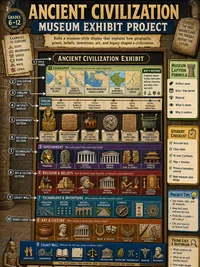
Select up to three ancient civilizations and compare them side by side across government, economy, religion, technology, geography, and legacy. Use the comparison notes to record your analysis and build your lab report.
Controls
Select Civilizations (up to 3)3/3 selected
Maximum 3 civilizations selected. Deselect one to choose another.
| Category | |||
|---|---|---|---|
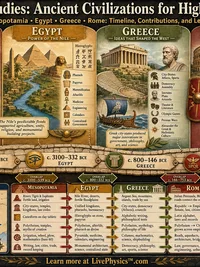
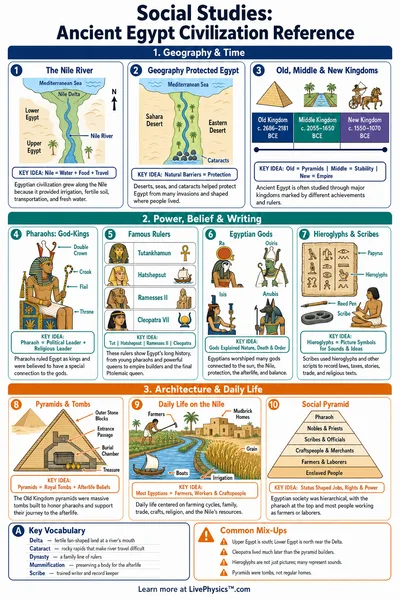
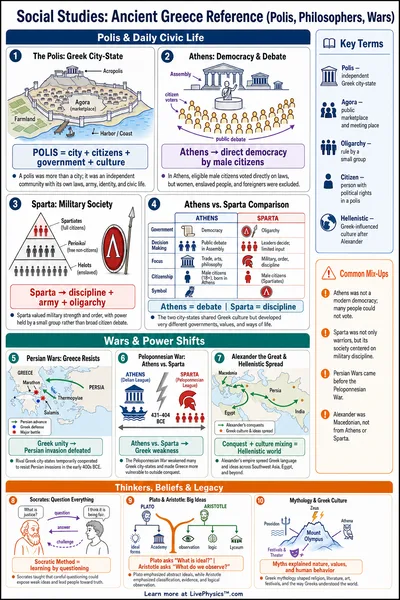
Government | Pharaonic monarchy. The pharaoh was considered a god on Earth with absolute power, assisted by viziers and a bureaucratic class of scribes. | Varied by city-state: Athenian democracy gave voting rights to male citizens, Sparta had dual kingship with ephors, other poleis had oligarchies or tyrannies. | Republican Senate and consuls (509-27 BCE) then Imperial monarchy. Roman law codified rights and duties, forming the basis of many modern legal systems. |
Economy | Agricultural surplus from Nile flooding. Trade in grain, papyrus, linen, and gold. Centralized state controlled redistribution of resources. | Maritime trade throughout the Mediterranean. Olive oil, wine, pottery, and silver exported. Slavery was widespread and integral to the economy. | Agriculture, conquest, and trade across a vast empire. Provincial taxes, tribute, and slave labor fueled the economy. Rome produced little, but distributed much. |
Religion | Polytheistic with a vast pantheon including Ra, Osiris, Isis, and Horus. Belief in the afterlife drove monumental tomb construction and mummification practices. | Polytheistic Olympian religion with Zeus, Athena, Apollo, and others. Oracles at Delphi guided decisions. Mystery religions like Eleusis offered personal salvation. | Initially polytheistic Roman pantheon (adapted from Greek gods). Christianity became the state religion in 380 CE after centuries as a persecuted minority faith. |
Technology | Pyramids, hieroglyphic writing, papyrus scrolls, advanced irrigation canals, copper and bronze tools, early surgery and medicine texts. | Antikythera mechanism (astronomical computer), catapult, water mill, Archimedes screw, advances in mathematics (Euclid, Pythagoras) and astronomy. | Concrete (opus caementicium), aqueducts, roads, arches, vaults, underfloor heating (hypocaust), and advanced military engineering including siege weapons. |
Geography | Nile River Valley provided annual floods with rich silt. Natural desert barriers on east and west offered protection. Mediterranean and Red Sea enabled trade. | Mountainous terrain separated city-states, promoting political fragmentation but also diversity. Access to Aegean, Ionian, and Mediterranean seas drove colonization. | Italian peninsula centrally located in Mediterranean. Seven hills of Rome defensible. Empire expanded from Britain to Mesopotamia, controlling key trade routes. |
Legacy | Calendar system, geometry for land surveying, architectural engineering, medical knowledge, and influence on Greek and Roman religion and philosophy. | Democracy, philosophy (Socrates, Plato, Aristotle), drama, Olympics, scientific inquiry, and Western architectural and artistic traditions. | Roman law, Latin language (roots of Romance languages), Christianity's spread, engineering infrastructure, and the concept of a republic influencing modern governance. |
Comparison Notes
(your analysis per category)Data Table
(0 rows)| # | Civilization | Period | Government Type | Economic Basis | Key Achievement | Legacy Today |
|---|
Reference Guide
Ancient Egypt (3100-30 BCE)
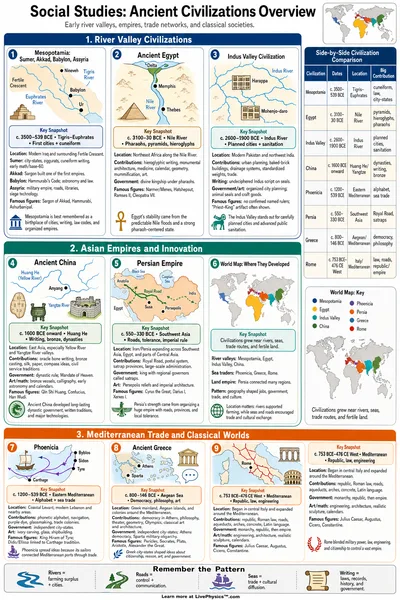
One of the longest-lasting civilizations in history, Egypt flourished along the Nile for over three thousand years. The annual Nile flood deposited rich silt that made the desert bloom, enabling surplus agriculture that supported a complex state.
Pharaohs ruled as divine kings overseeing monumental construction, military campaigns, and a vast administrative bureaucracy of scribes. Hieroglyphic writing recorded religious texts, trade records, and royal decrees on papyrus and stone.
Egyptian achievements in geometry (needed for resurveying flooded land), medicine, and astronomy directly influenced Greek science and, through it, the modern world. The 365-day solar calendar is their most enduring practical gift.
Ancient Greece and Rome (800 BCE - 476 CE)
Greece pioneered democratic governance in Athens, giving male citizens direct voting rights - a revolutionary idea that spread through Western history. Greek philosophy, theater, mathematics, and science formed the intellectual foundation of Western thought.
Rome absorbed Greek culture while adding its own genius for law, engineering, and administration. Roman concrete, aqueducts, and roads enabled an empire spanning from Scotland to Mesopotamia. Roman law codified individual rights in ways that still shape modern legal systems.
Together these two civilizations gave Western society its primary language roots, governmental models, philosophical traditions, and religious framework through the spread of Christianity.
Mesopotamia (3500-539 BCE)
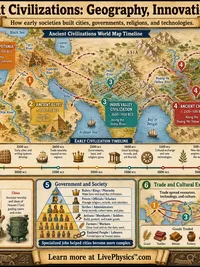
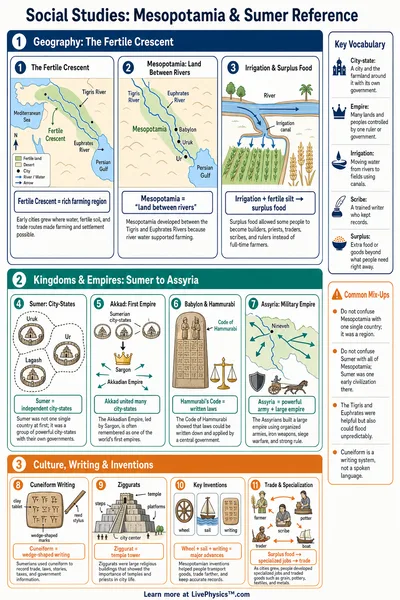
The "Cradle of Civilization" in the Tigris-Euphrates valley produced the world's first cities, writing system (cuneiform ~3400 BCE), and legal code (Hammurabi ~1754 BCE). Mesopotamian innovations in agriculture, metallurgy, and trade spread throughout the ancient world.
The 60-base number system developed here gave us 60 minutes per hour, 60 seconds per minute, and 360 degrees in a circle - units used globally today. Astronomical observations enabled the first accurate star catalogs and eclipse predictions.
Mesopotamian religious texts including the Epic of Gilgamesh contain flood narratives and cosmological ideas that influenced later Abrahamic traditions. The concept of written law itself originated here.
China and the Maya (221 BCE - 1500 CE)
Ancient China under the Qin and Han dynasties created the model of a centralized state administered by educated bureaucrats - the Civil Service examination system was a meritocratic innovation not matched in Europe for centuries. The four great inventions (paper, printing, gunpowder, compass) transformed world history.
The Maya of Mesoamerica independently developed a positional number system with zero, the most accurate calendar of any ancient civilization, and complex hieroglyphic writing. Their astronomical observations of Venus, eclipses, and star positions rival those of professional astronomers.
Both civilizations demonstrate that complex societies emerged independently across the globe, solving similar problems of governance, record-keeping, and astronomical timekeeping through different but equally sophisticated means.