Banking and Account Types Lab
Learn the common bank account types and when to use each one. Compare checking, savings, money market, and certificate of deposit accounts across interest, access, and minimum balance, then match each saver to the account that fits their goal.
Compare Account Types
Each account trades off how much interest it pays against how easily you can take your money out. Study the table, then test yourself in the scenario quiz below.
| Feature | Checking | Savings | Money Market | CD |
|---|---|---|---|---|
| Typical APY | 0.00% to 0.10% | 0.40% to 4.50% | 0.50% to 5.00% | 1.50% to 5.50% |
| Liquidity | Very high. Spend any time with a debit card, checks, or transfers. | High, with limits. Transfers are easy but withdrawals may be capped per month. | Medium to high. Often allows limited checks and a debit card, with a higher minimum. | Low. Funds are locked for a fixed term, and early withdrawal charges a penalty. |
| Minimum balance | Usually $0 to $25 | Usually $0 to $100 | Often $1,000 to $10,000 | Often $500 to $1,000 |
| Best for | Money you spend often, such as for groceries, bills, and everyday purchases. | An emergency fund or short-term goals where you want some interest but still quick access. | A larger balance you want to earn more interest on while keeping limited check access. | Money you will not need for a set period and want to earn the highest fixed rate. |
| FDIC insurance | FDIC insured up to $250,000 per depositor at a member bank. | FDIC insured up to $250,000 per depositor at a member bank. | FDIC insured up to $250,000 per depositor at a member bank. | FDIC insured up to $250,000 per depositor at a member bank. |
Controls
Scenario quiz
Read each saver's goal, pick the account that fits best, then check your answer to see the reasoning. Choices are logged in the data table below.
Match the Saver to the Account
The goal
Money you need for daily spending, like buying lunch and paying for the bus each week.
Which account fits best?
How APY Grows Your Money
APY stands for annual percentage yield. It is the interest your money earns in a year, including compounding. Adjust the values to see how a higher rate or a longer time builds a bigger balance.
$1,000.00
Starting deposit
$157.63
Interest earned
$1,157.63
Final balance
Data Table
(0 rows)| # | Saver's Goal | My Choice | Best Account | Result |
|---|
Reference Guide
Checking and Savings Accounts
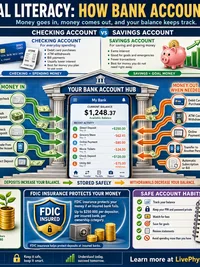
A checking account is built for everyday spending. You can use a debit card, write checks, and pay bills with very high liquidity, meaning the money is always available. The trade-off is that checking pays almost no interest.
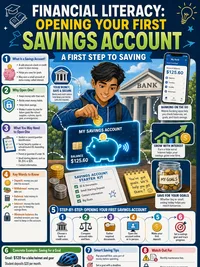
A savings account is built for money you want to keep but still reach quickly. It pays more interest than checking and is a strong fit for an emergency fund or a short-term goal. Some savings accounts limit the number of withdrawals per month.
- Checking. Frequent spending, bill pay, and direct deposit.
- Savings. Emergency funds and short-term goals that need quick access.
Money Market and Certificate of Deposit
A money market account often pays a higher rate on a larger balance and may let you write a limited number of checks or use a debit card. It usually requires a higher minimum balance than a basic savings account.
A certificate of deposit, or CD, locks your money for a fixed term in exchange for the highest fixed rate. If you withdraw early, you pay a penalty, so a CD suits money you are confident you will not need until the term ends.
- Money market. Larger balances that want more interest with limited checks.
- CD. Money you can lock away to earn the best guaranteed rate.
Interest, APY, and Liquidity
Interest is the money a bank pays you for keeping your funds with them. APY, the annual percentage yield, expresses that interest over a year and includes compounding, where you earn interest on your interest.
Liquidity describes how quickly you can turn an account into spendable cash without a penalty. Checking is the most liquid, a CD is the least. In general, the less liquid the account, the higher the rate it pays.
Example. A deposit of $1,000 at a 5% APY grows to about $1,050 after one year. The growth tool above lets you adjust the deposit, rate, and number of years.
Fees, Minimum Balances, and FDIC Insurance
Many accounts charge fees, such as a monthly maintenance fee, an overdraft fee when you spend more than your balance, or a fee for falling below a required minimum balance. Reading the account terms helps you avoid these costs.
A minimum balance is the amount you must keep in the account to avoid a fee or to earn the advertised rate. Money market accounts and CDs tend to ask for higher minimums than basic checking and savings accounts.
FDIC insurance protects your deposits at a member bank up to $250,000 per depositor. If the bank fails, the government guarantees your insured money, which is why a federally insured bank account is one of the safest places to keep cash.