Chemical Reactions Lab
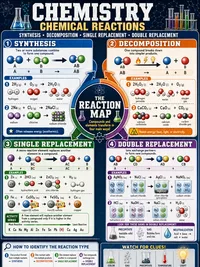
Click through six common reactions and see how each fits one of the five families, synthesis, decomposition, single replacement, double replacement, and combustion. Each entry shows the balanced equation, what you'd see in real life, and where it happens around you.
Guided Experiment Spot the Reaction Type
Each reaction in this lab belongs to one of five families. What do you predict are the rules for telling each family apart by just looking at the balanced equation?
Write your hypothesis in the Lab Report panel, then click Next.
Hydrogen + Oxygen makes water
Two or more simple substances combine to form a single product. A + B → AB.
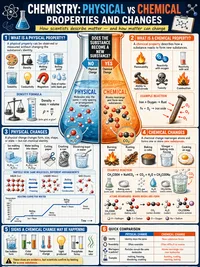
Loud bang as hydrogen ignites in air, then water droplets form.
Hydrogen fuel cells in cars combine the same gases more quietly to make water and electricity.
Data Table
(0 rows)| # | Trial | Reaction | Reactants | Products | Type | Observable |
|---|
Reference Guide
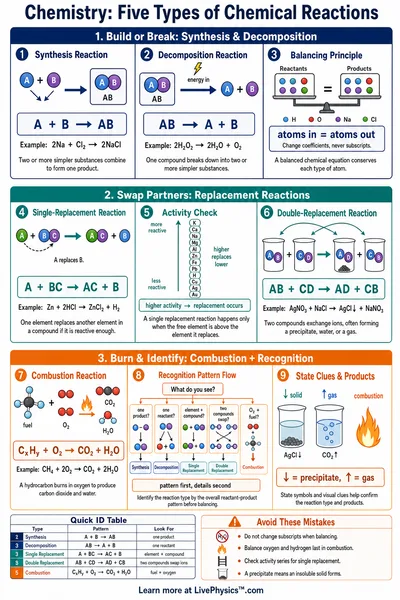
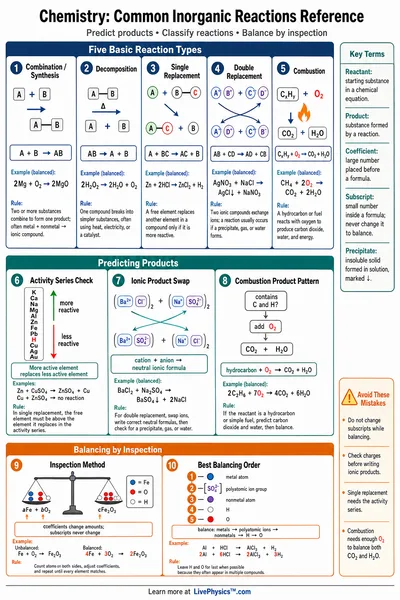
Synthesis and Decomposition
Synthesis reactions combine two simple substances into one product, like hydrogen and oxygen forming water.
Decomposition reactions are the opposite. A single compound breaks down into two or more simpler products, like water splitting into hydrogen and oxygen during electrolysis.
Replacement Reactions
In a single replacement reaction, one element kicks another element out of a compound. Iron displacing copper from copper sulfate is a classic example.
Double replacement reactions have two compounds that swap partners. The fizz of baking soda and vinegar is a double replacement that releases carbon dioxide.
Combustion
Combustion is the reaction of a fuel with oxygen that releases heat and light. Most combustion of a carbon-and-hydrogen fuel produces carbon dioxide and water.
The methane in a stove flame and the gasoline in a car engine both react this way. Magnesium burning is a special case where the fuel is a pure element.
Conservation of Mass
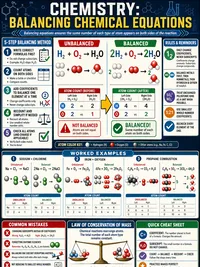
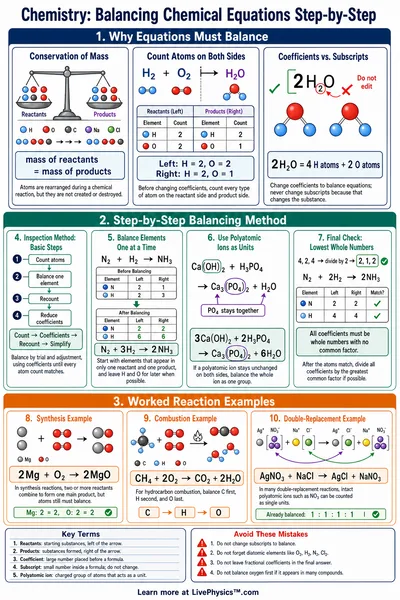
In every chemical reaction the atoms only rearrange. The number of atoms of each element is the same before and after, which is why every equation in this lab is balanced.
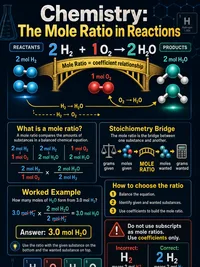
Balancing means choosing coefficients so each side of the equation has the same count of every element, no matter how the molecules are grouped.