Founding Documents Comparison Lab
Examine the three documents that shaped the United States. In the guided comparison, pick a dimension such as the power to tax, predict what each document says, then reveal the correct answer. In the attribution quiz, match a feature to the document that created it. The lab records your findings so you can write up a short conclusion.
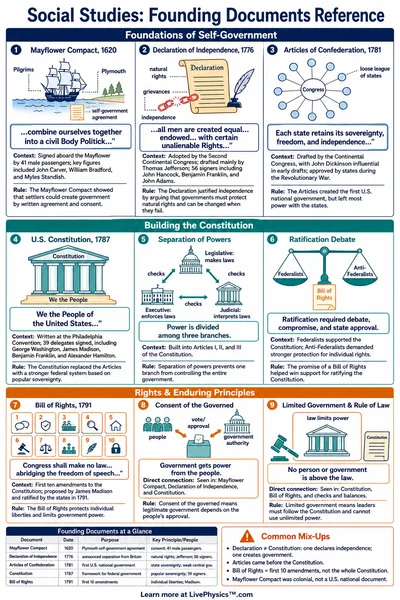
Announced that the thirteen colonies were breaking away from Great Britain and explained why.
The first national government of the United States. It created a loose league of states with a weak central government.
Replaced the Articles of Confederation. It set up the framework of government still used today.
Controls
Guided comparison
Pick a dimension, predict what each document says, then reveal the correct answer and record it.
Choose a Dimension to Compare
What was this document mainly created to do?
Data Table
(0 rows)| # | Dimension | Declaration (1776) | Articles (1781) | Constitution (1787) |
|---|
Reference Guide
Declaration of Independence (1776)
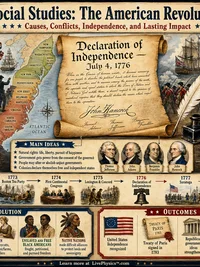
The Declaration announced that the thirteen colonies were breaking away from Great Britain. Thomas Jefferson was the principal author, and it was adopted on July 4, 1776.
- Purpose. Declared independence and explained the reasons.
- Key idea. All men are created equal and have rights to life, liberty, and the pursuit of happiness.
- Grievances. Listed complaints against King George III.
- Government. Did not set one up. It is a statement, not a plan of government.
The Declaration set out ideals. It did not build a working government, which is why the Articles came next.
Articles of Confederation (1781)
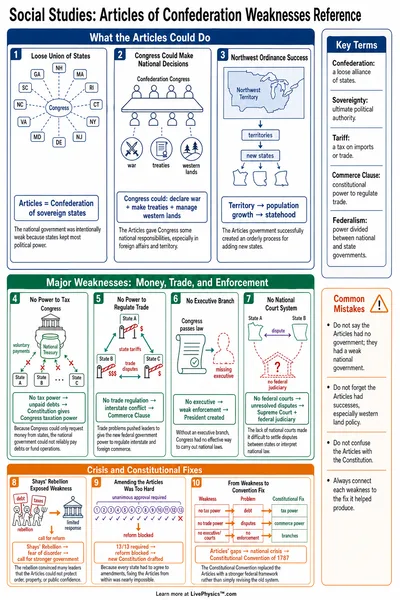
The Articles were the first written plan of government for the United States. They joined the states into a loose league and kept most power with the states.
- Central power. Deliberately weak, with most power left to the states.
- Taxes. Congress could not tax. It could only ask states for money.
- Army. Could not raise its own army and depended on the states for soldiers.
- Executive. No president and no executive branch, only a one-house Congress.
- Changing it. Needed all thirteen states to agree, which made change almost impossible.
These weaknesses convinced leaders to call the Constitutional Convention in 1787.
United States Constitution (1787)
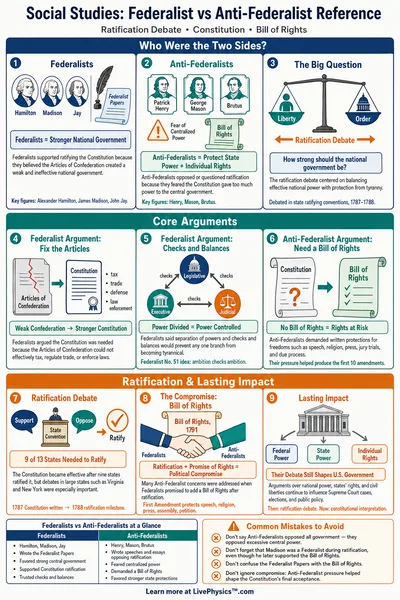
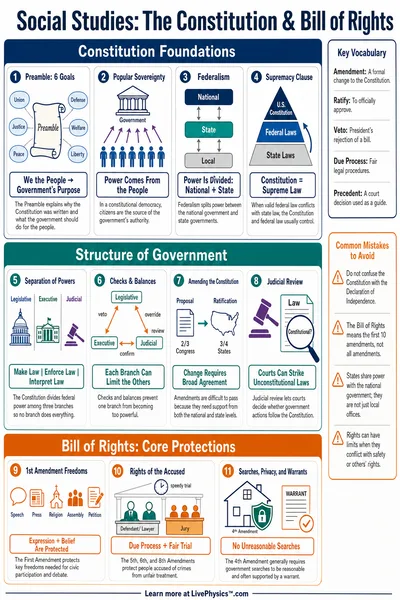
The Constitution replaced the Articles and created a stronger federal government. Its framework of three branches is still used today.
- Three branches. Legislative, executive, and judicial, with checks and balances.
- Taxes. Gave Congress the power to collect taxes directly from the people.
- Army. Gave Congress the power to raise and support armies and a navy.
- Executive. Created a single President to lead the executive branch.
- Changing it. Article V allows amendments. It has been amended twenty-seven times.
The Constitution fixed the weaknesses of the Articles while keeping power balanced among the branches.
How the Three Documents Connect
The three documents build on each other in order. Reading them as a sequence shows how the country moved from breaking away to building a lasting government.
- 1776. The Declaration states the ideals and announces independence.
- 1781. The Articles try a weak central government that struggles to function.
- 1787. The Constitution creates a stronger but balanced government.
- Big lesson. A government needs enough power to act and enough limits to stay fair.
Use the comparison table in the lab to line up each document side by side and see exactly how the powers changed.