Constitutional Amendments Explorer
Explore all 27 amendments to the US Constitution in plain language. Browse the Bill of Rights by category, then quiz yourself on which amendment protects each right.
Showing 27 of 27 amendments.
1st Amendment
Ratified 1791
Freedom of religion, speech, press, assembly, and petition
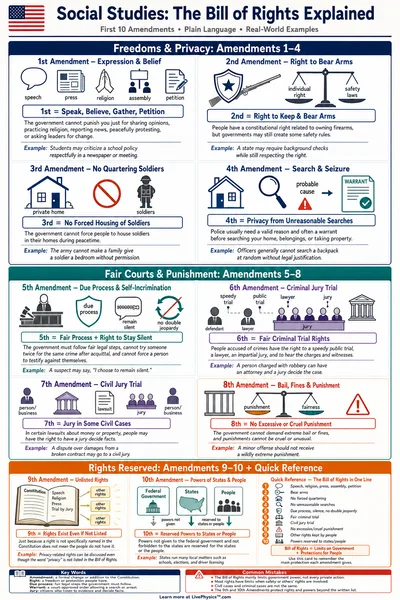
Protects five freedoms. The government cannot establish an official religion or stop you from practicing your faith, and it cannot silence your speech, censor the press, ban peaceful gatherings, or stop people from petitioning the government.
2nd Amendment
Ratified 1791
Right to keep and bear arms
Protects the right of the people to keep and bear arms, connected in its text to the need for a well regulated militia.
3rd Amendment
Ratified 1791
No forced quartering of soldiers
The government cannot force you to house soldiers in your home during peacetime without your consent.
4th Amendment
Ratified 1791
Protection from unreasonable searches and seizures
Protects against unreasonable searches and seizures. Police generally need a warrant supported by probable cause before searching your home or belongings.
5th Amendment
Ratified 1791
Due process, no self-incrimination, no double jeopardy
Guarantees due process of law. You cannot be tried twice for the same crime, you cannot be forced to testify against yourself, and the government cannot take private property without fair payment.
6th Amendment
Ratified 1791
Right to a speedy and public trial
Guarantees the rights of people accused of crimes, including a speedy and public trial by an impartial jury, the right to a lawyer, and the right to confront witnesses.
7th Amendment
Ratified 1791
Right to a jury trial in civil cases
Guarantees the right to a trial by jury in many civil cases, the kind of lawsuits that are about money or property rather than crimes.
8th Amendment
Ratified 1791
No excessive bail or cruel and unusual punishment
Bans excessive bail, excessive fines, and cruel and unusual punishment for people convicted of crimes.
9th Amendment
Ratified 1791
Rights not listed are still protected
Just because a right is not specifically listed in the Constitution does not mean people do not have it. The people keep other rights too.
10th Amendment
Ratified 1791
Powers not given to the federal government go to the states
Any powers that the Constitution does not give to the federal government, and does not forbid to the states, are reserved for the states or the people.
11th Amendment
Ratified 1795
Limits lawsuits against states in federal court
Limits when a state can be sued in federal court by citizens of another state or of a foreign country.
12th Amendment
Ratified 1804
Separate electoral votes for president and vice president
Changed how the Electoral College works so that electors cast separate votes for president and for vice president.
13th Amendment
Ratified 1865
Abolished slavery
Abolished slavery and involuntary servitude throughout the United States, except as punishment for a crime.
14th Amendment
Ratified 1868
Citizenship and equal protection under the law
Grants citizenship to all people born or naturalized in the United States and guarantees equal protection of the laws and due process for everyone.
15th Amendment
Ratified 1870
Right to vote cannot be denied based on race
The right to vote cannot be denied based on race, color, or previous condition of servitude.
16th Amendment
Ratified 1913
Allows a federal income tax
Gives Congress the power to collect an income tax on what people earn.
17th Amendment
Ratified 1913
Direct election of US senators
Senators are now elected directly by the people of each state, rather than being chosen by state legislatures.
18th Amendment
Ratified 1919
Banned alcohol (Prohibition)
Banned the making, selling, and transporting of alcoholic beverages across the United States. This period is known as Prohibition.
19th Amendment
Ratified 1920
Women's right to vote
The right to vote cannot be denied based on sex. This gave women the constitutional right to vote.
20th Amendment
Ratified 1933
Sets start dates for presidential and congressional terms
Sets the dates when the terms of the president, vice president, and members of Congress begin and end, shortening the lame-duck period.
21st Amendment
Ratified 1933
Repealed Prohibition
Repealed the 18th Amendment, ending Prohibition and making alcohol legal again. It is the only amendment that cancels an earlier one.
22nd Amendment
Ratified 1951
Limits the president to two terms
Limits a president to being elected to office no more than two times.
23rd Amendment
Ratified 1961
Electoral votes for Washington, DC
Gives residents of Washington, DC the right to electoral votes in presidential elections.
24th Amendment
Ratified 1964
Bans poll taxes in federal elections
Makes it illegal to charge a poll tax, a fee for voting, in federal elections.
25th Amendment
Ratified 1967
Presidential succession and disability
Spells out what happens if the president dies, resigns, or becomes unable to do the job, and how the vice presidency is filled.
26th Amendment
Ratified 1971
Voting age set at 18
Lowered the voting age to 18, so the right to vote cannot be denied to citizens who are 18 or older based on age.
27th Amendment
Ratified 1992
Delays congressional pay raises until after an election
A change to the pay of members of Congress cannot take effect until after the next election of representatives.
How it works
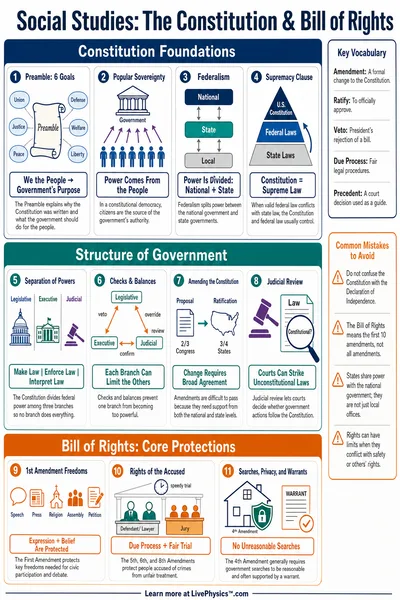
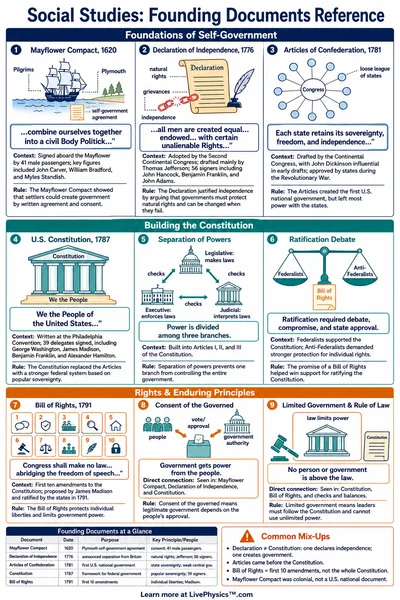
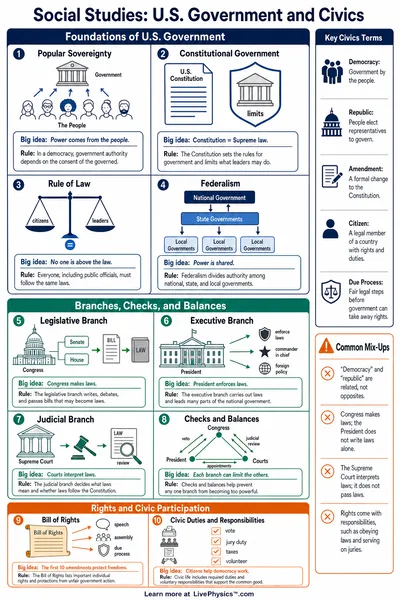
The Constitution can be changed through amendments. So far there are 27. The first ten, ratified in 1791, are known as the Bill of Rights and protect basic freedoms.
In Reference mode, filter the amendments by category and read each one in plain language. In Quiz mode, a right or scenario appears and you pick the amendment that protects it. Choose Learn for the Bill of Rights with a hint, Practice for the most commonly tested amendments, or Challenge for all 27.
Curriculum alignment
Built for middle school and high school civics and US history. It supports state standards on the Bill of Rights, the Reconstruction amendments, and the expansion of voting rights.
Students practice matching constitutional rights to the amendments that guarantee them, a core skill on civics assessments and the US citizenship test.
Reference Guide, The Bill of Rights
First through Fifth
- 1st. Freedom of religion, speech, press, assembly, and petition.
- 2nd. The right to keep and bear arms.
- 3rd. No forced quartering of soldiers in your home during peacetime.
- 4th. Protection from unreasonable searches and seizures.
- 5th. Due process, no double jeopardy, and no forced self-incrimination.
Sixth through Tenth
- 6th. The right to a speedy, public trial by an impartial jury and to a lawyer.
- 7th. The right to a jury trial in many civil cases.
- 8th. No excessive bail, fines, or cruel and unusual punishment.
- 9th. Rights not listed in the Constitution are still kept by the people.
- 10th. Powers not given to the federal government belong to the states or the people.
Key later amendments
- 13th (1865). Abolished slavery.
- 14th (1868). Citizenship and equal protection under the law.
- 15th (1870). The right to vote cannot be denied based on race.
- 19th (1920). Women's right to vote.
- 26th (1971). The voting age set at 18.