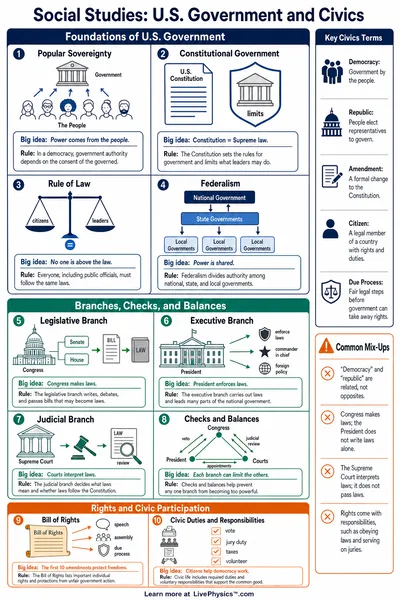
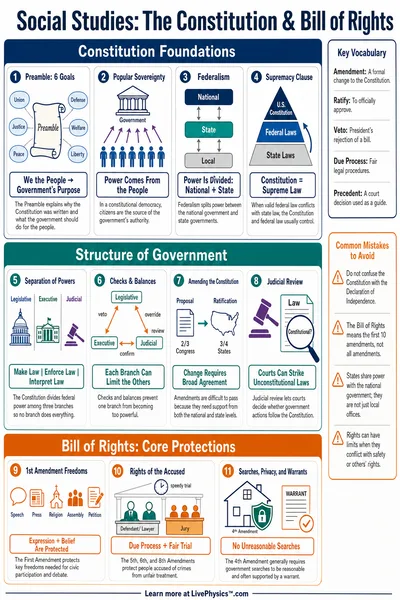
Federalism Powers Sorter
Sort United States government powers into federal, state, and shared categories. Each answer reveals the constitutional basis, from enumerated powers to the 10th Amendment.
A hint is shown for every power so you can reason it out.
Which level of government holds this power?
Grant patents and copyrights
An invention should be protected in every state at once.
Division of powers reference
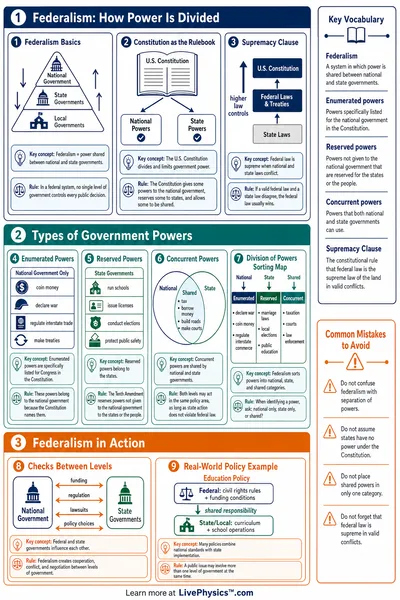
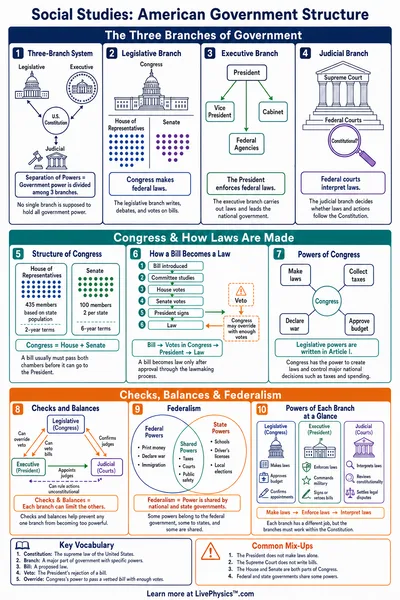
Federal Powers
Delegated (enumerated) powers held only by the national government, mostly listed in Article I, Section 8.
- Print and coin money
- Declare war
- Regulate trade between states
- Make treaties with foreign countries
- Establish post offices
- Set rules for becoming a citizen
- Raise and maintain an army and navy
- Grant patents and copyrights
- Control immigration into the country
- Place tariffs on imported goods
Shared Powers
Concurrent powers exercised by both the national government and the states at the same time.
- Collect taxes
- Borrow money
- Establish courts of law
- Make and enforce laws
- Charter banks
- Build roads
- Take private property for public use with payment
State Powers
Reserved powers kept by the states under the 10th Amendment, anything not delegated to the nation or denied to the states.
- Establish public schools
- Issue driver's licenses
- Issue marriage licenses
- Run local and state elections
- Create local police departments
- Build and maintain local roads
- License doctors and lawyers
- Set zoning and land use rules
- Charter and incorporate businesses
- Ratify amendments to the Constitution
How it works
You are shown one government power at a time. Decide whether it belongs to the national government, the states, or both, then check your answer. Every reveal explains the category and points to the part of the Constitution that supports it.
Learn mode shows a hint for each power. Practice mode hides the hints. Challenge mode mixes in tricky concurrent powers that both levels of government share. Use the share button to send a friend the same mode.
Curriculum alignment
Federalism and the division of powers are core middle school and high school civics topics. This tool supports the C3 Framework for Social Studies and common state standards on the structure of American government.
It reinforces the difference between delegated, reserved, and concurrent powers and connects each example to constitutional text such as Article I, Section 8 and the 10th Amendment.
Reference guide
Federal (delegated) powers
Powers given only to the national government, mostly enumerated in Article I, Section 8. Examples include coining money, declaring war, regulating interstate and foreign trade, making treaties, and setting rules for citizenship. The Necessary and Proper Clause lets Congress carry out these duties.
Shared (concurrent) powers
Powers exercised by both levels of government at the same time. Examples include collecting taxes, borrowing money, establishing courts, building roads, and making and enforcing laws. Both the national government and the states can act in these areas within their own authority.
State (reserved) powers
Powers kept by the states under the 10th Amendment, anything not delegated to the national government or denied to the states. Examples include running public schools, issuing driver's and marriage licenses, conducting elections, and creating local police departments.