Checks and Balances Simulator
Each branch of the United States government can limit the power of the other two. Read a real situation, choose the power that fits, and see exactly which branch is checking which, plus where the Constitution grants that power. Switch between Learn, Practice, and Challenge, then open the full checks matrix.
Score 0 / 0
Scenario 1 of 20
Shows which branches are involved before you answer.
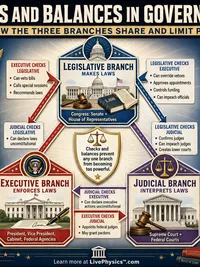
Legislative
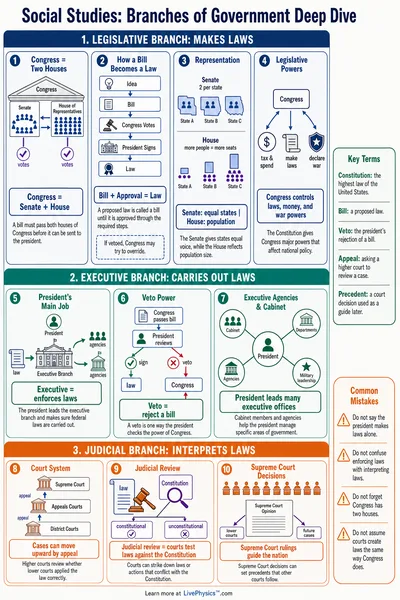
Congress (the Senate and the House of Representatives). Writes laws, controls spending, and confirms or removes officials.
Executive
The President, Vice President, and federal agencies. Enforces laws, commands the military, and makes appointments and treaties.
Judicial
The Supreme Court and lower federal courts. Interprets laws and the Constitution and decides cases.
Scenario
The President wants to commit the nation to a formal war. Which power belongs to Congress here?
Hint. This is the Legislative branch checking the Executive branch.
Which power or check fits this scenario?
Checks and Balances Reference Guide
Checks held by the Legislative branch
Congress holds more checks than any other branch.
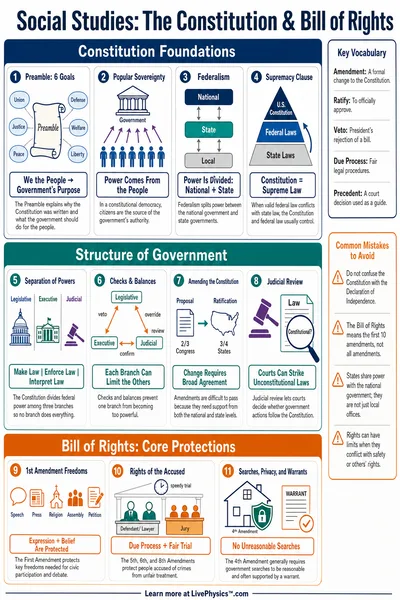
Over the Executive. Override a veto with a two thirds vote, control spending, declare war, confirm appointments, ratify treaties, and impeach and remove the President.
Over the Judicial. Confirm or reject judges, create and fund lower courts, set Supreme Court appellate jurisdiction, impeach judges, and propose constitutional amendments.
Checks held by the Executive branch
The President limits the other branches in several ways.
Over the Legislative. Veto a bill passed by Congress and command the armed forces as Commander in Chief.
Over the Judicial. Nominate federal judges, pardon people convicted of federal crimes, and carry out or enforce court rulings.
Checks held by the Judicial branch
The courts protect the Constitution.
Over both branches. Judicial review lets courts strike down a law of Congress or an executive action that conflicts with the Constitution. This power was established in Marbury v. Madison in 1803.
Independence. Federal judges serve during good behavior, usually for life, which shields them from political pressure.
How to use this tool
Read the scenario, then choose the power or check that best responds to it.
Learn. The hint tells you which branches are involved before you answer.
Practice. You see the scenario only, with no hint.
Challenge. Every check is in the mix with no hints.
After you answer, the branch cards highlight the acting branch and the branch being checked, and the explanation shows the constitutional basis.
Why checks and balances exist
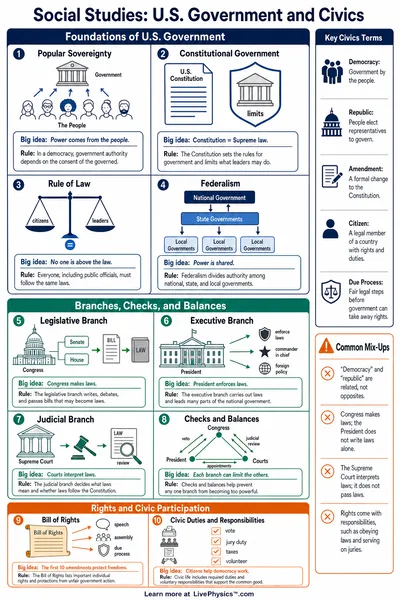
The framers of the Constitution divided power among three branches so that no single branch could dominate the others.
This is called separation of powers. Checks and balances are the specific tools each branch uses to limit the others, such as the veto, the override, judicial review, impeachment, and Senate confirmation.
The goal is a government that is strong enough to act but limited enough to protect liberty.