Text Summarizer Trainer
Read a passage, write your own summary, then compare it to a model. See which key ideas you captured and which ones to look for next time. Three steps, six passages, no account needed.
The Water Cycle
Water on Earth is constantly moving in a cycle called the water cycle. The sun heats water in oceans, lakes, and rivers, causing it to evaporate and rise into the air as water vapor. As the vapor rises, it cools and condenses into tiny droplets that form clouds. When enough droplets collect, water falls back to Earth as precipitation - rain, snow, or sleet. The water then flows into rivers, soaks into the ground, or collects in oceans, ready to begin the cycle again.
Read carefully. Think about the main idea and 2-3 key details before writing your summary.
Summarizing Strategies
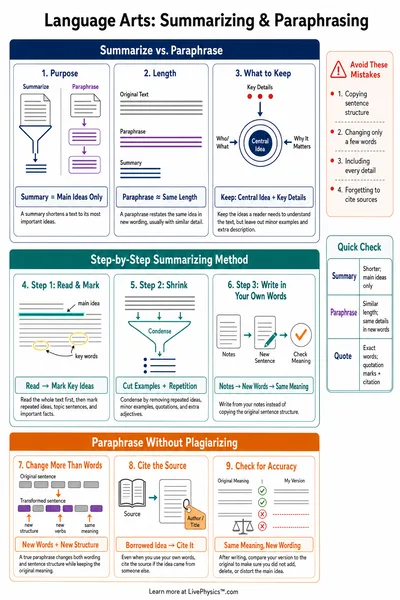
Find the Main Idea
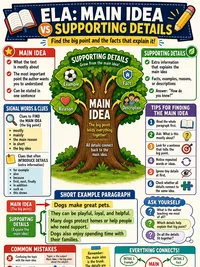
A main idea is the central point the author wants you to understand. It is broader than any single detail in the passage.
- Ask yourself, What is this passage mostly about?
- Check the first and last sentences - they often contain the main idea.
- If you had to explain the passage in one sentence, what would you say?
The main idea belongs in every good summary. Supporting details may or may not be needed, depending on how long your summary should be.
Select Key Details
Not every sentence in a passage is equally important. A good summary includes only the details that directly support the main idea.
- Include facts that explain why or how the main idea is true.
- Leave out examples, anecdotes, and interesting but minor details.
- Aim for 2-4 supporting points in a short summary.
Use Your Own Words
A summary is not a copy. Restating information in your own words shows you have truly understood the passage, not just memorized phrases.
- Cover the passage and write from memory first, then check for accuracy.
- Replace content words with synonyms where you can.
- Reorder ideas if the new order still makes sense.
- Keep technical terms (like "evaporation") - those are essential vocabulary.
Keep It Brief
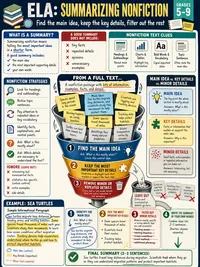
A good summary is much shorter than the original. For a short passage of 100 words, a summary of 30-60 words is a reasonable target.
- Two or three sentences is usually enough for a paragraph-length passage.
- If your summary is longer than half the original, you are including too much.
- Read your summary aloud - if it feels long, cut a sentence.
Brevity is a skill. It forces you to decide what truly matters.