Photosynthesis Rate Investigation Lab
A full quantitative photosynthesis investigation. Sweep light intensity, CO2 concentration, or temperature; record the net oxygen production rate; and fit Michaelis-Menten to extract V_max and K_m, or read T_opt from a bell-shaped temperature curve.
Choose an Investigation
Investigation A. Light Response Curve
How does the net oxygen production rate of a leaf depend on light intensity, and what does the Michaelis-Menten fit reveal about V_max and K_light?
Light intensity I (μmol photons/m²/s)
Net O₂ production rate r (μmol O₂/m²/s)
- CO₂ concentration (held high enough that light is the limiter)
- Temperature (held at the optimum)
- Leaf area, age, and chlorophyll content
Predict the shape of the r vs I curve. State expected V_max and K_light (light intensity for half saturation).
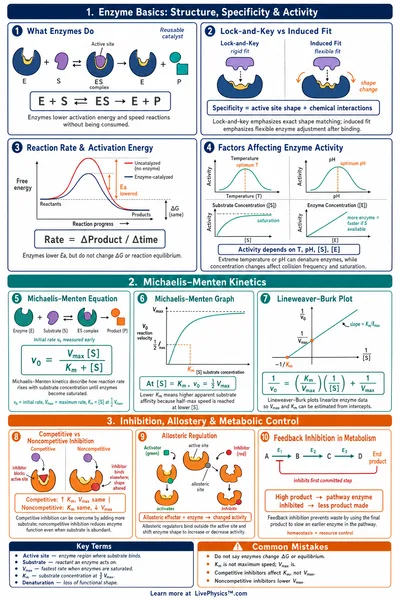
r rises sharply at low light, then approaches an asymptote V_max at high light. The Lineweaver-Burk transform 1/r vs 1/I gives a straight line with slope K_light/V_max and intercept 1/V_max.
- Pick the preset CO₂ and temperature (saturating CO₂ and T_opt)
- Record 6 trials at the light sequence 50, 100, 200, 400, 800, 1500 μmol/m²/s
- Plot r vs I and the Lineweaver-Burk transform on the second axis
- Read V_max from the y-intercept and K_light from slope/intercept
- Compute percent error against the accepted V_max and K_light
Setup (held constants)
Each Record Trial advances to the next value in the preset IV sequence (6 trials). The two non-IV factors stay fixed.
Net rate r (μmol O₂/m²/s) vs Light intensity I (μmol/m²/s)
Record at least 2 trials (or load sample data) to see the response curve.
Michaelis-Menten Fit
Fit uses the Lineweaver-Burk linearization 1/r vs 1/x with R² computed on the original axis. Negative rates (below the light compensation point) are dropped from the fit.
Data Table
(0 rows)| # | Trial | Light intensity I(μmol/m²/s) | Net O₂ rate r(μmol/m²/s) | 1/I | 1/r |
|---|
Reference Guide
Net vs Gross Rate
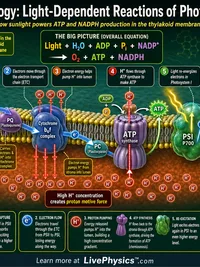
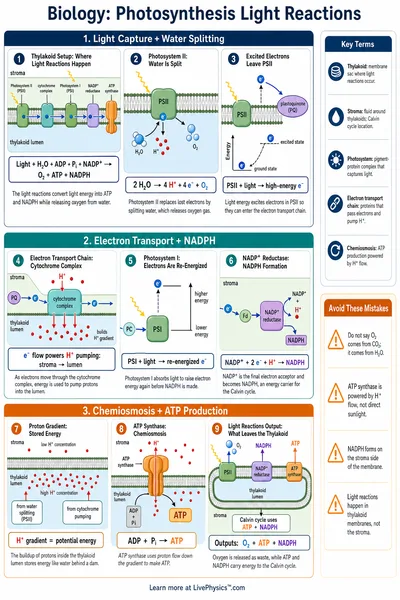
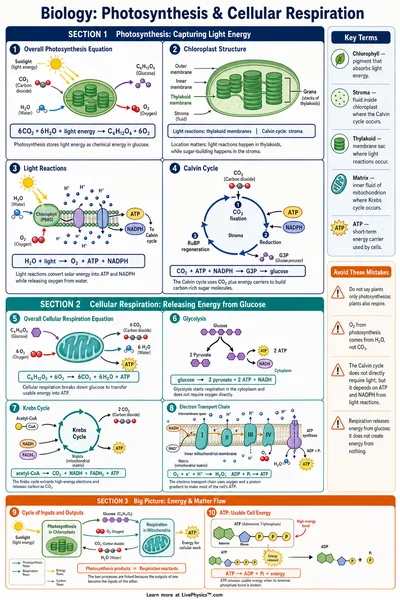
Net oxygen production equals gross photosynthesis minus dark respiration. Below the light compensation point the net rate is negative because the plant consumes more O2 than it produces.
Michaelis-Menten Saturation
For light or CO2 as the single limiting factor
The Lineweaver-Burk transform 1/r vs 1/S is linear with intercept 1/V_max and slope K_m / V_max. Use the linearized fit to estimate V_max and K_m, then check the R² in the original axis.
Law of Limiting Factors
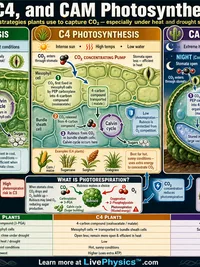
Gross photosynthesis is governed by the slowest of the individual rates, scaled by a temperature response factor.
Sweeping one factor at saturating values of the others isolates its contribution and avoids cross-talk between the three responses.
Temperature Bell Curve
The temperature response is approximately Gaussian with a peak at T_opt (around 30 C for many C3 plants).
Above the optimum, enzyme denaturation reduces the rate rapidly. Below it, low kinetic energy slows enzyme turnover.