Soundproofing Materials Lab
Pick a barrier material, set its thickness, and choose a noise frequency to see how much sound gets through. Watch the loud wave shrink as it crosses the wall, then compare every material by cost and by decibels blocked per dollar to find the smartest soundproofing choice.
Guided ExperimentWhich material blocks the most noise per dollar?
Predict which of the eight materials gives the best noise reduction for each dollar spent. Will the densest material (lead) also be the best value, or will a cheaper material win?
Write your hypothesis in the Lab Report panel, then click Next.
Sound Through the Wall
Controls
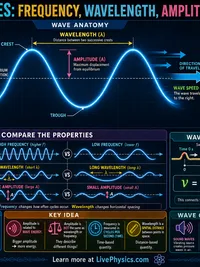
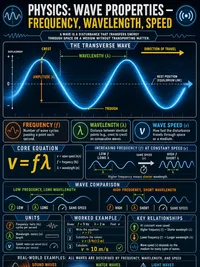
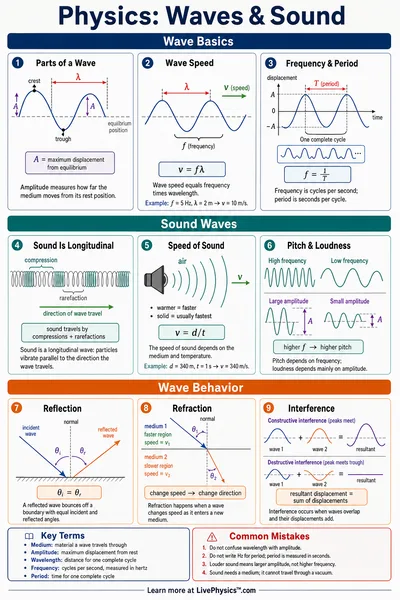
Low frequencies near 125 Hz are bass notes and are the hardest to block. High frequencies near 4000 Hz are easy to block.
Results
Surface mass m = 16.0 kg/m². The mass law says transmission loss depends on this surface mass, which is density times thickness, not on whether a material feels soft.
| Material | TL (dB) | Cost ($) | dB per $ |
|---|---|---|---|
| Cardboardbest value | 29.9 | 6.00 | 4.98 |
| Drywall (gypsum) | 31.1 | 8.00 | 3.88 |
| Plywood | 28.6 | 10.00 | 2.86 |
| Heavy curtain | 19.0 | 16.00 | 1.19 |
| Glass | 41.0 | 40.00 | 1.02 |
| Mass-loaded vinyl | 36.5 | 50.00 | 0.73 |
| Lead sheet | 54.1 | 120.00 | 0.45 |
| Acoustic foam | 2.5 | 12.00 | 0.21 |
The standard interior wall board, a solid all-round barrier for the price.
Data Table
(0 rows)| # | Material | Thickness (cm) | Frequency (Hz) | TL (dB) | Transmitted (dB) | Cost ($/m²) | dB per $ |
|---|
Reference Guide
The Acoustic Mass Law
A solid wall blocks sound mostly because of its mass. The heavier each square metre of the barrier, the harder it is for a sound wave to shake it into motion and pass energy through. This is captured by the mass law.
Here TL is the transmission loss in decibels, m is the surface mass in kg/m², and f is the frequency in hertz. The surface mass is just density times thickness, so a thin sheet of a dense material can match a thick slab of a light one.
Doubling the surface mass adds about 6 dB of blocking. Doubling the frequency also adds about 6 dB, which is why low bass notes are the hardest to keep out.
Why Foam Does Not Block Sound
Acoustic foam is sold in recording studios, so many people assume it soundproofs a room. Foam absorbs echoes that bounce around inside a room, which makes the room sound cleaner, but it weighs almost nothing.
Because the mass law depends on surface mass, a light material like foam has a tiny transmission loss. Sound passes straight through it to the neighbours. To stop sound leaving or entering a room you have to add mass, not softness.
Absorbing and blocking are two different jobs. Foam handles echoes. Dense barriers like drywall, glass, or mass-loaded vinyl handle blocking.
The Cost Tradeoff
Lead and glass are very dense, so they block the most sound, but they are expensive and awkward to install. Engineers rarely pick the best blocker. They pick the best blocker they can afford for the wall area they need to cover.
The comparison table in the lab ranks every material by decibels blocked per dollar. A cheap, fairly dense board like drywall usually wins, while pricey specialty materials fall behind on value even though their raw blocking is higher.
Reading the Decibels
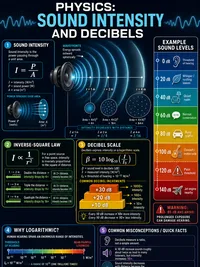
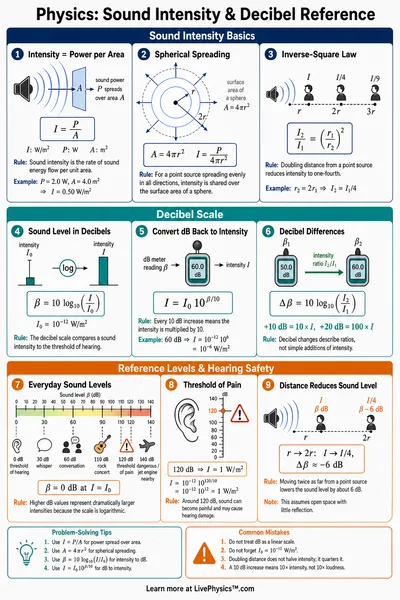
The transmitted level is the source loudness minus the transmission loss. A drop of 10 dB sounds roughly half as loud to your ears, so a barrier that blocks 30 dB makes a noise sound far quieter, not just a little softer.
For reference, a whisper is near 30 dB, normal conversation near 60 dB, a vacuum cleaner near 75 dB, busy traffic near 85 dB, and a rock concert near 100 dB. Sustained levels above about 85 dB can damage hearing over time.