Density Calculator
Enter any two of density, mass, and volume and the calculator solves for the third. Choose your units, pick a material from the library, and see whether your object floats or sinks in water, seawater, oil, or any fluid you specify.
Solve For
Material Library
Click a material to load its density.
Result
Density
1.0000 g/cm^3
Formula used
Substitution (SI units)
Sink or Float
Object density
1.0000 g/cm³
Fluid density
1.0000 g/cm³
The Science of Density
What Density Means
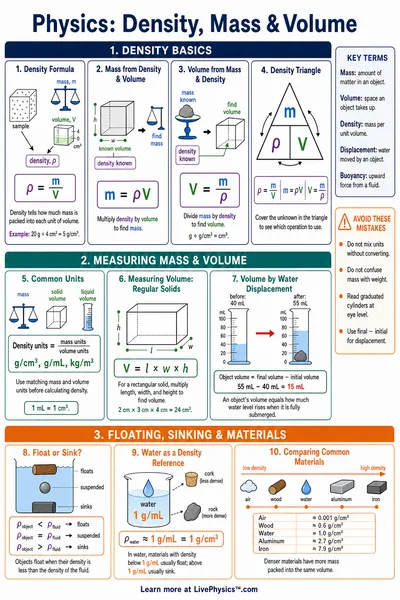
Density tells you how much mass is packed into a given volume. A dense material has many atoms crammed tightly together. A light material has fewer atoms spread over the same space.
The formula is straightforward.
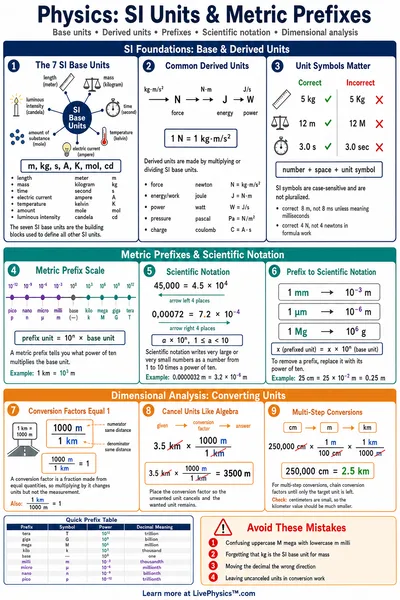
The standard SI unit is kilograms per cubic metre (kg/m³). In chemistry and everyday lab work, grams per cubic centimetre (g/cm³) is more common. Water at room temperature has a density of exactly 1.00 g/cm³, which makes it a useful reference point.
Units of Density and Converting Between Them
The two most common density units are g/cm³ and kg/m³. Because 1 cm³ equals 0.000001 m³ and 1 g equals 0.001 kg, there is a factor of 1000 between them.
| g/cm³ | kg/m³ |
|---|---|
| 0.001 | 1 |
| 1.00 (water) | 1000 |
| 2.70 (aluminum) | 2700 |
| 19.30 (gold) | 19300 |
To convert g/cm³ to kg/m³, multiply by 1000. To go the other direction, divide by 1000.
Why Objects Float or Sink
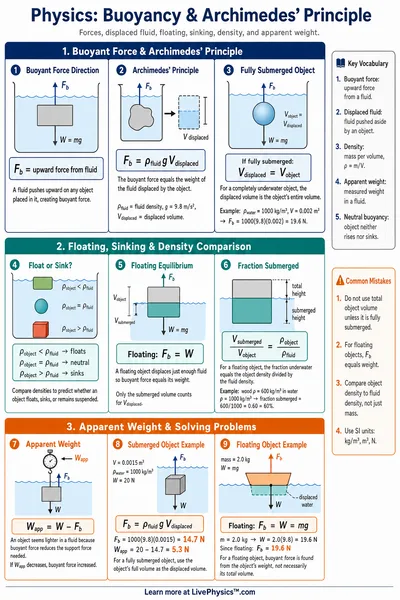
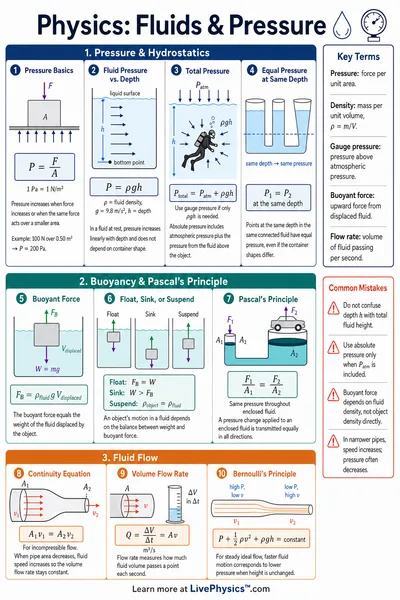
An object floats when its density is less than the density of the surrounding fluid. It sinks when its density is greater. This follows directly from Archimedes' principle, a submerged object displaces fluid equal to its volume, and the buoyant force equals the weight of that displaced fluid.
If the buoyant force matches the object's weight before the object is fully submerged, it floats at a partial depth. If the object is denser than the fluid, no depth can produce enough buoyant force and the object sinks.
Wood (0.6 to 0.9 g/cm³) floats in water. Iron (7.87 g/cm³) sinks. A hollow iron ship floats because the average density of the ship plus the air inside is less than water.
Icebergs and the Fraction Submerged
When an object floats at equilibrium, the fraction of its volume that sits below the surface equals the ratio of the object's density to the fluid's density.
Ice has a density of about 0.917 g/cm³ and seawater has a density of about 1.025 g/cm³. So an iceberg sits with about 89% of its volume below the water surface and only 11% visible above. This is where the phrase "tip of the iceberg" comes from.
A cork (0.24 g/cm³) in water is only 24% submerged. An oil droplet (0.92 g/cm³) in seawater is about 90% submerged and just barely breaks the surface.
Densities of Common Materials
| Material | Density (g/cm³) |
|---|---|
| Air | 0.0012 |
| Cork | 0.24 |
| Ice | 0.92 |
| Water | 1.00 |
| Aluminum | 2.70 |
| Iron | 7.87 |
| Copper | 8.96 |
| Lead | 11.34 |
| Gold | 19.30 |
Materials with densities below 1.00 g/cm³ float in water. Metals are all much denser than water, which is why solid metal objects always sink unless they trap air.