Sound Pitch and Frequency Explorer
Drag the sliders to change frequency and amplitude. Watch the wave change shape, then press Play Sound to hear the difference. See how pitch and loudness are controlled by wave properties.
Higher frequency = higher pitch. Human hearing range is about 20 Hz to 20,000 Hz.
Higher amplitude = louder sound. The wave gets taller on the screen.
Sound Examples
Sound plays for 1.5 seconds. Use headphones for best experience.
Frequency
440 Hz
Period
2.3 ms
Amplitude
0.50
Wave Type
sine
Wave Shape
Wave shape affects the tone quality (timbre), not the pitch. All shapes visualize as sine waves on screen.
Real-World Sound Examples
Whale Song
~40 Hz
Human Bass Voice
~120 Hz
Middle C (Piano)
~262 Hz
Concert A (440 Hz)
~440 Hz
Soprano Voice
~880 Hz
Dog Whistle
~1800 Hz
Bat (Ultrasound)
~2000 Hz
Reference Guide
What is Sound?
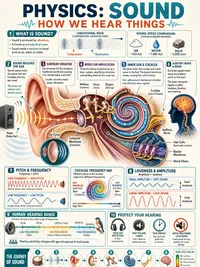
Sound is a vibration that travels through a medium such as air, water, or solid material. When an object vibrates, it pushes and pulls on the nearby air molecules, creating pressure waves that spread outward in all directions.
Your eardrum detects these pressure changes and your brain interprets them as sound. Sound cannot travel through a vacuum because there are no molecules to carry the vibration.
Sound travels through air at about 343 m/s at room temperature. It travels faster through denser materials like water (about 1480 m/s) and much faster through steel (about 5000 m/s).
Frequency and Pitch
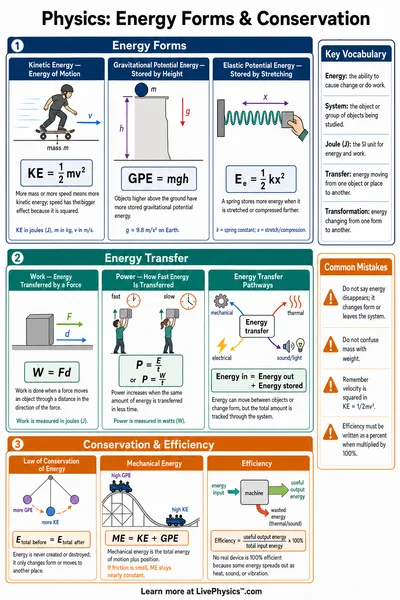
Frequency measures how many complete wave cycles occur each second. The unit is hertz (Hz). One hertz equals one cycle per second.
Pitch is how high or low a sound seems to the listener. Higher frequency produces higher pitch. A whistle at 2000 Hz sounds much higher than a bass guitar note at 80 Hz.
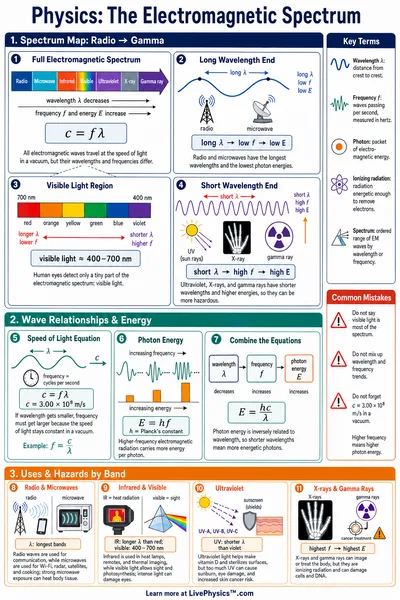
Humans can typically hear sounds between 20 Hz and 20,000 Hz. Dogs can hear up to about 65,000 Hz. Bats use frequencies above 20,000 Hz (ultrasound) to navigate and hunt.
- 20 to 80 Hz - very low (bass rumble)
- 80 to 250 Hz - low (bass instruments)
- 250 to 600 Hz - medium (human voice)
- 600 to 1200 Hz - high (songbirds)
- 1200 to 2000 Hz - very high (bat range)
Amplitude and Volume
Amplitude is the maximum displacement of the wave from its resting position - how tall the wave is. Greater amplitude means louder sound.
Volume is measured in decibels (dB). The decibel scale is logarithmic, meaning each increase of 10 dB sounds about twice as loud to human ears.
- 0 dB - threshold of hearing (barely audible)
- 30 dB - quiet library
- 60 dB - normal conversation
- 90 dB - lawnmower (hearing damage risk)
- 120 dB - rock concert (pain threshold)
Amplitude and frequency are independent. You can have a loud low-pitched sound or a quiet high-pitched sound.
Wave Properties
Every sound wave has several measurable properties that describe its behavior.
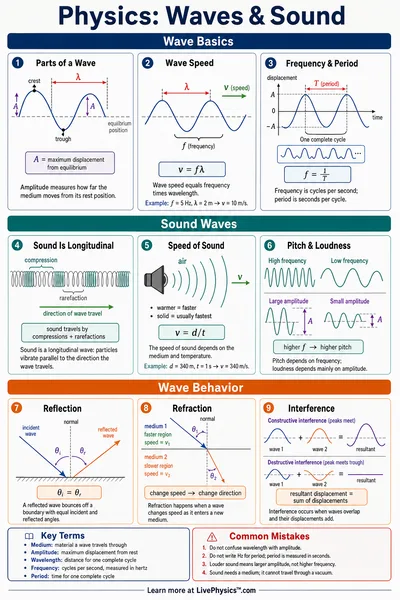
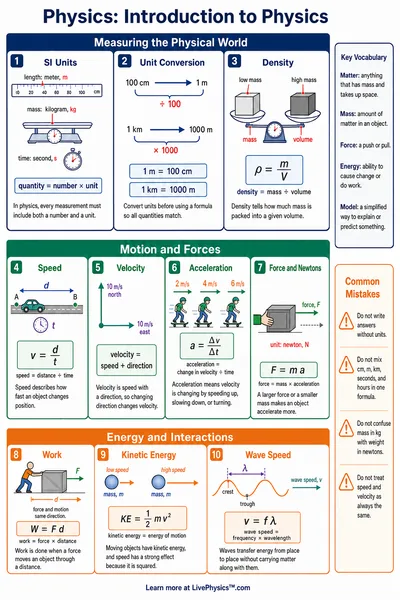
- Frequency (f). Cycles per second, measured in Hz. Controls pitch.
- Period (T). Time for one complete cycle, T = 1/f. Shown in milliseconds.
- Amplitude (A). Maximum displacement. Controls volume.
- Wavelength. Distance between two identical points on the wave.
- Wave speed. Determined by the medium, not the source.
The relationship between speed, frequency, and wavelength is v = f x wavelength. At a fixed speed, doubling the frequency halves the wavelength.