Young's Modulus & Stress-Strain Lab
Pull a virtual wire until it breaks and watch the stress-strain curve take shape. Pick a material, stretch it through the elastic region, past the yield point and the ultimate tensile strength, into necking and fracture. Read off Young's modulus from the slope and compare the toughness of ductile metals against brittle glass.
Guided ExperimentMeasure Young's modulus from the elastic slope
In the elastic region stress and strain should be proportional. What slope (in GPa) do you expect for mild steel, and how will you read it off the curve?
Write your hypothesis in the Lab Report panel, then click Next.
Controls
Mild Steel: E = 200 GPa, yield = 250 MPa, UTS = 400 MPa, ductile
Wire under tension
The wire elongates as the strain rises. Past the ultimate tensile strength a ductile wire necks, then fractures.
Results
Current stress
0.0MPa
Current strain
0.000%
Young's modulus
200GPa
Region
Elastic
Yield strength
250MPa
Ultimate tensile strength
400MPa
Toughness
84.49MJ/m³
Resilience
0.156MJ/m³
Stress-strain curve
The shaded elastic band is where the wire springs back. The dashed line is the slope, Young's modulus (200 GPa). The light fill under the whole curve is the toughness. The dark dot is your current strain.
Takeaways
- •Below the yield point the wire returns to its original length when released, that is the elastic region.
- •Past the ultimate tensile strength the wire necks and then fractures.
- •Steel absorbs far more energy before breaking than glass, so it is much tougher.
Elastic region, stress = E · strain, with E = 200 GPa. Toughness is the area under the full curve (here 84.49 MJ/m³), and resilience is the elastic part up to yield (here 0.156 MJ/m³).
Data Table
(0 rows)| # | Material | Strain(%) | Stress(MPa) | Region | Young's modulus(GPa) | Toughness(MJ/m³) |
|---|
Reference Guide
Stress, Strain, and Young's Modulus
A tensile test pulls a specimen and records how it responds. Stress is the force divided by the cross-sectional area, and strain is the fractional change in length.
stress = E · strain (elastic region)
- Stress is measured in pascals, often megapascals.
- Strain is a dimensionless fraction, shown here as a percent.
- Young's modulus E is the slope of the elastic line.
A stiff material like steel has a steep elastic slope, so it needs a large stress to stretch even a little.
The Elastic Region and Hooke's Law for Materials
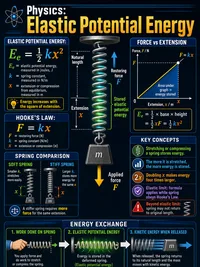
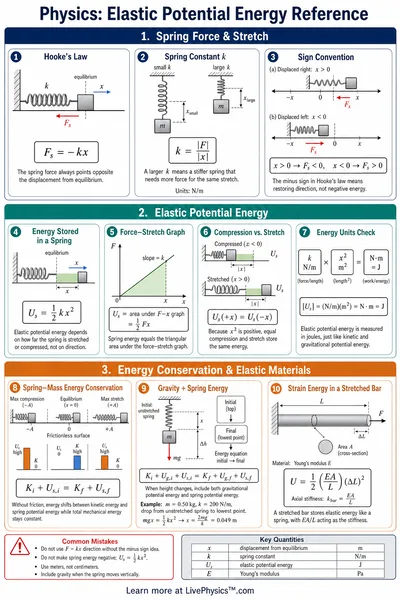
In the elastic region the wire behaves like a stiff spring. Remove the load and it springs back to its original length, storing no permanent change.
- Stress rises in direct proportion to strain.
- The slope of that line is Young's modulus.
- This is Hooke's law written for a material, not a coil spring.
The springs version of Hooke's law uses F = kx for a single coil. The materials version replaces force and extension with stress and strain so the result is a material property.
Yield Point, Plastic Deformation, UTS, and Necking
Past the yield point the wire deforms permanently. The curve flattens, the wire stretches, and the stress climbs more slowly to a peak.
- The yield point ends the elastic region.
- The peak of the curve is the ultimate tensile strength.
- After the peak a ductile wire necks, then fractures.
Engineering stress falls during necking because it uses the original area while the neck keeps thinning.
Toughness vs Resilience, Ductile vs Brittle
Toughness is the energy a material absorbs before breaking, the area under the whole stress-strain curve. Resilience is the elastic part of that energy, up to the yield point.
- Ductile metals stretch a long way and are tough.
- Brittle materials snap early with little plastic stretch.
- Steel is far tougher than glass even at similar stress.
A material can be strong yet brittle. Glass reaches a high stress but breaks suddenly, so it stores little energy and has low toughness.