Full Hooke's Law Investigation Lab
A full-workflow physics investigation. Choose an investigation, state your hypothesis, identify the independent and dependent variables, collect replicated trials, fit a regression line, and analyze residuals and percent error.
Choose an Investigation
Investigation A. F vs x (derive k)
How does the force applied to a spring depend on its extension, and what does the slope of F vs x tell us about the spring constant?
Mass m hung on the spring (or applied force F)
Extension x (averaged from 3 ruler readings)
- Spring constant k (one fixed spring)
- Gravity g (local, constant)
- Temperature, mounting position
Predict the shape of the F vs x curve below the elastic limit. What relationship should appear, and what does the slope represent?
F vs x is linear with slope = k. R² should exceed 0.99 with careful measurement. Derived k should match the nominal spring constant within a few percent.
- Record 6 to 8 trials at different masses (or applied forces) within the elastic range
- Verify F vs x is linear (R² near 1)
- Read the slope directly. The slope IS the spring constant k
- Compute percent error vs the accepted nominal k
- Identify any trials whose residuals stand out as outliers
Setup
Each "Record Trial" simulates 3 ruler readings of the extension with realistic measurement scatter (±2 mm). The recorded x is the average of those three readings. In Investigation A the applied force is m·g; in Investigations B and C the applied force F is set directly.
Current Setup
Force F (N) vs Extension x (m)
Record at least 2 trials (or load sample data) to see the regression line.
Regression & Error Analysis
Record at least 2 trials to compute the regression. For a defensible fit you should collect 6 or more trials across the full range of the IV.
Data Table
(0 rows)| # | Trial | Mass (m)(kg) | Force F(N) | Extension x (avg of 3)(m) | x std dev(m) | Elastic PE(J) | Derived k = F/x(N/m) |
|---|
Reference Guide
Investigation Workflow
A scientific investigation needs more than a single measurement. It needs a hypothesis, a clear independent and dependent variable, repeated trials, a fit line, and an honest error analysis.
- State a testable hypothesis
- Identify IV, DV, and controlled variables
- Record at least 6 replicated trials across the range of the IV
- Fit a regression line and inspect residuals
- Quote a final value with uncertainty and percent error
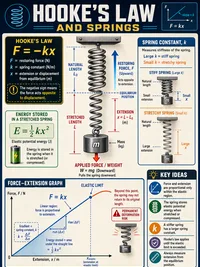
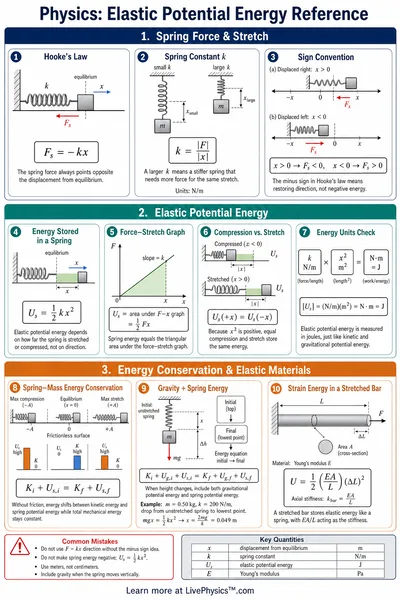
Hooke's Law
For an ideal spring inside its elastic range, the restoring force is proportional to the extension.
Doubling the extension doubles the force. The constant of proportionality k is the spring constant in newtons per metre. Stiffer springs have larger k.
The elastic potential energy stored in a stretched spring grows quadratically with the extension.
Deriving k from F vs x
Hooke's Law is already linear in x, so the slope of a best-fit line through your F vs x data IS the spring constant.
A higher R² and a smaller slope uncertainty give a more reliable derived k. With careful ruler readings R² should exceed 0.99 across six trials in the elastic regime.
In Investigation A the applied force is m·g for each mass; in Investigation B the same fixed force is applied to springs of different stiffness; in Investigation C the force is pushed beyond the yield point so the slope changes.
Error Analysis
Quote the derived value with both uncertainty and percent error.
Slope uncertainty propagates directly to k since k equals the slope. Inspect residuals for systematic patterns. A growing residual at high x is a signature of the spring approaching its elastic limit, where Hooke's Law no longer holds and the apparent k drops below the small-extension value.
The main sources of uncertainty are ruler resolution (about 1 mm), parallax in reading the ruler, slight nonlinearity of the spring, and the mass of the spring itself adding a small extra extension.