Practice applying the law of conservation of energy to physical systems, energy transformations, and everyday examples.
Read each problem carefully. Show your work and explain your reasoning when needed.
How energy changes form while the total amount stays constant
Physics - Grade 9-12
- 1
State the law of conservation of energy in your own words.
- 2
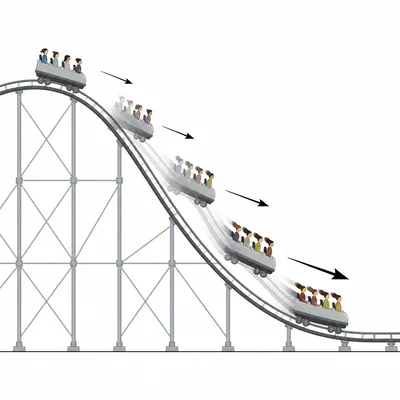
A roller coaster starts at the top of a hill with a large amount of gravitational potential energy. As it moves down the hill, what happens to its potential energy and kinetic energy?
- 3
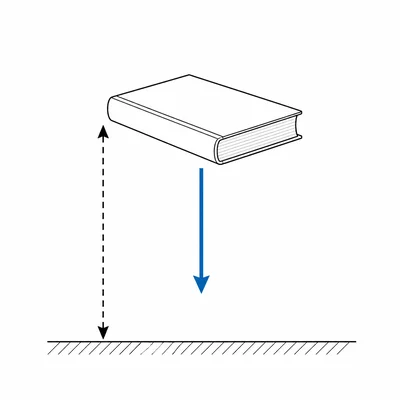
A 2 kg book is held 5 m above the ground. Using g = 9.8 m/s^2, calculate its gravitational potential energy.
- 4
A moving cart has 120 J of kinetic energy. If friction does 30 J of work on the cart, how much kinetic energy remains if no other energy transfers occur?
- 5
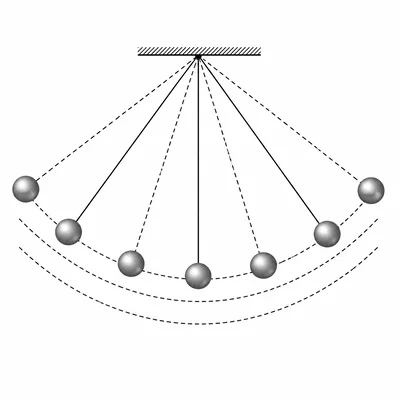
Explain why a swinging pendulum never returns to exactly the same height if air resistance and friction are present.
- 6
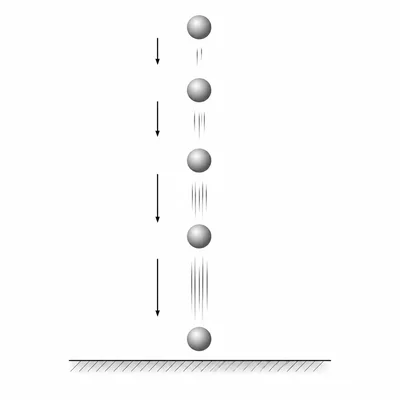
A 0.5 kg ball is dropped from a height of 10 m. Ignore air resistance. What is its speed just before it hits the ground? Use g = 9.8 m/s^2.
- 7
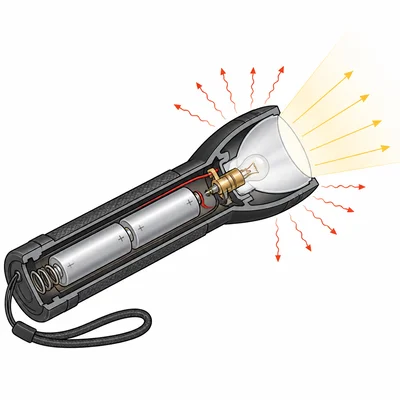
A battery powers a flashlight. Describe the main energy transformations that take place.
- 8
A spring stores 45 J of elastic potential energy. If all of this energy is converted into kinetic energy of a toy car, how much kinetic energy does the car have?
- 9
A student says, "Energy disappeared because the ball stopped moving." Explain why this statement is incorrect.
- 10
A 3 kg object moves at 4 m/s. Calculate its kinetic energy.
- 11
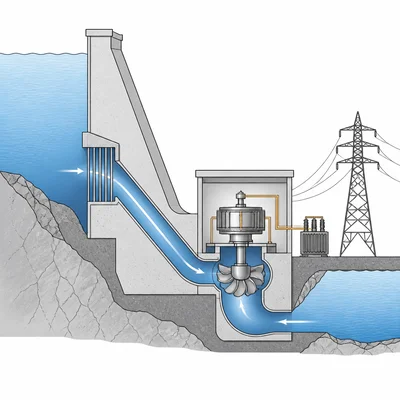
In a hydroelectric dam, water stored behind the dam eventually helps produce electricity. Describe the sequence of major energy transformations.
- 12
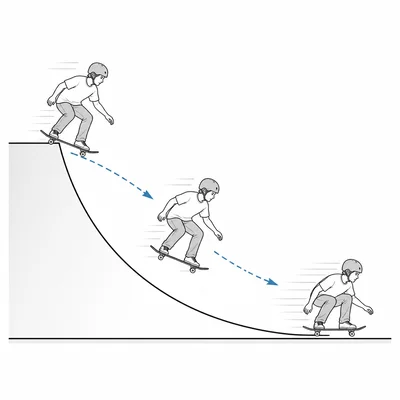
A skater has 600 J of total mechanical energy at the top of a ramp. If the skater has 150 J of potential energy at one point on the ramp, how much kinetic energy does the skater have there, assuming no friction?
- 13
Why is food often described as stored chemical energy for the human body?
- 14
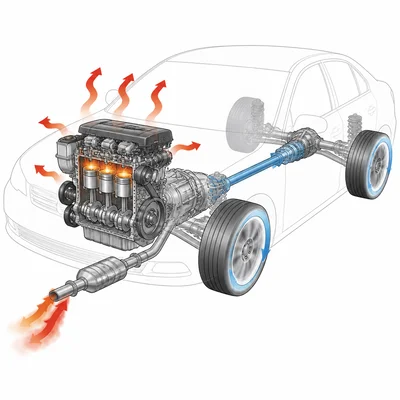
A car engine converts gasoline's chemical energy into motion, but the process is not perfectly efficient. Where does much of the remaining energy go?
- 15
Give one real-world example of conservation of energy and explain the energy transformations involved.