Understanding 3D Nets and Shape Folding Explorer
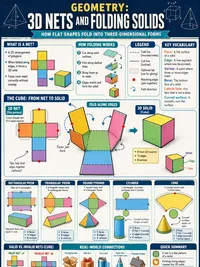
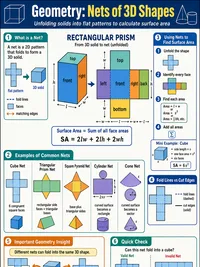
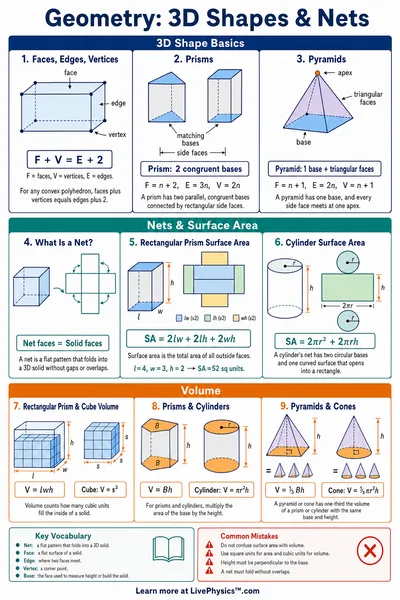
A net works only when its faces can move without bumping into each other as they fold. Two nets may have the same number of squares, yet only one may make a cube. The important detail is where each square is attached.
For a cube, four side squares must form a band around the shape, while the remaining two squares become the top and bottom. If those squares are placed in the wrong spots, some faces overlap or leave an opening. This is why tracing connections matters more than simply counting shapes.
Imagine each shared side in a net as a hinge. When paper folds, the two faces connected by that hinge stay connected along the whole side. Edges that are far apart on the flat paper can meet after folding and become one edge of the solid.
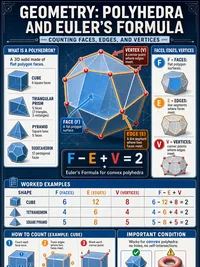
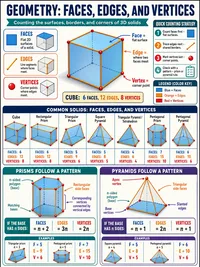
Students often count an edge twice because they see it on two touching faces. On the finished solid, it is only one edge. A careful way to check is to point to each line where two faces meet and count it once.
Vertices can be especially tricky because several corners may come together in one place. A cube has three edges meeting at every vertex, so three face corners join there during folding. Looking at one corner of a real box helps make this easier to picture.
In a triangular prism, the triangular ends have different corner patterns from the rectangular side faces. Paying attention to the face shapes tells you which solid is possible. A solid with triangles and rectangles cannot be a cube, since every cube face is a square.
Nets appear in ordinary objects made from cardboard, paper, or thin plastic. A cereal box begins as a printed flat pattern with tabs for glue, then machines fold it into shape. Gift boxes, shipping cartons, party hats, and some food packages use the same idea.
Try finding the seams on a box and imagining which edges were folded first. When learning, rotate the solid in your mind and match every face in the net to its final location. Making a paper model can show mistakes clearly, because a net that looks reasonable on a screen may not close in real life.