Average Atomic Mass Calculator
Add each isotope of an element with its mass and percent abundance, and the tool returns the abundance-weighted average atomic mass. Use the reverse mode to solve for an unknown abundance from a known average, or load a real element preset to check your work.
The average sits closer to the more abundant isotope.
| Isotope | Mass (u) | Abundance | Contribution |
|---|---|---|---|
| Cl-35 | 34.969 | 75.77% | 26.4960(74.7%) |
| Cl-37 | 36.966 | 24.23% | 8.9569(25.3%) |
Average atomic mass is reported in unified atomic mass units (u). The accepted standard atomic weight rounds to 3 decimal places here for comparison.
Understanding Average Atomic Mass
What average atomic mass is
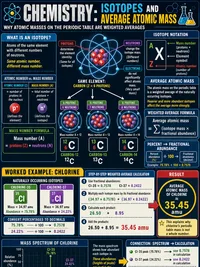
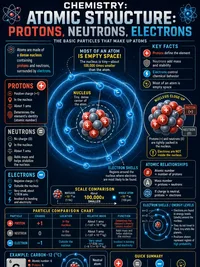
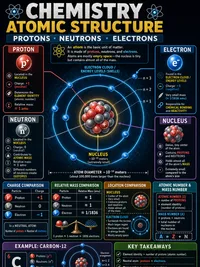
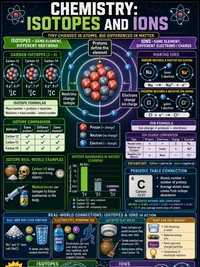
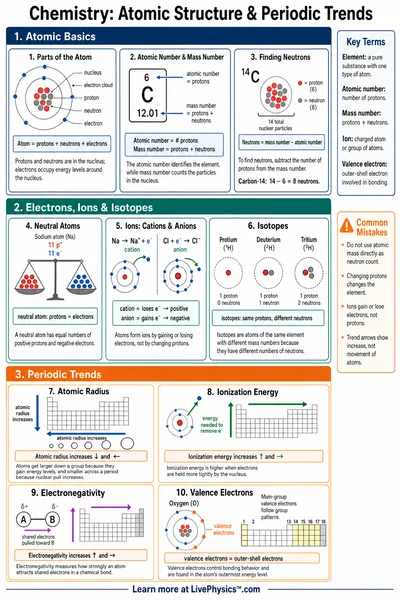
Most elements exist as a mixture of isotopes. Isotopes share the same number of protons but differ in neutrons, so they have different masses. The average atomic mass is the mass you would measure for an average atom of the element, taking into account how common each isotope is. It is the value printed on the periodic table.
The weighted-average formula
The average is the sum of each isotope mass multiplied by its fractional abundance. Convert a percent abundance to a fraction by dividing by 100. For chlorine that is (34.969)(0.7577) plus (36.966)(0.2423), which gives about 35.45 u. The fractional abundances must add up to 1, or equivalently the percentages must add up to 100.
Why the value is not a whole number
A single isotope has a mass very close to a whole number of mass units. The periodic table value is not a whole number because it blends several isotopes. Chlorine reads 35.45 even though no single chlorine atom weighs 35.45 u. The average lands between the lightest and heaviest isotope and sits closer to whichever isotope is more abundant.
Isotopes and abundance
Percent abundance is the fraction of atoms of an element that are a given isotope, measured by mass spectrometry. If you know the average atomic mass and all but one abundance, you can solve for the missing one. The reverse mode does this for you. Pick the unknown isotope, enter the target average, and read off the abundance that makes the numbers balance.