Gravimetric Analysis Lab
In gravimetric analysis you convert the analyte into an insoluble precipitate of known formula, then filter, dry, and weigh the solid. Choose a determination, enter the sample mass and the measured precipitate mass, and the lab computes the gravimetric factor, the analyte mass, and the percent composition. Every trial is recorded in the data table for your lab report.
Guided Experiment Determining Percent Chloride by Gravimetric Analysis
A weighed sample contains an unknown percentage of chloride. If you precipitate all of the chloride as silver chloride and weigh the dried solid, how can you work back to the mass of chloride and the percent chloride in the sample, and what assumptions must hold for the answer to be accurate?
Write your hypothesis in the Lab Report panel, then click Next.
Controls
Chloride is precipitated as white silver chloride. The solid is kept away from light, filtered, dried near 130 °C, and weighed.
Precipitant added in excess silver nitrate (AgNO₃).
Data Table
(0 rows)| # | Trial | Determination | Sample mass (g) | Precipitate mass (g) | Gravimetric factor | Analyte mass (g) | Percent (%) |
|---|
Reference Guide
What Gravimetric Analysis Is
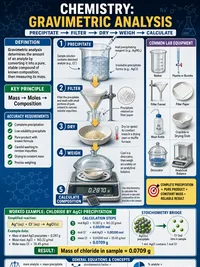
Gravimetric analysis is a classical quantitative method that measures the amount of an analyte by mass alone. The analyte is converted into a pure, insoluble solid of known composition, and the mass of that solid is measured on an analytical balance.
Because the result comes from a direct mass measurement and known molar masses, the method needs no calibration standard and can be very accurate. It is the reference technique behind many standardized determinations of chloride, sulfate, and metals.
The Gravimetric Factor
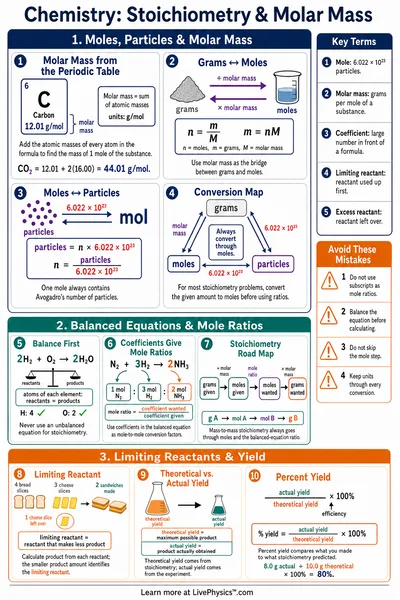
The gravimetric factor converts the weighed precipitate mass into the mass of the analyte. It equals the moles of analyte per mole of precipitate multiplied by the ratio of their molar masses.
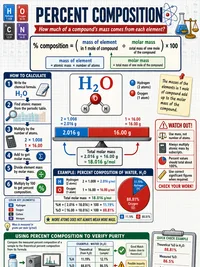
For chloride weighed as silver chloride the factor is the molar mass of chloride divided by the molar mass of AgCl, about 0.2474. For sulfate weighed as barium sulfate it is about 0.4116. Multiplying the precipitate mass by the factor gives the analyte mass, and dividing by the sample mass gives the percent composition.
The Procedure
Dissolve. Weigh the sample accurately and dissolve it completely.
Precipitate. Add the precipitant in excess so all of the analyte is captured as the insoluble solid.
Digest. Warm the mixture so small particles grow into larger, easier to filter crystals.
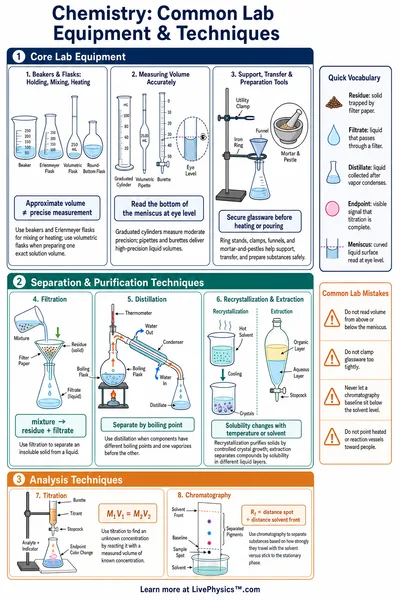
Filter. Separate the solid from the solution and wash it free of soluble impurities.
Dry or ignite. Heat the solid to constant mass so its composition is exactly the known formula.
Weigh. Record the dried-precipitate mass and apply the gravimetric factor.
Sources of Error
Co-precipitation is the main error. Foreign ions can be trapped inside or adsorbed onto the growing crystals, adding mass that is not analyte. Digesting the precipitate and reprecipitating reduce this.
Other errors include loss of fine particles through the filter, solubility losses when the precipitate is not quite insoluble, incomplete drying that leaves water in the solid, and for silver chloride photochemical darkening in light. Drying to constant mass and protecting light-sensitive solids keep the result accurate.