Carbon Cycle Simulator
Explore how carbon moves between the atmosphere, oceans, biosphere, and geosphere. Adjust human activity fluxes and see a 100-year projection of atmospheric CO2 and global temperature change.
Carbon Reservoirs and Fluxes
Current Status
Human Activity Fluxes
Scenario Presets
Carbon Sources (add CO2)
Carbon Sinks (remove CO2)
100-Year CO2 Projection
Reference Guide
Carbon Reservoirs
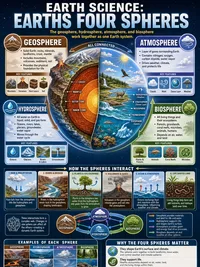
Carbon is stored in four main reservoirs on Earth. Each holds a vastly different amount and exchanges carbon at different rates.
| Reservoir | Size (Gt C) |
|---|---|
| Atmosphere | ~850+ |
| Ocean (total) | ~38,000 |
| Biosphere (land) | ~2,300 |
| Geosphere (fossil) | ~66,000,000 |
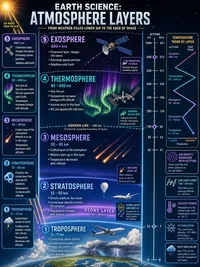
The atmosphere holds only about 850 Gt C today (420 ppm), but even small changes dramatically affect global temperature because CO2 acts as a greenhouse gas.
Human Fluxes
Human activities release carbon that was previously locked in long-term storage, disrupting the natural cycle.
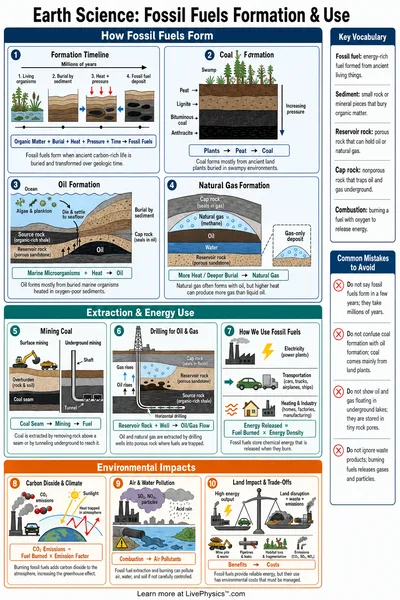
- Fossil fuels release ~10 Gt C/yr today by burning coal, oil, and gas stored over millions of years.
- Deforestation releases ~1.5 Gt C/yr when forests are cleared and burned, removing a major natural sink.
- Ocean uptake absorbs extra CO2 as surface waters dissolve more atmospheric carbon (natural + enhanced).
- Land sinks include soil carbon storage and reforestation efforts that remove CO2 from the atmosphere.
Climate Sensitivity
Climate sensitivity describes how much warming results from a given increase in atmospheric CO2.
The best estimate is approximately 3 degrees C of warming per doubling of CO2 above pre-industrial levels (280 ppm). This relationship follows a logarithmic curve, not a straight line.
| CO2 (ppm) | Warming above 1850 |
|---|---|
| 280 | 0.0 degrees C (baseline) |
| 350 | +0.7 degrees C |
| 420 | +1.3 degrees C |
| 560 | +3.0 degrees C |
| 1120 | +6.0 degrees C |
The Paris Agreement aims to limit warming to 1.5-2 degrees C, requiring CO2 to stay below roughly 430-450 ppm.
Natural Fluxes
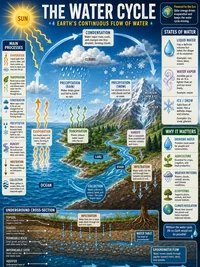
Without human activity, natural fluxes are nearly balanced. The main natural processes move carbon between reservoirs continuously.
- Photosynthesis removes ~120 Gt C/yr from the atmosphere
- Respiration returns ~118.7 Gt C/yr to the atmosphere
- Ocean absorption takes in ~90 Gt C/yr from the air
- Ocean outgassing releases ~88 Gt C/yr back to air
- Weathering releases ~0.3 Gt C/yr from rocks
- Volcanism releases ~0.1 Gt C/yr from the Earth
Natural net flux to the atmosphere is only about +1.7 Gt C/yr, a small imbalance dwarfed by human emissions of ~11.5 Gt C/yr.
Units and Conversions
Scientists measure carbon in two main units. Understanding both helps connect atmospheric measurements to physical carbon quantities.
| Gt C | Gigatons of carbon (10^9 tonnes) |
| ppm | Parts per million CO2 by volume in air |
| 1 ppm | = 2.13 Gt C in atmosphere |
| 1 Gt C | = 0.47 ppm CO2 |
To convert CO2 mass (Gt CO2) to carbon mass (Gt C), divide by 3.67 (the ratio of molecular masses of CO2 to C).
Climate Thresholds
Scientists have identified key CO2 concentration thresholds associated with major climate risks.
- 350 ppm is considered the safe upper limit for long-term stability by some scientists (already exceeded).
- 450 ppm roughly corresponds to the 2 degrees C warming threshold targeted by the Paris Agreement.
- 560 ppm is double the pre-industrial level of 280 ppm, expected to cause about 3 degrees C of warming.
- Beyond 600 ppm risks triggering feedback loops like permafrost thaw, ice-albedo effects, and Amazon dieback.