Supreme Court Reasoning Lab
Landmark cases are easier to understand when you separate what happened from the legal question and from the reasoning. Read each case as a card, then test yourself by sorting statements into facts, the constitutional question, majority reasoning, and dissent reasoning.
Guided ExperimentFacts vs the constitutional question
Predict the difference between a fact of a case and the constitutional question. Which one describes what happened, and which one names the part of the Constitution the Court must apply?
Write your hypothesis in the Lab Report panel, then click Next.
Controls
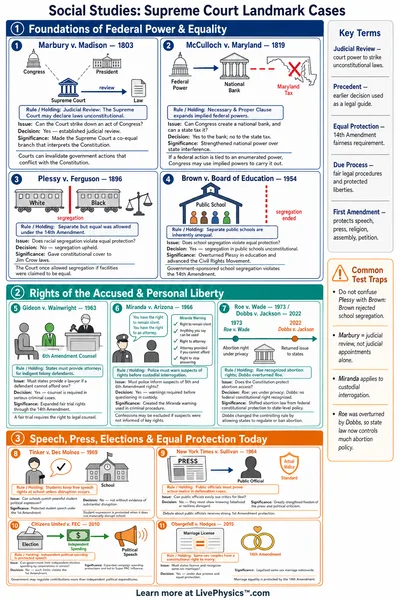
Marbury v. Madison (1803)
Article III and the role of the courtsA late-term appointment was approved but the official paperwork was never delivered. The appointee asked the Supreme Court to order the new administration to hand it over.
Can the Supreme Court strike down an act of Congress that conflicts with the Constitution?
Yes. The Court established judicial review, the power to declare a law unconstitutional, and found that the statute the appointee relied on exceeded what the Constitution allowed.
The Constitution is the supreme law, so when an ordinary law conflicts with it the courts must follow the Constitution. That makes it the judiciary's duty to say what the law is.
Data Table
(0 rows)| # | Case | Year | Provision | Holding (short) | Classify accuracy(%) |
|---|
Reference Guide
The Parts of a Court Case
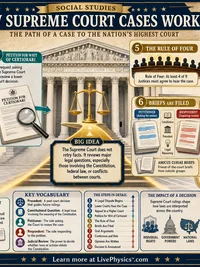
Every case has facts, which describe the real situation that started the dispute. The facts lead to a constitutional question, which is the legal issue the Court must answer, usually about a clause of the Constitution.
The holding is the Court's answer. The reasoning explains why. Telling these apart is the first step in reading any decision, because the same facts can support more than one line of reasoning.
Majority and Dissent
The majority opinion is the reasoning of the justices who won the vote, and it sets the rule that courts follow afterward. A dissent is the reasoning of justices who disagreed.
Some decisions are unanimous, with no dissent at all, like Brown v. Board and Gideon v. Wainwright. Others split the Court. Dissents do not change the outcome, but they often shape how people argue about the issue later.
Judicial Review and Why Landmarks Matter
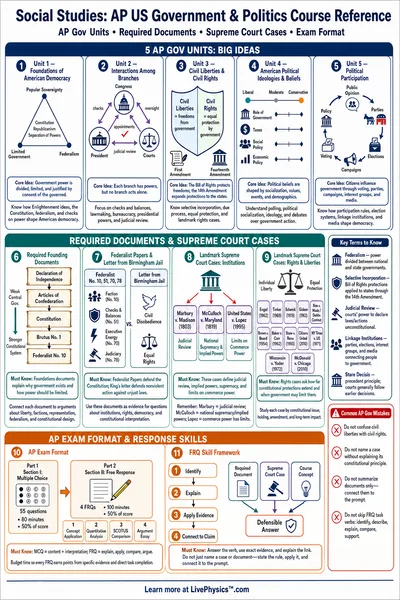
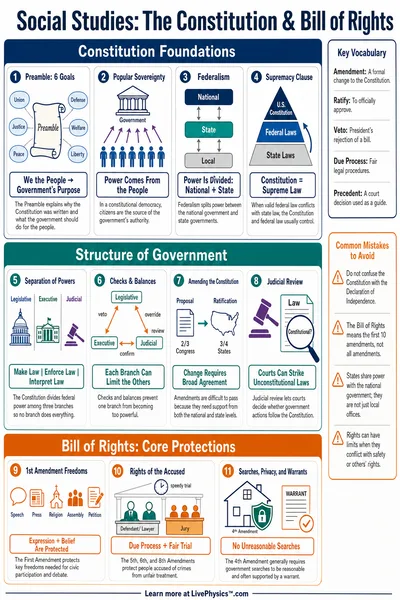
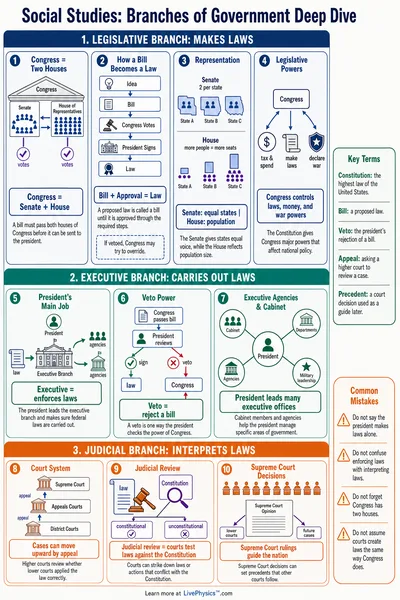
In Marbury v. Madison the Court established judicial review, the power to decide whether a law agrees with the Constitution. That power is why Supreme Court cases can reshape the rules for the whole country.
Landmark cases set lasting standards, such as the right to a lawyer, the limits of school authority over student speech, and the warnings police must give before questioning a suspect.
How to Use the Lab
Pick a case and use Read the case to study its facts, question, holding, and the reasoning on each side. Then switch to Classify the reasoning to label each statement and check your score.
Record cases in the data table to compare which ones were unanimous and which had a dissent. The case summaries here are written in plain language for study and are not quotations from the Court.