How a Bill Becomes a Law
Walk a bill through the US federal legislative process step by step. Make the choices at committee, floor votes, the other chamber, conference, and presidential action, then see whether the bill becomes law or dies.
Start a bill
Choose where your bill begins and how you want to move through the process. Then start the journey.
Where is the bill introduced?
How do you want to learn?
How it works
Pick the chamber where your bill begins, then move it through each stage of the federal lawmaking process. In decide mode you choose what happens at each fork, such as whether a committee reports the bill or whether the president signs or vetoes it. The tool branches correctly and explains every stage. In guided tour mode it walks the common path to becoming law and explains each step along the way. The flow diagram on the side highlights where the bill is and the progress bar shows how far it has traveled.
Curriculum alignment
This tool supports middle school and high school civics and US government units on the structure of Congress, the legislative process, checks and balances, and the veto and override powers. It fits lessons on how the House and Senate share lawmaking authority and how the executive and legislative branches interact when a bill reaches the president.
Reference Guide
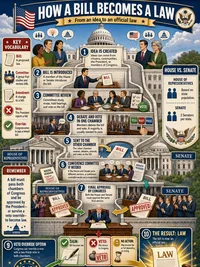
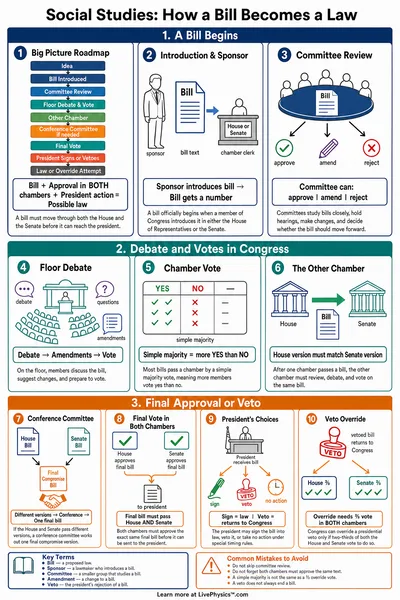
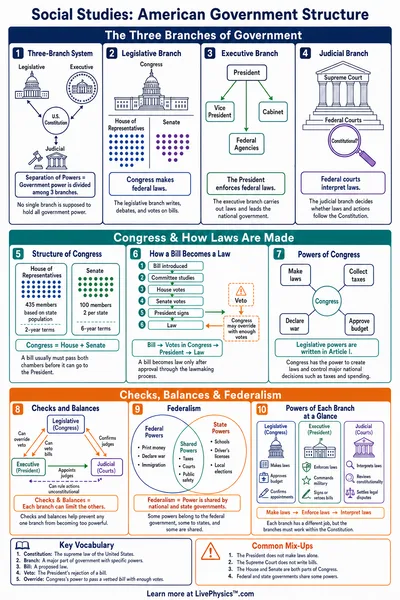
The stages a bill passes through on its way to becoming federal law.
Introduction
A member of Congress sponsors the bill and introduces it in the House or the Senate. Revenue bills must start in the House.
Committee Review
A subject matter committee holds hearings, amends the text, and either reports the bill to the full chamber or tables it. Most bills die here.
Floor Debate and Vote
The full chamber debates, amends, and votes. A simple majority is needed to pass and send the bill to the other chamber.
The Other Chamber
The second chamber runs its own committee and floor process. It can pass the bill as is, change it, or reject it.
Conference Committee
When the two chambers pass different versions, a conference committee reconciles them into one text that both chambers must approve.
Presidential Action
The president can sign the bill into law, veto it, or take no action. A pocket veto ends the bill when Congress has adjourned.
Veto Override
After a veto, Congress can pass the bill anyway with a two thirds vote in both the House and the Senate. Overrides are rare.