Implicit Differentiation Step-by-Step Solver
Find dy/dx for an implicitly defined curve with full step-by-step work. Differentiate both sides, apply the chain rule to y terms, collect, and solve, then evaluate the slope at a point and see the tangent line.
Click near the curve to snap a new point. The teal curve is the equation, the amber dashed line is the tangent.
Slope at the point
Computed numerically with the implicit function theorem, dy/dx = -Fx / Fy, where Fx and Fy are the partial derivatives of F(x, y) = 0.
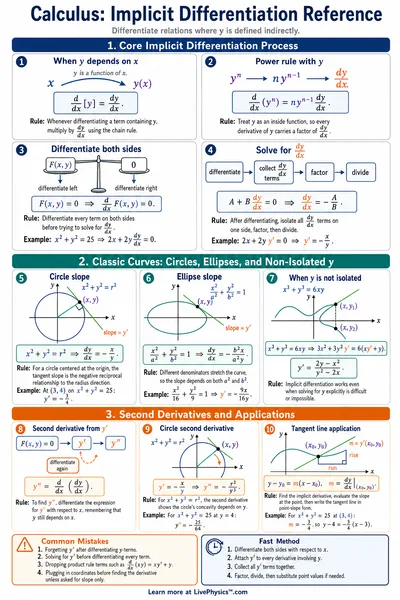
We differentiate both sides with respect to x, treating y as a function of x. Every time a y appears, the chain rule produces a factor of dy/dx. We then collect the dy/dx terms and solve.
Treat y as a function of x, so y itself depends on x.
Differentiating y² gives 2y times dy/dx, because y is a function of x.
Symbolic answer
Reference Guide
What implicit differentiation is
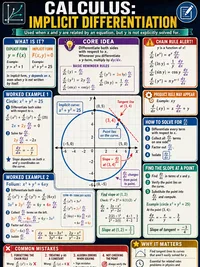
Some curves cannot be written as y = f(x). An equation like x² + y² = 25 mixes x and y together. Implicit differentiation lets you find the slope dy/dx without first solving for y. You differentiate both sides of the equation with respect to x and keep y as an unknown function of x.
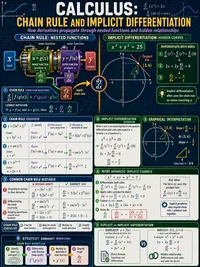
The chain rule produces dy/dx
Because y depends on x, differentiating a y term needs the chain rule. The derivative of y² with respect to x is 2y times dy/dx, not just 2y. Every y term you differentiate carries an extra factor of dy/dx. That is the key idea that makes the method work.
Collect and solve
After differentiating, gather every term that contains dy/dx on one side and move everything else to the other side. Factor out dy/dx, then divide. The result is a formula for dy/dx in terms of both x and y, which is normal for implicit curves.
Evaluating the slope at a point
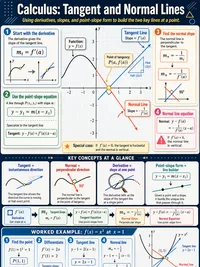
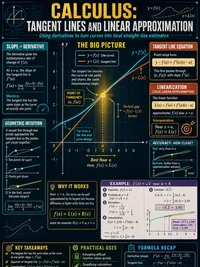
To get a number, substitute the coordinates of a point that lies on the curve into the dy/dx formula. The tool does this numerically with the implicit function theorem, dy/dx equals minus Fx over Fy, and draws the tangent line at that point so you can check the slope visually.