Practice using Boyle's law, Charles's law, and the ideal gas law to describe and calculate gas behavior.
Read each problem carefully. Use correct units, convert temperatures to kelvin when needed, and show your work in the space provided.
Relating pressure, volume, temperature, and moles in gases
Chemistry - Grade 9-12
- 1
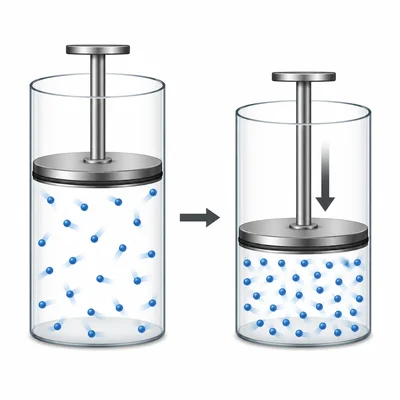
A gas sample has a volume of 4.0 L at a pressure of 1.5 atm. If the temperature stays constant and the pressure increases to 3.0 atm, what is the new volume?
- 2
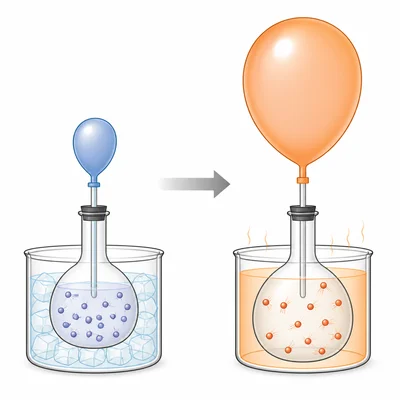
A balloon has a volume of 2.5 L at 300 K. If the pressure remains constant and the temperature increases to 360 K, what is the new volume?
- 3
A container holds 1.0 mol of gas at 2.0 atm and 273 K. If the container volume is 11.2 L, does this data agree with the ideal gas law? Use R = 0.0821 L-atm/mol-K.
- 4
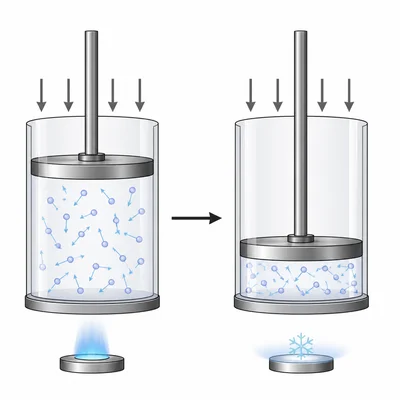
A gas occupies 750 mL at 25 degrees C. If the pressure stays constant and the gas is cooled to 0 degrees C, what is the new volume? Express your answer in milliliters.
- 5
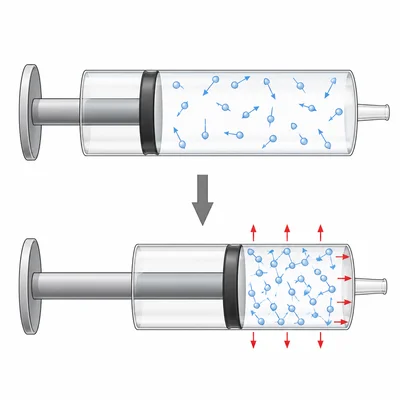
A syringe contains 30.0 mL of air at 1.00 atm. The plunger is pushed until the volume is 12.0 mL at constant temperature. What is the new pressure?
- 6
A gas has a volume of 5.00 L, a pressure of 1.20 atm, and a temperature of 350 K. How many moles of gas are present? Use R = 0.0821 L-atm/mol-K.
- 7
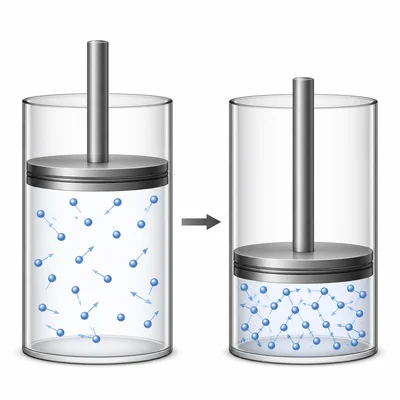
A gas sample occupies 9.0 L at 0.80 atm. If the temperature remains constant, what pressure is needed to compress the gas to 6.0 L?
- 8
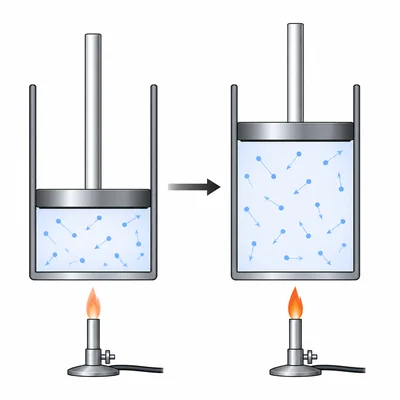
A gas has a volume of 1.80 L at 250 K. At constant pressure, what temperature in kelvin is needed for the volume to increase to 2.16 L?
- 9
What is the pressure of 0.500 mol of a gas in a 10.0 L container at 300 K? Use R = 0.0821 L-atm/mol-K.
- 10
Explain in words the main difference between Boyle's law and Charles's law.
- 11
A sealed flask contains gas at 2.0 L, 1.0 atm, and 300 K. If the amount of gas is 0.0812 mol, does this approximately satisfy PV = nRT? Use R = 0.0821 L-atm/mol-K.
- 12
A student says gas temperatures can be used in degrees Celsius directly in Charles's law calculations. Is the student correct? Explain.