Probability Calculator
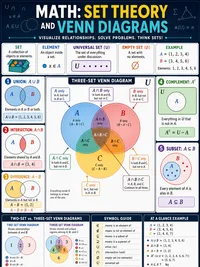
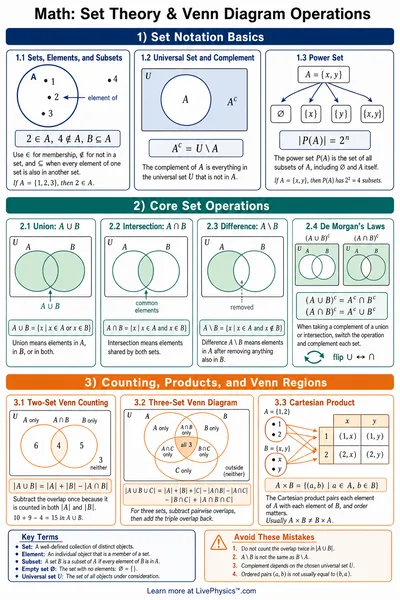
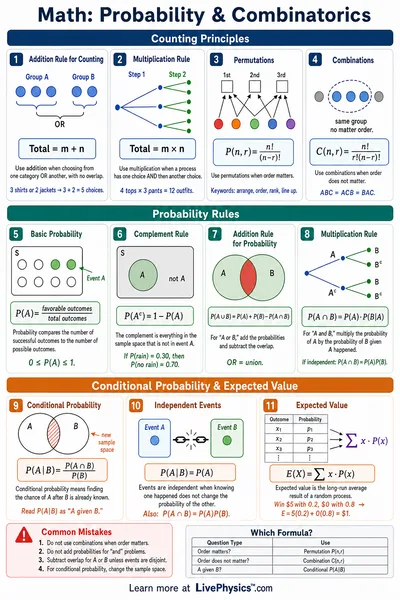
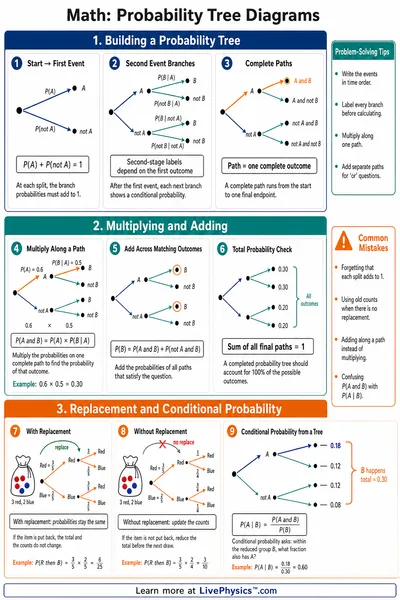
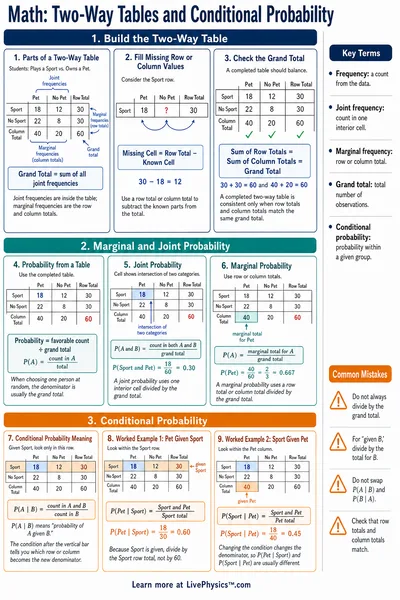
Enter P(A), P(B), and P(A intersection B) to compute union, complement, and conditional probabilities. The Venn diagram highlights each region and step-by-step formulas show the math.
Input
Results
P(A)
0.300000
P(B)
0.500000
P(A ∩ B)
0.100000
P(A ∪ B)
0.700000
P(A')
0.700000
P(B')
0.500000
P(A|B)
0.200000
P(B|A)
0.333333
Venn Diagram
Step-by-Step
1. Addition Rule
2. Complement Rule
3. Conditional Probability
Reference Guide
Addition Rule
The probability of A or B occurring equals the sum of their individual probabilities minus the overlap.
Multiplication Rule
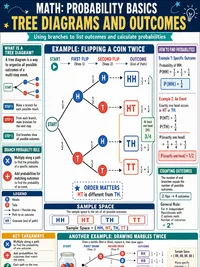
For independent events, the probability of both occurring is the product of each.
Conditional Probability
The probability of A given that B has occurred narrows the sample space to B.
Complement Rule
The probability of an event not happening equals one minus the probability of it happening.
Related Content
Related Tools
MAP Growth Grade 3 Math Practice
Original independent MAP Growth Grade 3 Math skill practice with explanations, adjustable difficulty and first-attempt progress; no official RIT score.
MAP Growth Grade 4 Math Practice
Original independent MAP Growth Grade 4 Math skill practice with explanations, adjustable difficulty and first-attempt progress; no official RIT score.
MAP Growth Grade 5 Math Practice
Original independent MAP Growth Grade 5 Math skill practice with explanations, adjustable difficulty and first-attempt progress; no official RIT score.
MAP Growth Grade 6 Math Practice
Original independent MAP Growth Grade 6 Math skill practice with explanations, adjustable difficulty and first-attempt progress; no official RIT score.
Related Labs
Probability & Combinatorics Lab
Explore probability rules with interactive Venn diagrams. Compute permutations and combinations with step-by-step formulas. Discover patterns in Pascal's triangle
Ratio, Proportion & Percent Lab
Visualize ratios with bar models, solve proportions using cross-multiplication, and calculate percent change. Discover the asymmetry of percent increase and decrease
Fraction Operations & Equivalents Lab
Explore fraction arithmetic with visual fraction bars. Add, subtract, multiply, and divide fractions and mixed numbers step by step. Find equivalent fractions and simplify to lowest terms