Rocket Staging Simulator
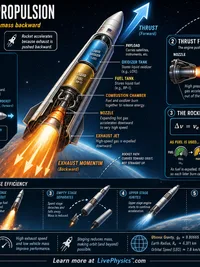
Build a one, two, or three stage rocket. Set the dry mass, propellant, specific impulse, and thrust-to-weight ratio for each stage and watch the Tsiolkovsky equation produce a total delta-v, a vertical-ascent trajectory, and a mission capability readout.
Stage 1 (booster)
Stage 2 (upper)
Altitude vs time (vertical ascent, no drag)
Per-stage results
| Stage | m initial (kg) | m final (kg) | Mass ratio | Δv (m/s) | Burn (s) |
|---|---|---|---|---|---|
| 1 | 557,700 | 146,700 | 3.80 | 3,694 | 148.4 |
| 2 | 124,500 | 17,000 | 7.32 | 6,797 | 200.3 |
Mission capability
Reaches low Earth orbit.
Mass breakdown
Solid blocks are propellant. Striped blocks are dry mass. The payload sits at the top.
Tsiolkovsky rocket equation
The total Δv of a multi-stage rocket is the sum of each stage's Δv. Staging works because shedding empty tanks lifts the mass ratio of the next burn. This simulator uses a vertical-launch model with constant gravity (9.81 m/s²) and no atmospheric drag, so the numbers represent ideal Δv. Real rockets lose roughly 1.5 to 2 km/s to gravity and drag during ascent.
Reference Guide
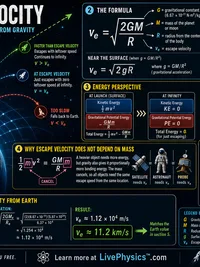
Tsiolkovsky rocket equation
- Δv. Velocity change a stage can deliver, in m/s.
- Isp. Specific impulse in seconds. Higher Isp means more delta-v per kg of propellant.
- g₀. Standard gravity, 9.81 m/s².
- m₀ and mf. Stage mass at ignition and burnout. Their ratio is the mass ratio.
Total mission delta-v is the sum of each stage's delta-v. That is why staging multiplies the achievable delta-v.
Why staging helps
Single-stage rockets must lift their empty tanks all the way to orbital velocity. The dry mass becomes a tax on every additional kg of propellant.
Staging drops empty tanks. The next stage starts with a smaller final mass, so its mass ratio (m₀ / mf) jumps. Since delta-v scales with the natural log of the mass ratio, even modest jumps add hundreds of m/s.
Try this. Set Falcon 9 to 1 stage by combining the propellants and dry masses. Notice the total delta-v drops below LEO.
Δv targets for common destinations
| Destination | Δv from Earth surface | Notes |
|---|---|---|
| Suborbital | ~3,000 m/s | Up and down only |
| Low Earth orbit (LEO) | ~9,400 m/s | Includes gravity and drag losses |
| Geostationary transfer (GTO) | ~11,800 m/s | Usually with a kick stage |
| Translunar injection (TLI) | ~13,100 m/s | Apollo Saturn V flew this |
| Earth escape | ~16,700 m/s | Heliocentric trajectories |
Real rockets pay an extra 1.5 to 2 km/s for gravity and atmospheric drag during ascent. The simulator shows ideal delta-v, so figures are optimistic.
Specific impulse by propellant
| Propellant class | Isp (vacuum) | Example |
|---|---|---|
| Solid (APCP) | 220 to 270 s | Shuttle SRB, Castor |
| Kerosene + LOX | 280 to 340 s | Falcon 9 Merlin, Saturn V F-1 |
| Methane + LOX | 320 to 370 s | Raptor, BE-4 |
| Hydrogen + LOX | 420 to 460 s | RS-25, J-2, RL10 |
| Ion (electric) | 3,000 to 10,000 s | Dawn NSTAR, NEXT |
Higher Isp means each kg of propellant produces more delta-v. Hydrogen's high Isp comes with low density, which forces bigger tanks. That trade-off is why most launchers use kerosene first stages and hydrogen upper stages.
Reading the trajectory plot
- Solid colored lines. Each stage's powered burn. The slope is the climb rate.
- Dashed line. Coast phase after the last stage burns out.
- Stage markers. Dots mark ignition, separation, and apogee.
- Apogee. Highest altitude reached during the simulated vertical climb.
- Burn time. Stage propellant divided by the mass flow rate from thrust and Isp.
- No drag. The model ignores atmosphere and Earth rotation, so apogee figures are upper bounds.
Try these experiments
1. Trade Isp for mass
Cut Falcon 9 second stage Isp by 50 s. Compare the loss in total delta-v against doubling the propellant.
2. Add a third stage
Take the Space Shuttle preset and split it into 2 or 3 stages with the same total mass. Watch the payload fraction climb.
3. Tyranny of the equation
Increase payload by 20 percent on Saturn V. Notice how much more total propellant is needed to keep delta-v above TLI.