Understanding Solar System Scale Explorer
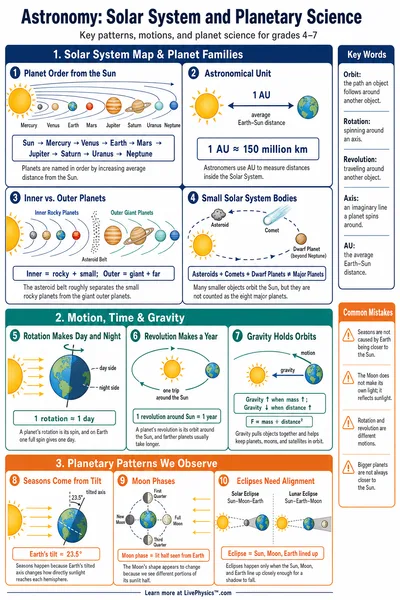
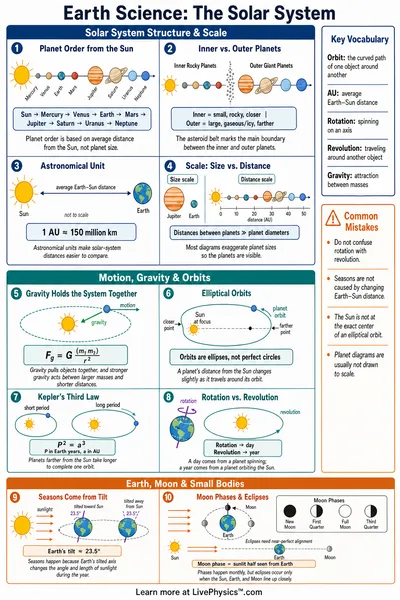
A scale model forces you to think in ratios rather than familiar objects. If Earth were shrunk to the size of a peppercorn, its nearest neighbors would still be far apart, while the Sun would be much larger than most classroom objects. This happens because space between planets grows far more dramatically than planet diameters.
A model can preserve one relationship well, but practical limits make another relationship hard to show at the same time. That limitation is not a flaw in science. It shows that measurements need a stated scale before a picture can be interpreted correctly.
Planet paths are not tracks painted in space. Each planet keeps moving forward because of its motion, while the Sun's gravity continually bends that motion into an orbit. A planet closer to the Sun must travel faster to stay in orbit, which is why inner planets complete years quickly.
More distant planets have longer paths and move more slowly, so their years are much longer. Their paths are slightly oval rather than perfectly round, though diagrams often make them look circular for clarity. The direction and speed of a planet depend on where it is in its orbit.
Distance in the solar system affects what we can observe. Sunlight takes about eight minutes to reach Earth, so seeing the Sun means seeing it as it was minutes earlier. Light needs much longer to cross the outer solar system, which matters when spacecraft send pictures and signals home.
A command sent to a distant probe cannot produce an instant response. Scientists plan missions carefully because communication delays are real physical effects, not problems with the equipment.
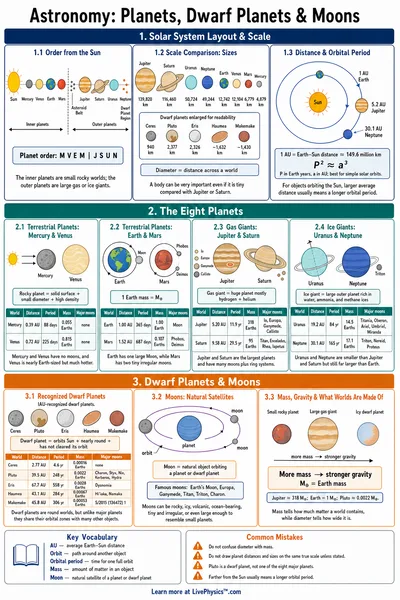
Size alone does not tell the full story of a planet. Mass determines the strength of gravity, while density helps explain how much mass is packed into a certain volume. Saturn is much wider than Earth but has a low average density because it is mostly hydrogen and helium.
Earth, Mercury, Venus, and Mars are smaller rocky worlds with dense materials. Comparing these groups helps explain why some planets have solid surfaces, why gas giants have deep atmospheres, and why moons behave differently around different worlds.
When studying a visual model, pay attention to the labels, units, and choices made by its designer. A line that looks short may represent millions of kilometers, and an object that looks large may be enlarged so that it remains visible. Try estimating a relationship before checking a value.
Then explain whether the estimate was wrong because of size, distance, motion, or the limits of the display. This habit builds scientific thinking because it separates evidence from what a picture merely seems to show.