Types of Government Sorter
Sort real world scenarios under the correct form of government. Practice democracy, republic, monarchy, dictatorship, oligarchy, theocracy, anarchy, and communism with instant explanations.
Choose a mode
Read each scenario and pick the form of government it describes. Reveal the answer to see the definition and a real world example.
One leader took control after a military takeover, banned other parties, and rules without any free elections.
How it works
Each round shows a short scenario that describes how a country makes and enforces its laws. Pick the form of government that best matches, then reveal the answer to read a clear definition, who holds the power, and one or two real world examples. Learn mode adds a hint about where power sits. Practice mode removes the hint. Challenge mode mixes in tricky contrasts, such as telling a republic apart from a direct democracy or an oligarchy apart from a dictatorship.
Curriculum alignment
This tool supports middle school and high school civics and social studies units on forms of government, comparative political systems, and the structure of states. It reinforces the skill of classifying systems by who holds power, which appears in standards on government and citizenship across the United States.
Reference guide to the major forms of government
Direct democracy
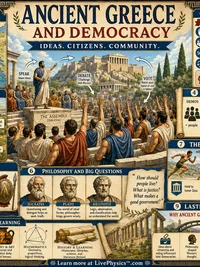
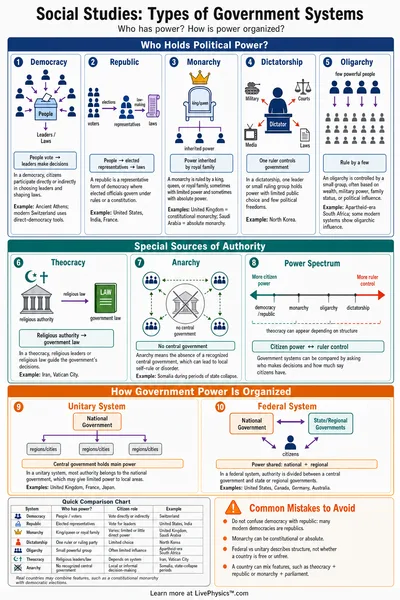
Citizens vote directly on laws and policies themselves. Power sits with the people, voting on each issue. Ancient Athens is the classic example.
Representative democracy
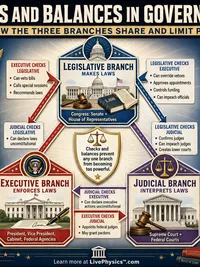
Citizens elect officials to make laws on their behalf. Power sits with elected representatives. Most modern legislatures work this way.
Republic
Power rests with elected representatives and an elected head of state rather than a monarch, often under a written constitution. The United States and France are examples.
Absolute monarchy
A king or queen holds total power with no constitutional limits. Saudi Arabia is a modern example, as was France under Louis XIV.
Constitutional monarchy
A monarch is head of state but power is limited by a constitution while elected officials govern. The United Kingdom and Japan are examples.
Dictatorship or autocracy
One ruler holds absolute power, usually seized by force and kept without free elections. Power sits with a single ruler who controls the state.
Oligarchy
A small group, often wealthy or powerful families, controls the government. Power is shared among a small elite rather than one person or the public.
Theocracy
Religious leaders rule and laws are based on religious teachings. Iran and Vatican City are examples.
Anarchy
There is no formal government or central authority, so no group makes or enforces laws for everyone. Somalia in the early 1990s is a frequent example.
Communist state
A single ruling party controls the government and major parts of the economy. The Soviet Union and Cuba are examples.