Practice using solubility rules to predict whether precipitation reactions occur, write balanced molecular equations, and identify net ionic equations.
Use standard solubility rules to answer each problem. Show your work, include states of matter when needed, and balance all equations.
Predicting precipitates and writing ionic equations
Chemistry - Grade 9-12
- 1
Classify each compound as soluble or insoluble in water: NaCl, AgCl, KNO3, BaSO4, and NH4Br.
- 2
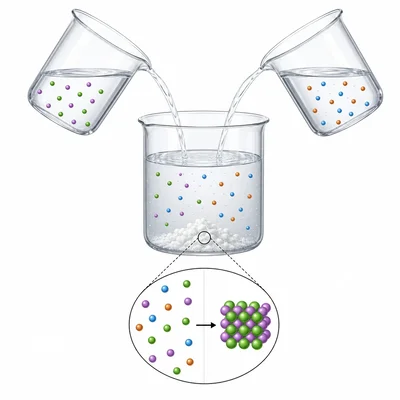
Predict whether a precipitate forms when aqueous solutions of silver nitrate and sodium chloride are mixed. Write the balanced molecular equation.
- 3
Write the complete ionic equation for the reaction between AgNO3(aq) and NaCl(aq).
- 4
Write the net ionic equation for the reaction between AgNO3(aq) and NaCl(aq).
- 5
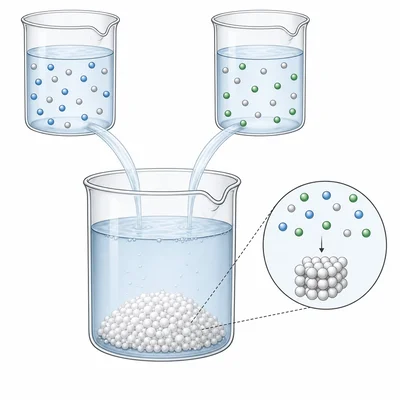
Predict whether a precipitate forms when aqueous potassium sulfate and barium nitrate are mixed. If a precipitate forms, identify it.
- 6
Write the balanced molecular equation for the reaction between K2SO4(aq) and Ba(NO3)2(aq). Include states of matter.
- 7
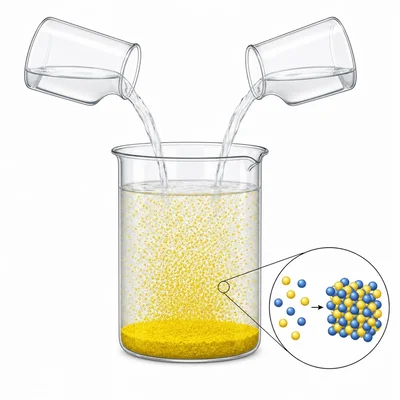
A student mixes Pb(NO3)2(aq) and KI(aq). Predict the products, identify any precipitate, and write the balanced molecular equation.
- 8
Write the net ionic equation for the reaction between Pb(NO3)2(aq) and KI(aq).
- 9
Will a precipitation reaction occur when NaNO3(aq) and KCl(aq) are mixed? Explain your answer.
- 10
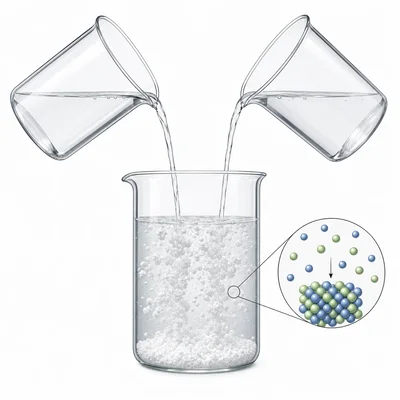
Complete and balance the molecular equation if a reaction occurs: CaCl2(aq) + Na2CO3(aq) ->
- 11
Write the complete ionic equation and the net ionic equation for CaCl2(aq) + Na2CO3(aq) -> CaCO3(s) + 2NaCl(aq).
- 12
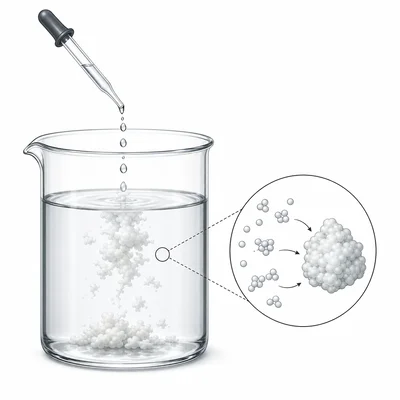
A solution contains Mg2+(aq), Na+(aq), Cl-(aq), and NO3-(aq). A few drops of NaOH(aq) are added. Predict whether a precipitate forms and write the net ionic equation.
- 13
Use solubility rules to decide which ion pair will form an insoluble compound: Na+ and NO3-, Ag+ and Cl-, K+ and Br-, or NH4+ and SO4 2-. Explain your choice.
- 14
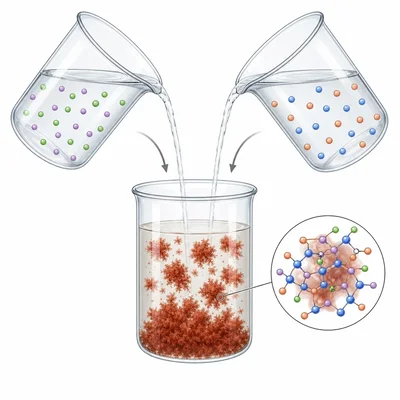
A chemist mixes equal volumes of 0.10 M FeCl3(aq) and 0.30 M NaOH(aq). Predict the precipitate and write the balanced molecular equation.
- 15
A reaction is represented by the net ionic equation Ba2+(aq) + SO4 2-(aq) -> BaSO4(s). Name two pairs of aqueous reactants that could produce this precipitate.