Net Ionic Equation Builder
Pick a reaction and watch it move from the balanced molecular equation to the complete ionic equation, then to the net ionic equation. Strong electrolytes split into aqueous ions, spectator ions are highlighted before they cancel, and the tool confirms the net result balances in both atoms and charge. Built for high school chemistry, AP Chemistry, and introductory college courses.
Choose a reaction
From molecular to net ionic
Analysis
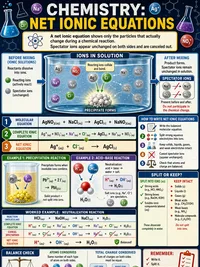
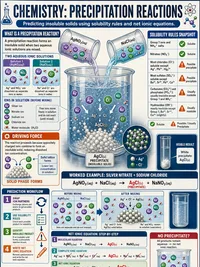
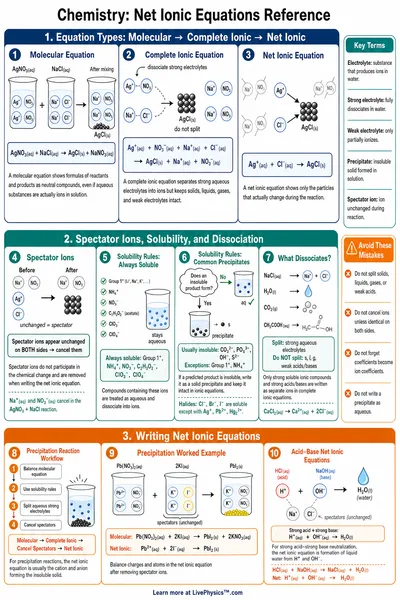
Mixing silver nitrate and sodium chloride drops insoluble silver chloride out of solution.
- NO₃⁻ and Na⁺ appear unchanged on both sides, so they are spectator ions and cancel out.
- The net ionic equation keeps only the species that actually react.
- The net ionic charge is balanced: 0 on the left and 0 on the right.
How to read each step
The molecular equation is the balanced reaction with full formulas. The complete ionic equation rewrites every strong electrolyte as the separate aqueous ions it forms in water, while precipitates, gases, water, and weak electrolytes stay together. The net ionic equation removes the spectator ions that appear unchanged on both sides, so only the species that actually react remain.
Reference Guide
Molecular, complete ionic, and net ionic
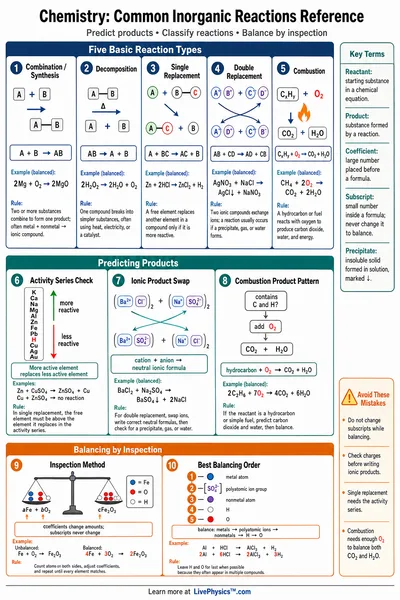
A reaction in solution can be written three ways, each more focused than the last.
- The molecular equation uses full neutral formulas with state labels.
- The complete ionic equation rewrites dissolved strong electrolytes as the separate ions they form.
- The net ionic equation drops the ions that do not change, keeping only the real chemistry.
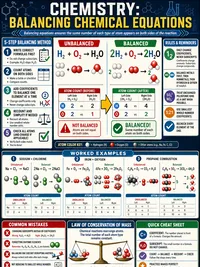
If you still need to balance the molecular equation first, use the Balance Chemical Equations tool.
Which compounds split into ions
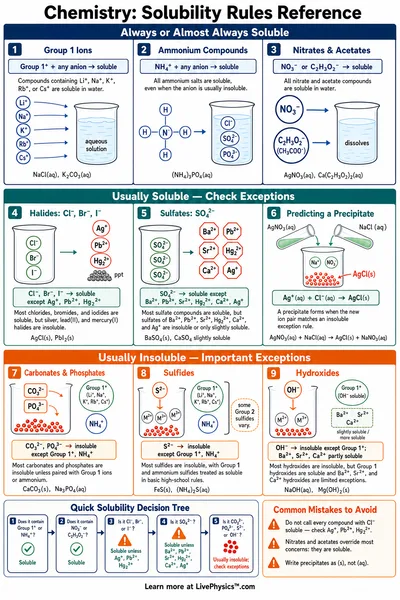
Only strong electrolytes dissolved in water break apart into ions in the complete ionic equation.
- Soluble ionic compounds, such as NaCl and KNO₃, split fully.
- Strong acids (HCl, HNO₃, H₂SO₄) and strong bases (NaOH, KOH) split fully.
- Precipitates, gases, liquid water, weak acids, and metals stay together.
Solubility rules decide which products are precipitates. A solid product such as AgCl or BaSO₄ keeps its full formula and an (s) label.
Spectator ions and how to cancel them
A spectator ion appears in exactly the same form and amount on both sides of the complete ionic equation. It floats through the reaction without changing.
To find the net ionic equation, cross out any ion that is identical on the left and the right. In the silver chloride reaction, sodium and nitrate ions are spectators, so the net ionic equation reduces to Ag⁺ + Cl⁻ → AgCl(s).
If every species cancels, the substances do not actually react, which is a useful result in itself.
Balancing atoms and charge
A correct net ionic equation must balance two ways at once.
- Atoms balance when each element has the same count on both sides.
- Charge balances when the total ionic charge is equal on both sides.
Charge balance is the extra check that molecular equations do not need. In the zinc and copper(II) sulfate reaction, the net ionic charge is +2 on each side, so it balances. The tool reports both checks for every reaction.