Practice solving problems involving capacitors, inductors, RC and RL time constants, reactance, impedance, resonance, and energy in RLC circuits.
Read each problem carefully. Show your work, include units, and round answers to a reasonable number of significant figures.
Energy storage, time constants, reactance, resonance, and AC circuit behavior
Physics - Grade 9-12
- 1
A 12 V battery is connected across a 6.0 microfarad capacitor. How much charge is stored on the capacitor after it is fully charged?
- 2
A capacitor has 0.0030 C of charge stored on it when the voltage across it is 15 V. What is the capacitance?
- 3
A 10 microfarad capacitor is charged to 20 V. How much electrical energy is stored in the capacitor?
- 4
A 1000 ohm resistor is in series with a 220 microfarad capacitor. What is the time constant of the RC circuit?
- 5
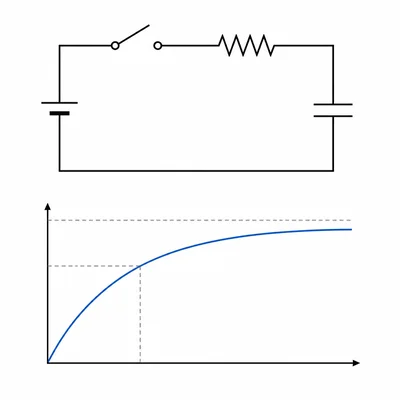
In an RC charging circuit, the time constant is 0.50 s and the battery voltage is 10 V. About what voltage is across the capacitor after one time constant?
- 6
A 2.0 H inductor carries a current of 3.0 A. How much energy is stored in the magnetic field of the inductor?
- 7
A 4.0 H inductor is in series with a 20 ohm resistor. What is the time constant of the RL circuit?
- 8
An AC source has a frequency of 60 Hz and is connected to a 50 microfarad capacitor. What is the capacitive reactance?
- 9
An AC source has a frequency of 400 Hz and is connected to a 0.25 H inductor. What is the inductive reactance?
- 10
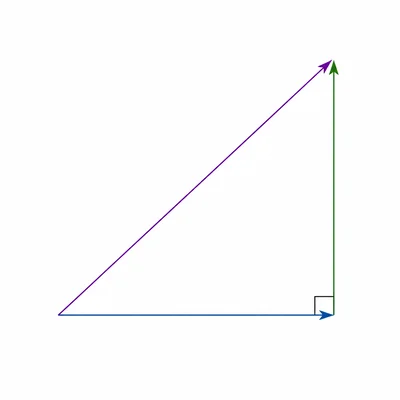
A series RLC circuit has R = 30 ohms, XL = 80 ohms, and XC = 40 ohms. What is the impedance of the circuit?
- 11
A series RLC circuit has a 0.50 H inductor and a 20 microfarad capacitor. What is the resonant frequency of the circuit?
- 12
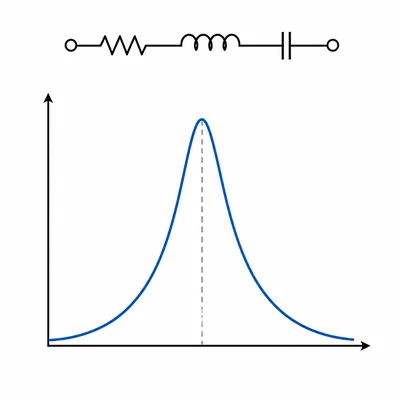
A graph shows current versus frequency for a series RLC circuit. The current reaches its maximum value at 120 Hz. What is the resonant frequency, and what happens to the impedance at that frequency?