Understanding Momentum & Collision Simulator
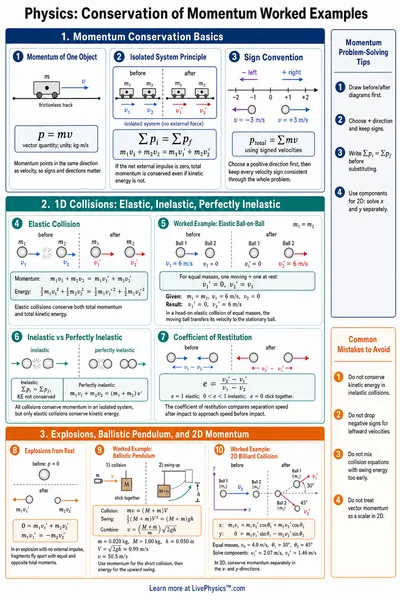
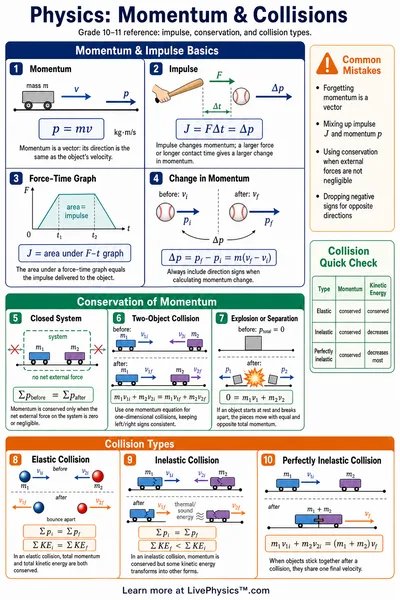
Momentum is useful because it combines how heavy an object is with how fast it moves and in which direction. A slow truck can have more momentum than a fast tennis ball. Direction matters, so velocities moving left are usually treated as negative while those moving right are positive.
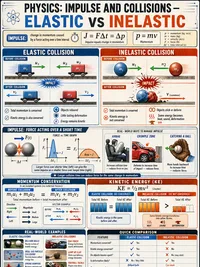
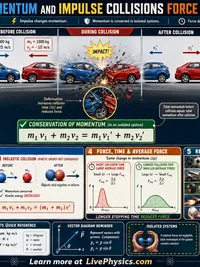
During a short collision, the objects push on each other with forces that are equal in size and opposite in direction. These forces act for the same time interval, giving each object an equal and opposite change in momentum. This is why the total momentum of the pair stays fixed when outside forces are too small to matter.
The word system means the group of objects chosen for analysis. For two carts on a nearly level track, friction and air resistance are often small during the instant of impact. Their combined momentum before contact can therefore be compared directly with their combined momentum after separation.
Kinetic energy behaves differently from momentum. It depends on mass and on the square of speed, so doubling speed makes kinetic energy four times larger. This makes speed measurement especially important when checking how much energy is transformed in a crash.
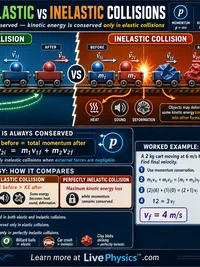
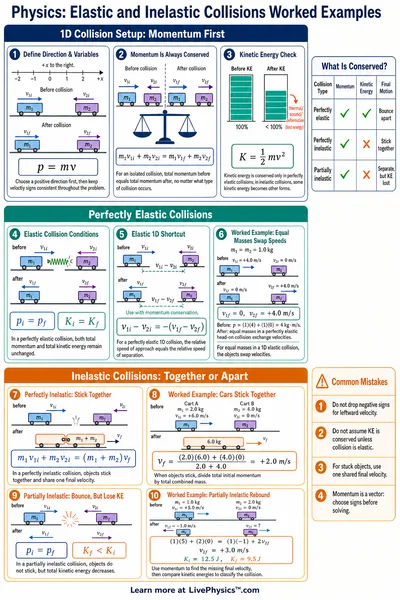
In a perfectly elastic collision, the objects bounce apart without a loss of kinetic energy from the moving system. Real objects rarely meet this ideal exactly because surfaces bend, vibrate, and make sound. Elastic models still work well for some hard objects, such as steel balls rolling on a good track.
In an inelastic collision, some kinetic energy becomes other forms of energy. It may become heat inside the materials, sound in the air, or energy used to permanently change shape. Momentum remains conserved for the system even though the amount of motion energy decreases.
A completely inelastic collision is a special case in which the objects leave the impact with the same velocity. Examples include lumps of clay that stick together or train cars that couple. The joined objects then move as one larger mass, which can be found from the total starting momentum.
Many ordinary impacts are partially inelastic. A basketball rebounds from the floor, yet it does not return to its original height because energy was transferred to the ball, floor, and air. The coefficient of restitution describes how strongly objects rebound compared with how quickly they approached.
A coefficient of restitution near one means a strong bounce and a collision close to elastic. A value near zero means little separation after impact and behavior close to sticking. It describes relative speeds, not the total amount of kinetic energy retained, so students should not treat the two ideas as identical.
Signs cause many mistakes in one dimensional collision problems. Choose one direction as positive before writing any values, then keep that choice throughout the calculation. An object moving in the opposite direction has a negative velocity, and its momentum must carry the same sign.
Checking units helps reveal errors. Momentum is measured in kilogram metres per second, while kinetic energy is measured in joules. A final velocity with an unexpected direction may be correct, but it should be checked against the initial masses, speeds, and physical situation.
Collision ideas appear in vehicle safety, sports, spacecraft docking, and particle experiments. Crumple zones increase the time of impact, which reduces the average force needed to change a car's momentum. When using a simulator, change one quantity at a time and watch which results depend on mass, direction, rebound, or energy loss.