Practice organizing numerical data in frequency tables and interpreting histograms.
Read each problem carefully. Show your work in the space provided.
Organizing data with counts, intervals, and graphs
Statistics - Grade 6-8
- 1
The number of books read by 12 students last month was: 2, 4, 1, 3, 2, 5, 4, 2, 0, 3, 1, 2. Make a frequency table for the number of books read.
- 2
Use this frequency table for quiz scores: 6 points: 2 students, 7 points: 5 students, 8 points: 6 students, 9 points: 4 students, 10 points: 3 students. How many students took the quiz?
- 3
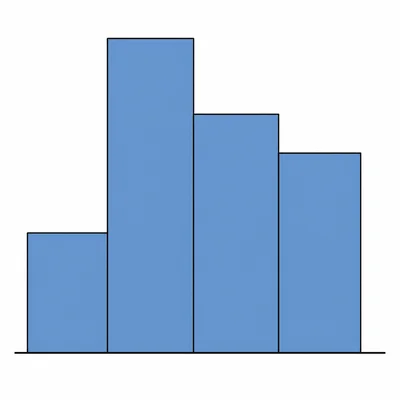
A histogram shows the following frequencies for minutes spent reading: 0-9 minutes: 3 students, 10-19 minutes: 7 students, 20-29 minutes: 5 students, 30-39 minutes: 4 students. Which interval has the greatest frequency?
- 4
The heights of plants in centimeters are: 12, 15, 18, 21, 24, 26, 29, 31, 34, 36, 39, 40. Create a grouped frequency table using intervals 10-19, 20-29, 30-39, and 40-49.
- 5
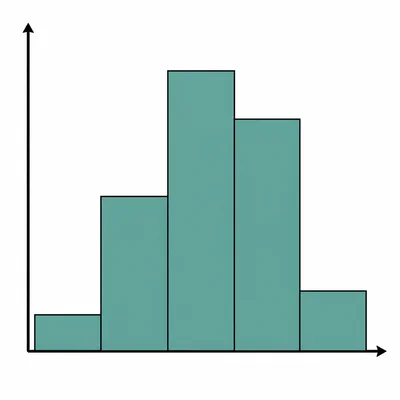
A histogram has bars for test score ranges. The frequencies are 50-59: 1, 60-69: 4, 70-79: 8, 80-89: 6, and 90-99: 3. How many scores are shown in the histogram?
- 6
The number of pets owned by students in a class is shown in this frequency table: 0 pets: 4 students, 1 pet: 9 students, 2 pets: 6 students, 3 pets: 3 students, 4 pets: 1 student. How many students own at least 2 pets?
- 7
A data set has these values: 5, 6, 6, 7, 8, 8, 8, 9, 10, 10. Explain why a frequency table can be more useful than a list for this data.
- 8
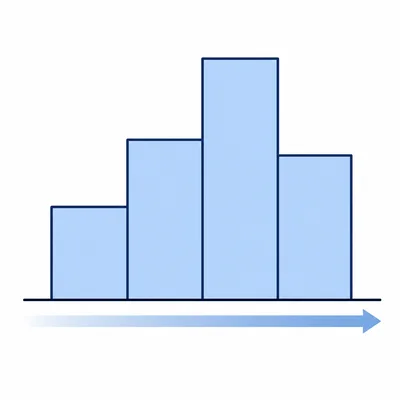
A histogram groups ages into intervals of 10 years: 0-9, 10-19, 20-29, and 30-39. Explain why the bars in a histogram should touch.
- 9
The number of minutes 15 students practiced an instrument is: 12, 18, 20, 22, 25, 27, 29, 31, 33, 35, 38, 40, 42, 44, 49. Make a grouped frequency table using intervals 10-19, 20-29, 30-39, and 40-49.
- 10
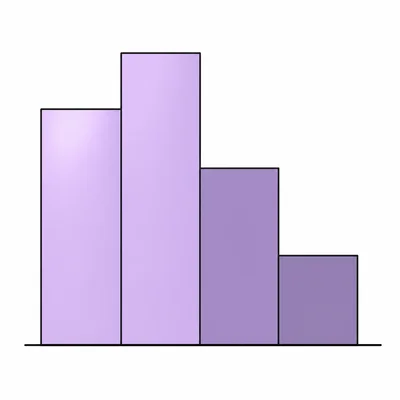
A histogram shows the number of text messages sent in one day. The interval 0-19 has frequency 6, 20-39 has frequency 9, 40-59 has frequency 5, and 60-79 has frequency 2. How many people sent fewer than 40 messages?
- 11
A frequency table for shoe sizes shows: size 6: 2 students, size 7: 4 students, size 8: 7 students, size 9: 5 students, size 10: 2 students. Identify the mode and explain what it means.
- 12
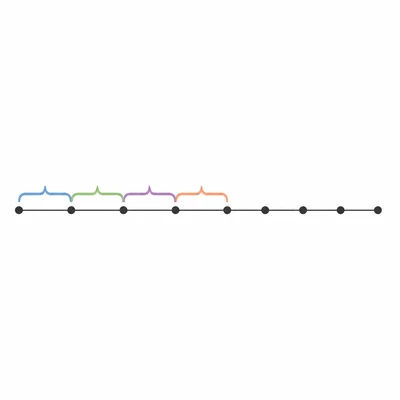
A student makes a histogram for the data values 1, 2, 3, 4, 5, 6, 7, 8 using intervals 1-2, 2-3, 3-4, and 4-5. Explain one problem with these intervals.