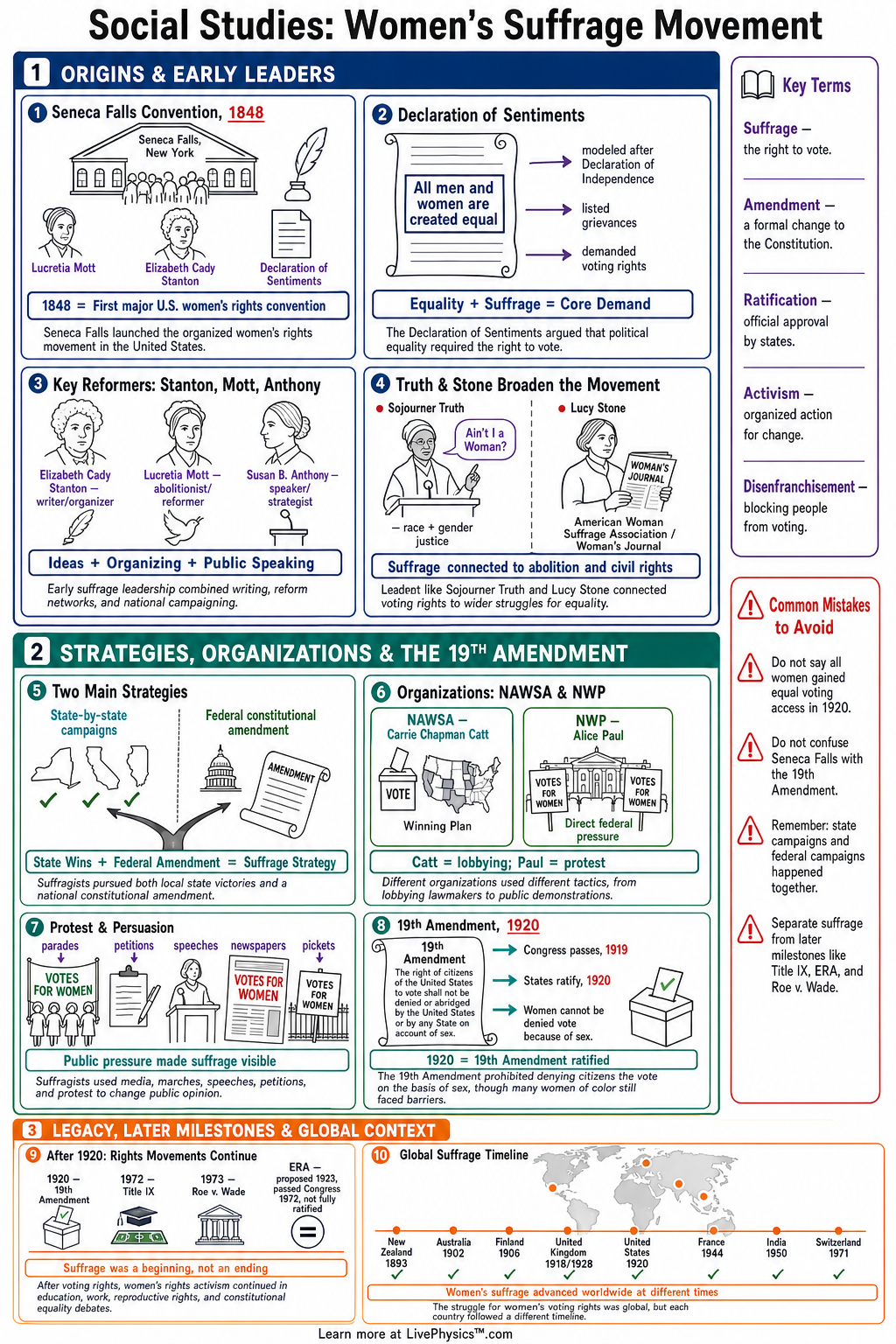
The women’s suffrage movement was the long campaign to win voting rights for women in the United States. Students need this cheat sheet to connect major events, leaders, strategies, and laws in a clear timeline. It also helps explain how activism, public opinion, and constitutional change worked together.
The movement is important because it expanded democracy and inspired later civil rights campaigns.
Core concepts include suffrage, equal citizenship, reform movements, and constitutional amendments. Key events include the Seneca Falls Convention in 1848, the formation of national suffrage groups, state-level voting victories, and the ratification of the 19th Amendment in 1920. Important leaders included Elizabeth Cady Stanton, Susan B.
Anthony, Sojourner Truth, Ida B. Wells, Alice Paul, and Carrie Chapman Catt. Students should also remember that the 19th Amendment did not fully protect all women from discrimination at the polls.
Key Facts
- Suffrage means the right to vote in political elections.
- The Seneca Falls Convention was held in 1848 and produced the Declaration of Sentiments, which demanded equal rights and women’s suffrage.
- The 15th Amendment, ratified in 1870, protected voting rights regardless of race, color, or previous condition of servitude but did not include women.
- The National American Woman Suffrage Association used state campaigns, speeches, petitions, and lobbying to win support for women’s voting rights.
- The National Woman’s Party used marches, picketing, hunger strikes, and civil disobedience to pressure the federal government.
- The 19th Amendment was ratified in 1920 and says voting rights cannot be denied or abridged on account of sex.
- Wyoming granted women the right to vote in 1869, decades before the 19th Amendment became national law.
- Many Black, Indigenous, Asian American, and Latina women still faced poll taxes, literacy tests, intimidation, citizenship barriers, and discrimination after 1920.
Vocabulary
- Suffrage
- Suffrage is the legal right to vote in elections.
- 19th Amendment
- The 19th Amendment is the constitutional amendment that prohibited denying the vote because of sex.
- Seneca Falls Convention
- The Seneca Falls Convention was an 1848 meeting in New York that launched a national push for women’s rights.
- Declaration of Sentiments
- The Declaration of Sentiments was a document modeled on the Declaration of Independence that listed women’s rights demands.
- Civil Disobedience
- Civil disobedience is the nonviolent refusal to obey a law or order considered unjust.
- Ratification
- Ratification is the official approval process needed to make an amendment part of the Constitution.
Common Mistakes to Avoid
- Saying all women gained full voting access in 1920 is wrong because many women of color still faced legal and illegal barriers at the polls.
- Confusing the 19th Amendment with the 15th Amendment is wrong because the 15th addressed race-based voting discrimination, while the 19th addressed sex-based voting discrimination.
- Assuming the movement had only one strategy is wrong because suffragists used petitions, speeches, lawsuits, marches, lobbying, state campaigns, and civil disobedience.
- Leaving out women of color is wrong because leaders such as Sojourner Truth, Ida B. Wells, Mary Church Terrell, and Mabel Ping-Hua Lee made important contributions despite discrimination.
- Treating suffrage as a short campaign is wrong because the national movement lasted from the mid-1800s until the 19th Amendment in 1920 and voting rights struggles continued afterward.
Practice Questions
- 1 How many years passed between the Seneca Falls Convention in 1848 and the ratification of the 19th Amendment in 1920?
- 2 Wyoming granted women voting rights in 1869. How many years before the 19th Amendment was ratified did this happen?
- 3 List two tactics used by suffrage organizations and explain how each tactic was meant to create political change.
- 4 Why did the 19th Amendment represent a major expansion of democracy even though it did not guarantee equal voting access for all women?
Understanding Women's Suffrage Movement
The movement developed within a society where married women often had limited control over property, wages, and legal decisions. These rules were sometimes called coverture. Under coverture, a husband could have broad legal authority over family property and income.
Reformers argued that voting mattered because laws affected women’s work, education, custody of children, and safety. Many early activists had worked against slavery or for temperance. Those experiences taught them how to organize meetings, print newspapers, gather signatures, and speak in public despite criticism.
The movement was never made up of one identical group with one set of priorities. Class, race, region, religion, and immigration status shaped what different women faced.
Strategy caused serious disagreements. Some organizers believed patient work in individual states would build lasting support. A state victory could show that women voted responsibly and could give local activists useful experience.
Other organizers thought state campaigns moved too slowly because each state had its own rules and political leaders. They focused pressure on Congress and the president instead. Public demonstrations made the issue hard to ignore, but they could bring arrest, violence, or hostile newspaper coverage.
Hunger strikes in jail exposed harsh treatment by officials. Both approaches depended on ordinary people who raised money, distributed leaflets, wrote letters, attended meetings, and persuaded neighbors. Major changes usually come from this less visible work as much as from famous speeches.
A constitutional amendment is difficult to win because it needs support beyond one election or one political party. Congress must approve it by a two thirds vote in both houses. Then three fourths of the states must approve it.
This process forced suffrage supporters to build coalitions across many regions. Opponents used arguments about family roles, political corruption, and state authority. Some feared that women voters would support reforms they disliked.
Studying opposition is useful because it shows that rights are often resisted even when the arguments now seem unfair. It also explains why campaigners had to change tactics as political conditions changed.
A legal promise does not automatically produce equal access. After women gained a national voting right, many state and local officials still used rules designed to block Black voters. Indigenous women could be excluded when federal citizenship laws did not recognize them.
Some Asian American women faced citizenship restrictions tied to racist immigration laws. Latina women could face language barriers, discrimination, or intimidation. Later federal action, especially the Voting Rights Act of 1965, gave stronger tools to challenge racial discrimination in elections.
Students should separate the wording of a law from its enforcement in real life. When reading a source, notice whose experiences it includes, who is missing, and whether it describes a right on paper or the ability to use that right safely. These habits help students understand current issues such as voter registration, identification rules, polling place access, and representation.