Sign in to save

Bookmark this page so you can find it later.

Sign in to save

Bookmark this page so you can find it later.

Chemistry middle-school May 21, 2026

Why Is pH Important?

A simple scale for acids, bases, and living systems
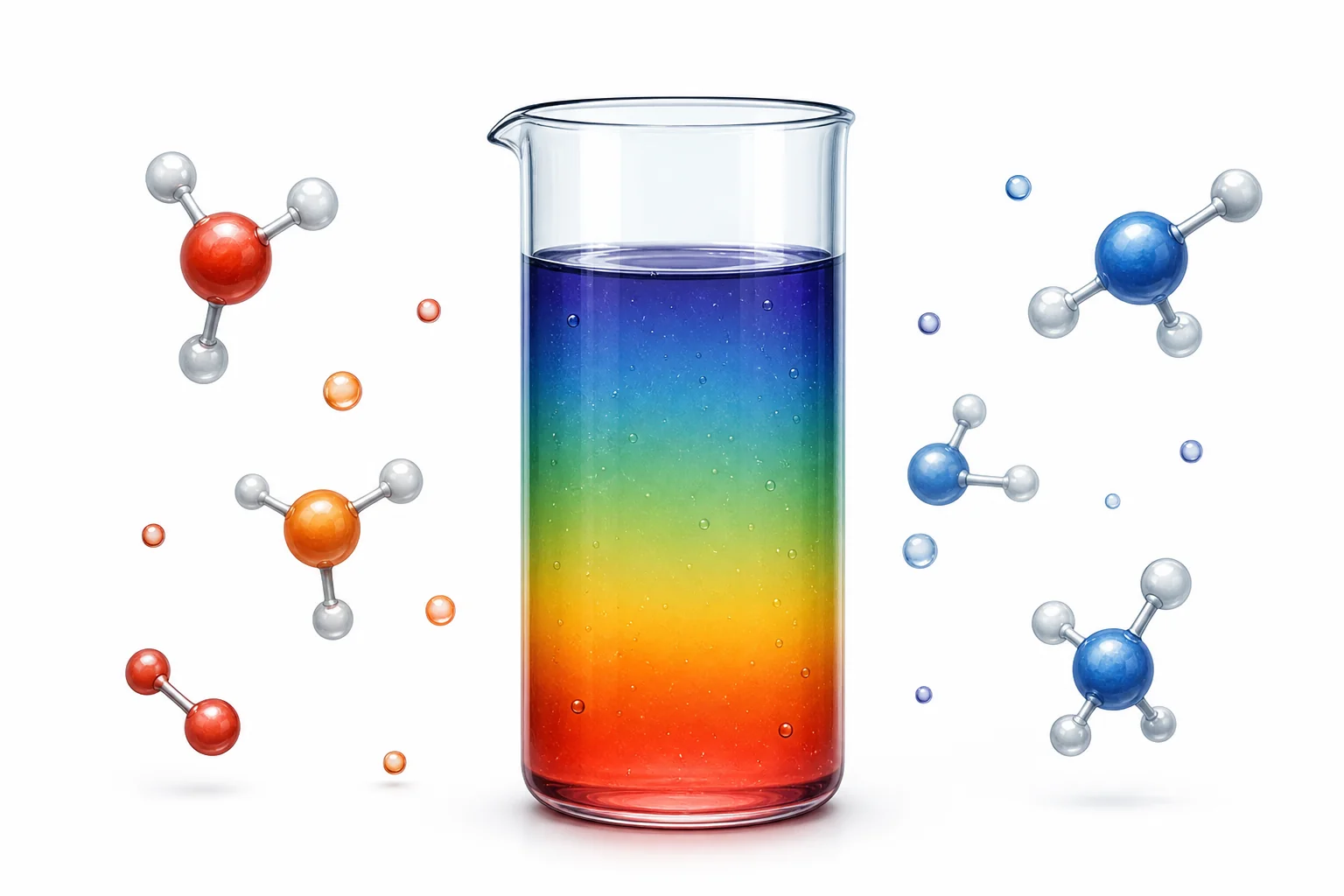
A pH scale with beakers showing acidic, neutral, and basic solutions and a student using indicator paper.

pH tells how acidic or basic a water-based mixture is. It matters because pH changes how substances react, dissolve, and affect living cells. Many systems work only within a small pH range, including blood, soil, and lakes.

Big Idea. NGSS MS-PS1-2 connects pH to how substances can be identified by their properties and how they interact in chemical processes.

pH is a small number with a big job. It helps chemists describe how acidic or basic a solution is. Lemon juice, soap, rainwater, pool water, and blood all have pH values. These values are not just labels. They help predict what a solution can do. A low pH solution can taste sour, react with metals, or irritate skin. A high pH solution can feel slippery and break down grease. A pH near 7 is called neutral, like pure water at room temperature. The scale is linked to hydrogen ions in water. More hydrogen ions usually means lower pH. Fewer hydrogen ions usually means higher pH. Because the pH scale is based on powers of 10, a change of 1 pH unit is a big chemical change. That makes pH useful in labs, kitchens, gardens, hospitals, and ecosystems.

What pH measures
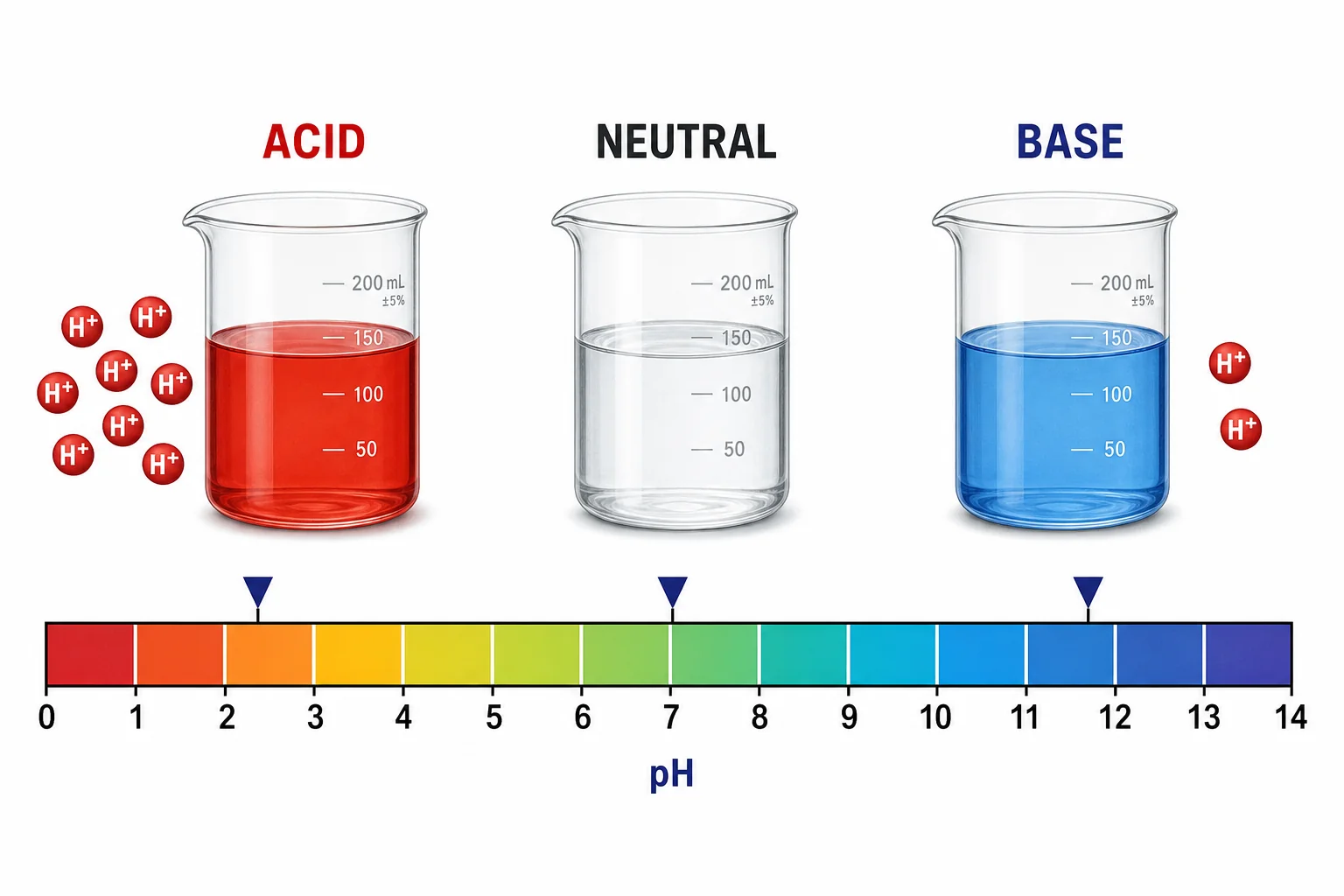
A pH scale from 0 to 14 with acidic solutions on the low end, neutral water at 7, and basic solutions on the high end.
The pH scale compares hydrogen ion levels
pH describes how many hydrogen ions are in a water-based solution. Chemists write hydrogen ions as $\text{H}^+$. A solution with many $\text{H}^+$ ions has a low pH and is acidic. A solution with fewer $\text{H}^+$ ions has a high pH and is basic. Pure water sits near pH 7 at room temperature because it has a balance of acidic and basic particles. The pH scale usually runs from 0 to 14 in school science, but some strong solutions can be outside that range. The number is not a simple count. It is a compressed scale. A solution at pH 3 has 10 times more hydrogen ions than a solution at pH 4. That is why a small pH change can matter a lot.

Lower pH means more hydrogen ions in the solution.

Acids and bases behave differently
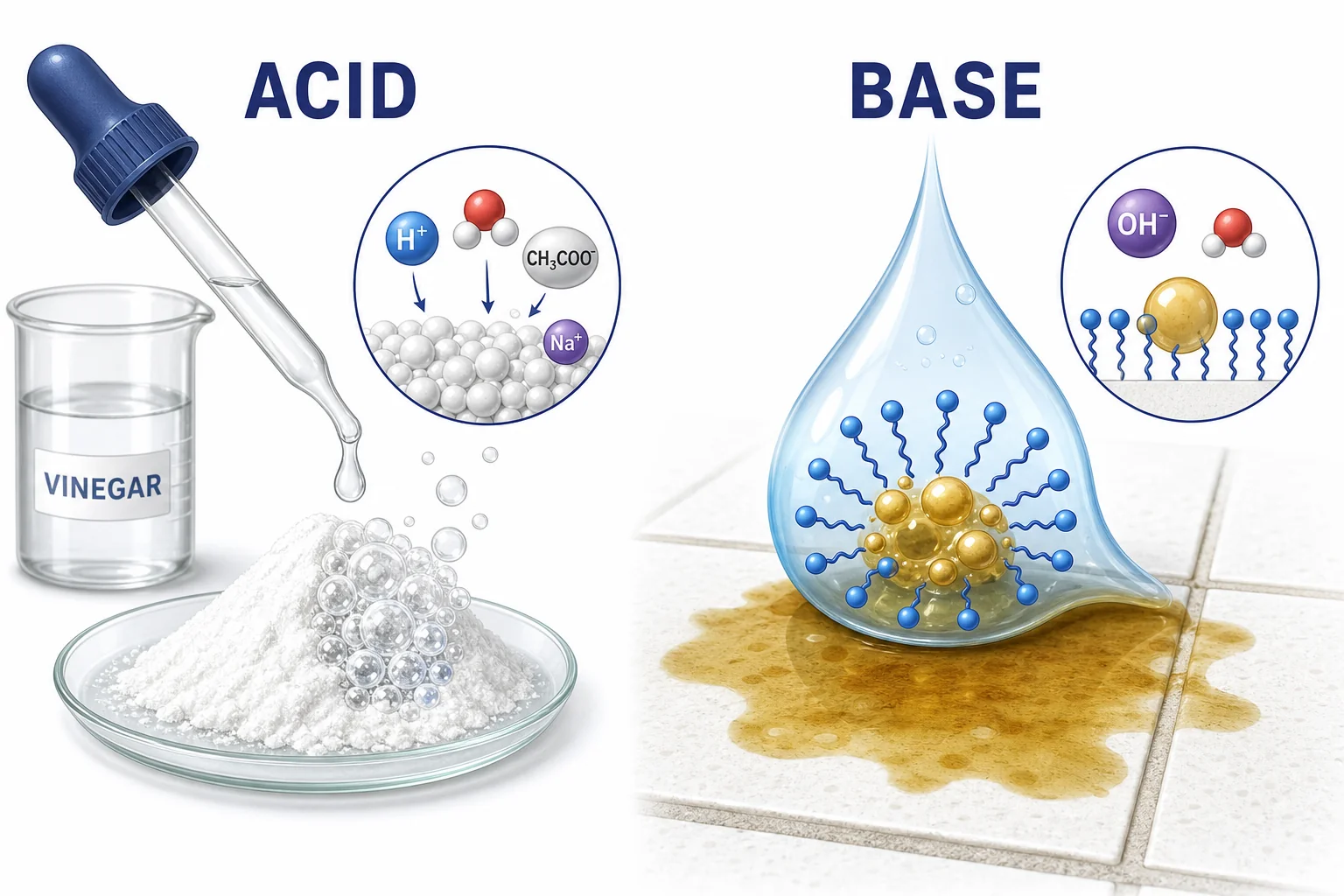
Two simple reactions showing vinegar bubbling with baking soda and a basic cleaner lifting oil from a surface.
pH helps predict chemical behavior
Acids and bases can look alike, so pH helps make invisible differences measurable. Acidic solutions often react with metals and carbonates. Vinegar reacts with baking soda because an acid and a base interact and form new substances, including carbon dioxide gas. Basic solutions often help dissolve oils and fats, which is why many cleaners are basic. These patterns come from how particles in the solution move and react. pH does not tell everything about a substance. A weak acid and a strong acid can have the same pH if they are mixed at different amounts. Safety also matters. Some acids and bases are safe in food, while others can burn skin or damage eyes. In class, pH is a starting clue that helps students connect properties to particle behavior.

pH is one property that helps identify and compare substances.

Indicators show pH changes
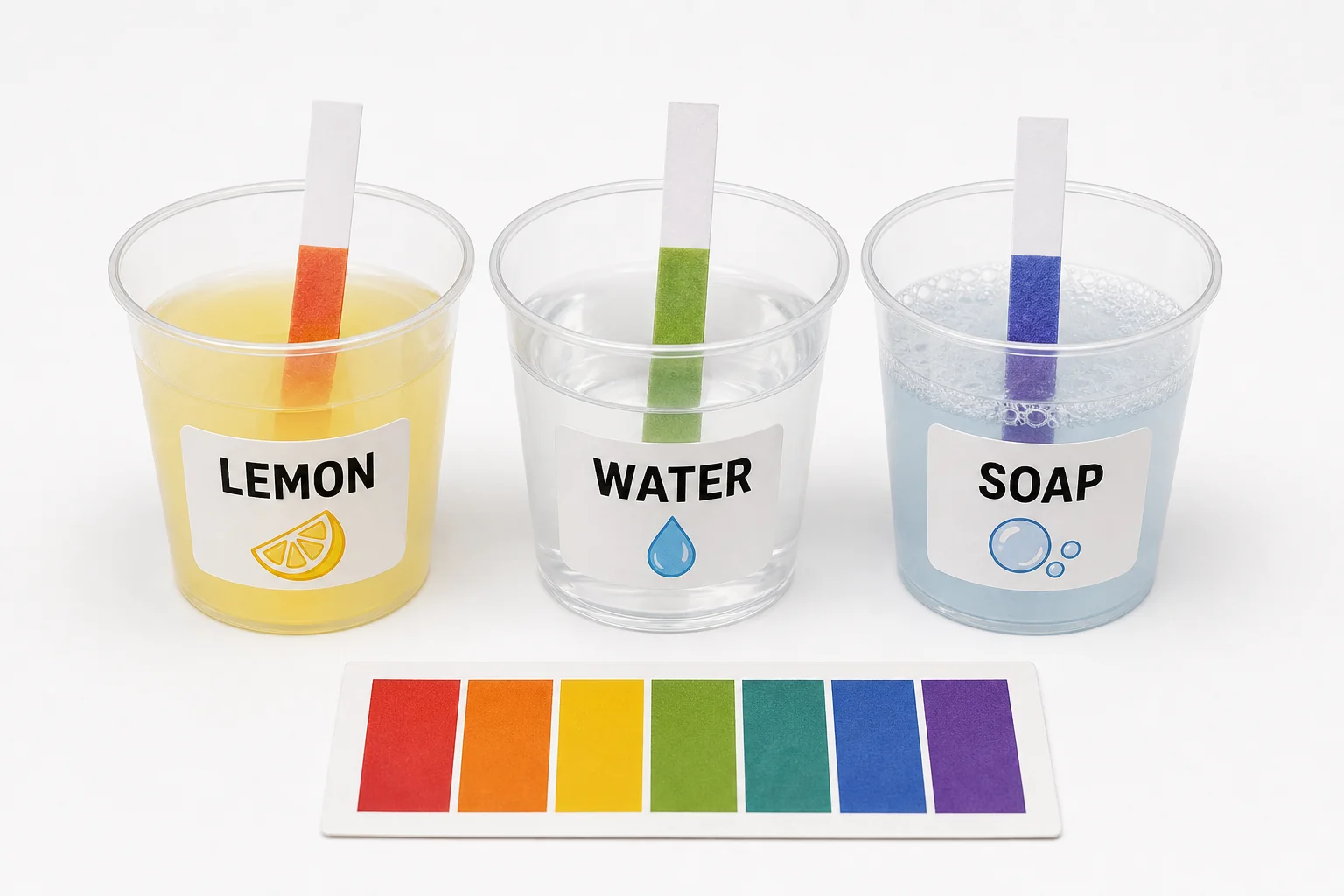
Indicator paper strips changing color after being dipped into lemon juice, water, and soapy water.
Indicators turn pH into visible color
An indicator is a chemical that changes color when pH changes. Litmus paper, universal indicator, and red cabbage juice are common examples. They work because their molecules change shape or charge in different pH conditions. That change affects which colors of light they absorb and reflect. In a middle-school lab, students can dip indicator paper into several safe liquids and compare the color to a chart. Lemon juice might turn red or orange. Soapy water might turn blue or green. Water might stay near the neutral color. Indicators are useful because they make a hidden particle pattern visible. They do not give perfect answers every time. Color can be hard to judge, and dark liquids can hide the result. Still, indicators are a simple way to connect observations to chemical properties.

Indicators help students see evidence of acidity or basicity.

Living things need narrow ranges
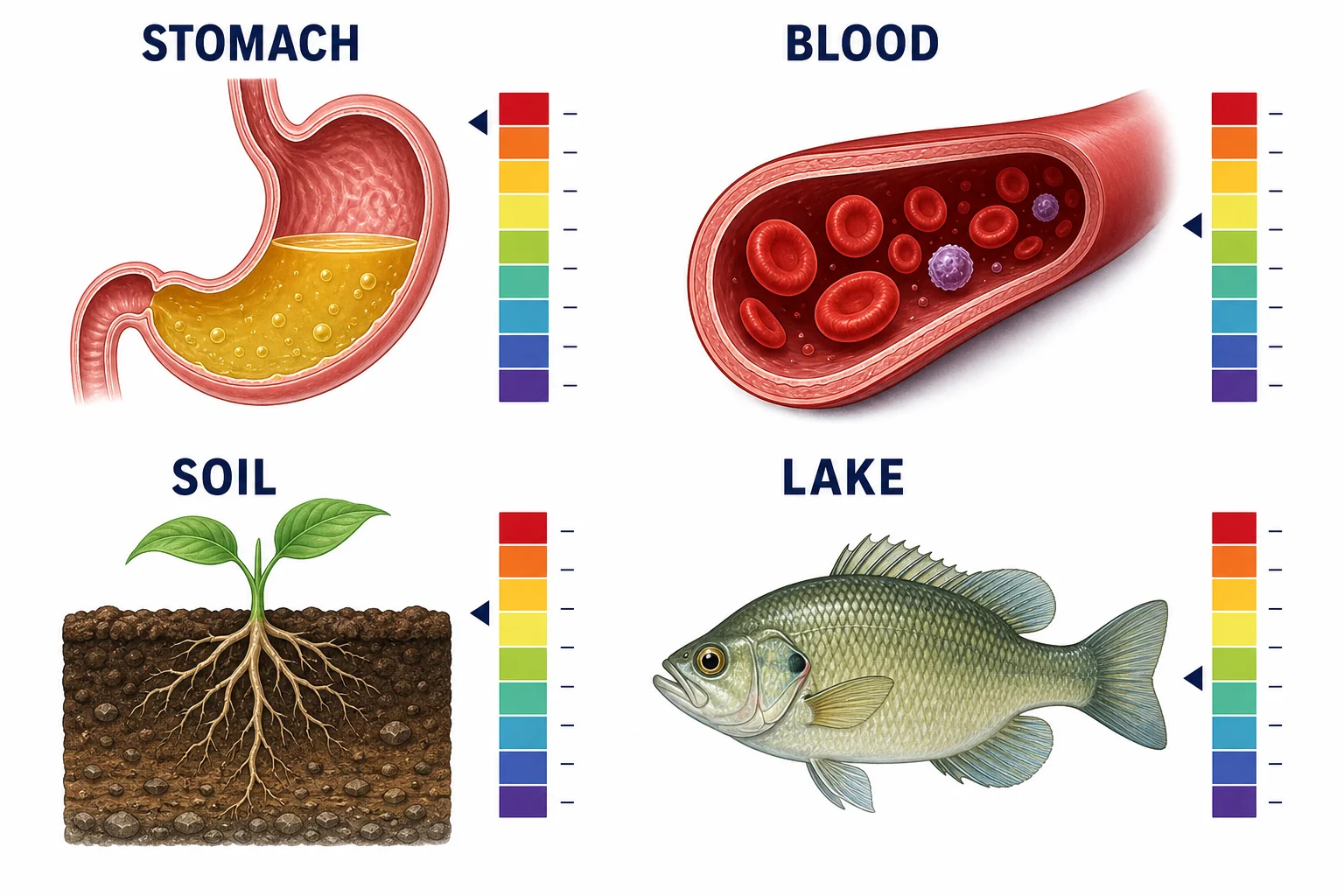
Examples of biological pH ranges including stomach acid, blood, soil near plant roots, and freshwater habitat.
Life works within pH limits
Cells depend on pH because proteins, enzymes, and membranes work best in certain conditions. Human blood stays close to pH 7.4. If it changes too much, body chemistry can fail. The stomach is very acidic, which helps break down food and kill many microbes. The small intestine is less acidic because digestive enzymes there need a different pH. Plants also depend on pH. Soil pH affects whether roots can take in nutrients. A lake or stream can be harmed if the pH shifts too far from the range that fish, insects, and algae can tolerate. This is why scientists measure pH in medicine, farming, and environmental testing. A pH number gives a quick warning when a living system is under chemical stress.

Small pH changes can strongly affect living systems.

pH connects to powers of 10
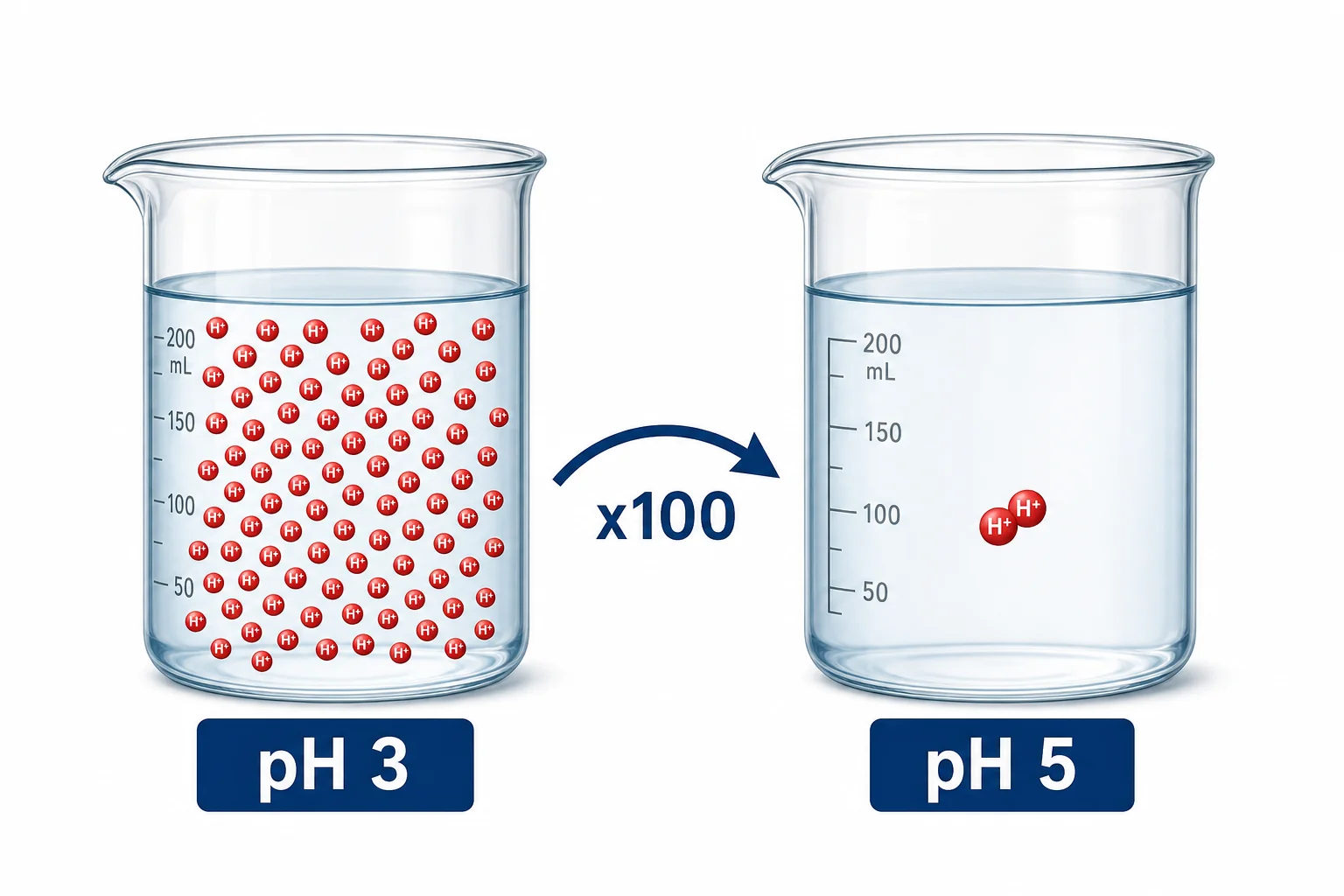
A comparison showing that pH 3 has 100 times more hydrogen ions than pH 5 using particle groups.
Each pH step means a tenfold change
The pH scale is logarithmic, which means each step changes by a factor of 10. The idea can be written as $\text{pH} = -\log[\text{H}^+]$. Middle-school students do not need to calculate with logarithms to use pH. The key idea is that the scale compresses very large differences in hydrogen ion concentration. A drink at pH 3 has 100 times more hydrogen ions than a drink at pH 5. That is because it is two pH steps lower, and each step is 10 times. This helps explain why pH is powerful. A chart from 0 to 14 can compare solutions whose hydrogen ion levels are very different. pH is a math tool and a chemistry tool at the same time.

One pH unit is a tenfold change in hydrogen ion concentration.

Vocabulary

pH
A number that describes how acidic or basic a water-based solution is.
Acid
A substance that increases hydrogen ions in water and usually has a pH below 7.
Base
A substance that lowers hydrogen ion concentration in water and usually has a pH above 7.
Hydrogen ion
A tiny charged particle written as H+ that is used to define acidity in water.
Indicator
A chemical that changes color when the pH of a solution changes.
Neutral
A solution that is not acidic or basic, with a pH near 7 at room temperature.

In the Classroom

Test safe household liquids

30 minutes | Grades 6-8

Students use indicator paper to test water, lemon juice, vinegar, baking soda solution, and soapy water. They record color, estimate pH, and sort each sample as acidic, neutral, or basic.

Make a cabbage indicator

40 minutes | Grades 6-8

Students prepare red cabbage indicator and add it to small cups of safe solutions. They compare color changes and explain how an indicator provides evidence of pH.

Model the pH scale with groups of 10

20 minutes | Grades 7-8

Students use beads or counters to model how each pH step represents a tenfold change in hydrogen ion concentration. They compare pH 3, pH 4, and pH 5 without using logarithms.

Key Takeaways

  • pH measures how acidic or basic a water-based solution is.
  • Lower pH means more hydrogen ions, and higher pH means fewer hydrogen ions.
  • The pH scale changes by powers of 10, so one pH step is a large change.
  • Indicators change color and make pH easier to observe.
  • Living systems, soils, and waterways often need pH to stay within a narrow range.