Acids and Bases for Kids
Drag the pH slider to explore the full acid-base scale from battery acid to drain cleaner. Watch the indicator strip change color, see household examples at each pH, and discover what happens when you mix an acid with a base.
Indicator Strip
Full spectrum color
Ion Concentrations
H⁺ (mol/L)
1.00 × 10⁻⁷
OH⁻ (mol/L)
1.00 × 10⁻⁷
Nearby Examples(pH 5.5 to 8.5)
Perfectly neutral, neither acid nor base
Slightly acidic waste filtered by kidneys
Slightly basic due to dissolved salts
Chemistry Reference
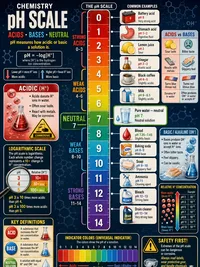
The pH Scale
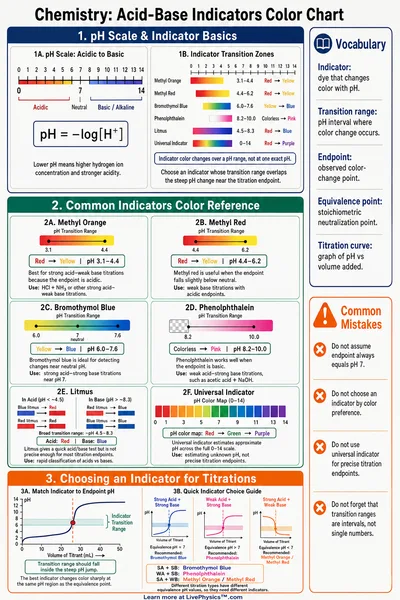
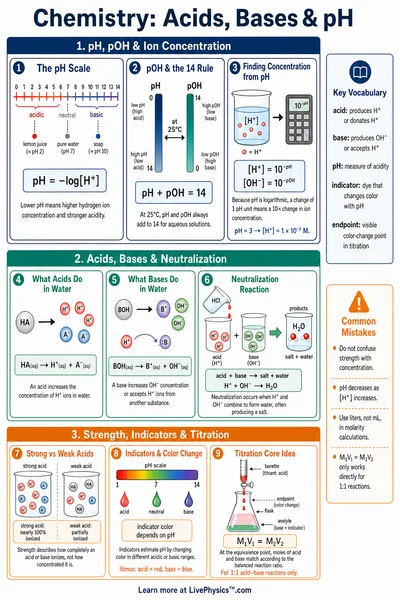
pH stands for "power of Hydrogen." It measures how many hydrogen ions (H+) are in a liquid.
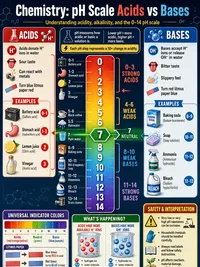
pH 0-6 Acidic. More H+ ions than OH- ions. Tastes sour.
pH 7 Neutral. Equal H+ and OH- ions. Pure water.
pH 8-14 Basic (alkaline). More OH- ions than H+ ions. Feels slippery.
Each step on the pH scale is 10 times more acidic or basic than the last.
Indicators
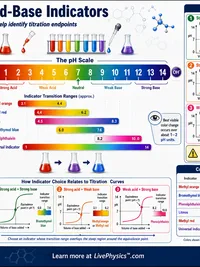
An indicator is a substance that changes color depending on pH. Scientists use them to test whether a solution is acidic or basic.
Litmus paper turns red in acids and blue in bases. It is the most common pH test.
Universal indicator shows a full rainbow of colors from red (acid) through green (neutral) to purple (base).
Red cabbage juice contains anthocyanin, a natural pigment that changes color across all 14 pH steps. You can make it at home!
Acids and Bases in Daily Life
Acids and bases are everywhere around you
- Lemon juice (pH 2) is a weak acid that makes food taste tangy.
- Baking soda (pH 8.3) is a weak base used in cooking to make cakes rise.
- Stomach acid (pH 1.5) helps your body break down food.
- Antacids (pH 11) neutralize stomach acid to relieve heartburn.
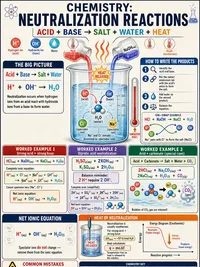
Neutralization happens when an acid and a base react to form salt and water, moving the pH closer to 7.