Titration Curve Explorer
Explore acid-base titration curves interactively. Choose a titration type, adjust concentrations and Ka values, and drag the volume slider to trace the pH curve. See buffer regions, equivalence points, Henderson-Hasselbalch equations, and indicator color bands in real time.
Titration Parameters
Titration Curve
Current Point
Key Values
pH Indicators
Reference Guide
Titration Types
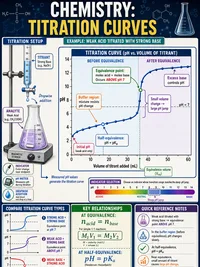
A titration measures the concentration of an unknown solution by adding a known solution (titrant) until the reaction reaches completion (the equivalence point).
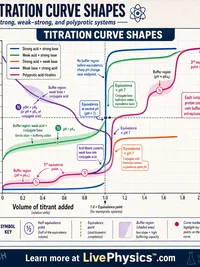
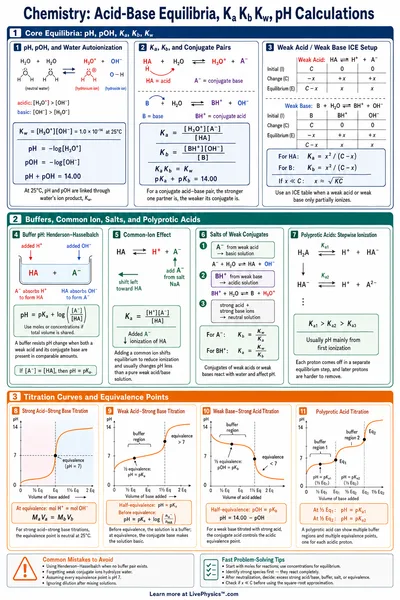
- Strong acid + strong base gives pH = 7 at equivalence
- Weak acid + strong base gives pH > 7 (conjugate base hydrolysis)
- Weak base + strong acid gives pH < 7 (conjugate acid)
- Diprotic acid shows two equivalence points and two buffer regions
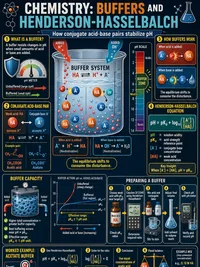
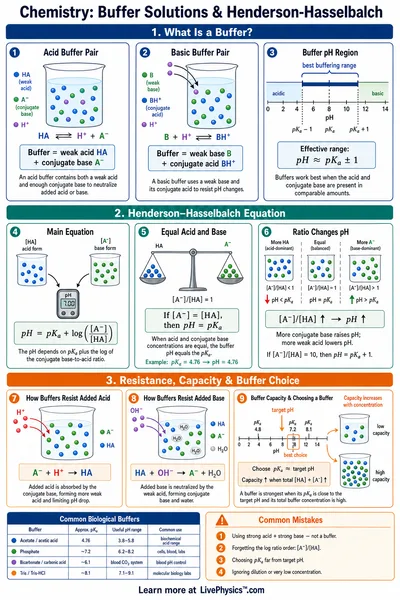
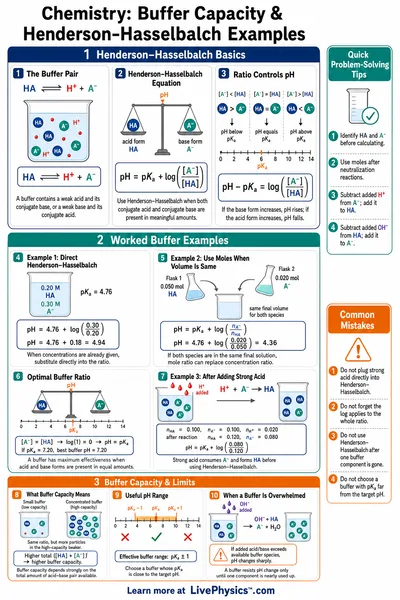
Henderson-Hasselbalch Equation
In the buffer region, the Henderson-Hasselbalch equation relates pH to the ratio of conjugate base to weak acid concentrations.
At the half-equivalence point, , so and . This is the point of maximum buffer capacity.
The Equivalence Point
At the equivalence point, moles of titrant equal moles of analyte. The volume needed is
The pH at equivalence depends on the type of titration. For a weak acid titrated with strong base, the solution contains only the conjugate base , which undergoes hydrolysis to produce , giving pH > 7.
pH Indicators
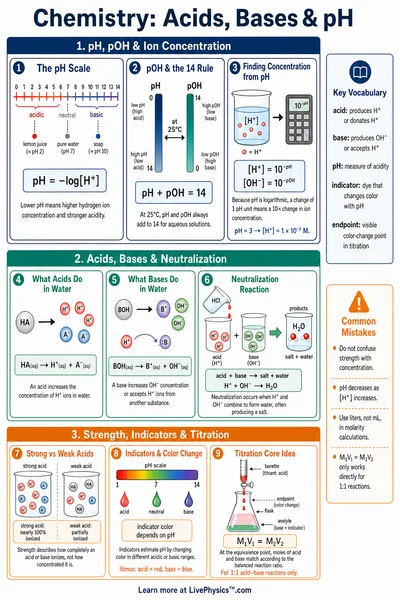
An indicator changes color over a specific pH range. Choose one whose transition range includes the equivalence pH.
| Indicator | Range | Color Change |
|---|---|---|
| Methyl orange | 3.1 - 4.4 | Red to yellow |
| Litmus | 5.0 - 8.0 | Red to blue |
| Bromothymol blue | 6.0 - 7.6 | Yellow to blue |
| Phenolphthalein | 8.2 - 10.0 | Colorless to pink |
For a strong acid-strong base titration (pH 7 at equivalence), bromothymol blue is ideal. For weak acid-strong base (pH > 7), phenolphthalein works well.