Sign in to save

Bookmark this page so you can find it later.

Sign in to save

Bookmark this page so you can find it later.

Earth Science middle-school May 21, 2026

How Do Hurricanes Form?

Warm water powers spinning storms
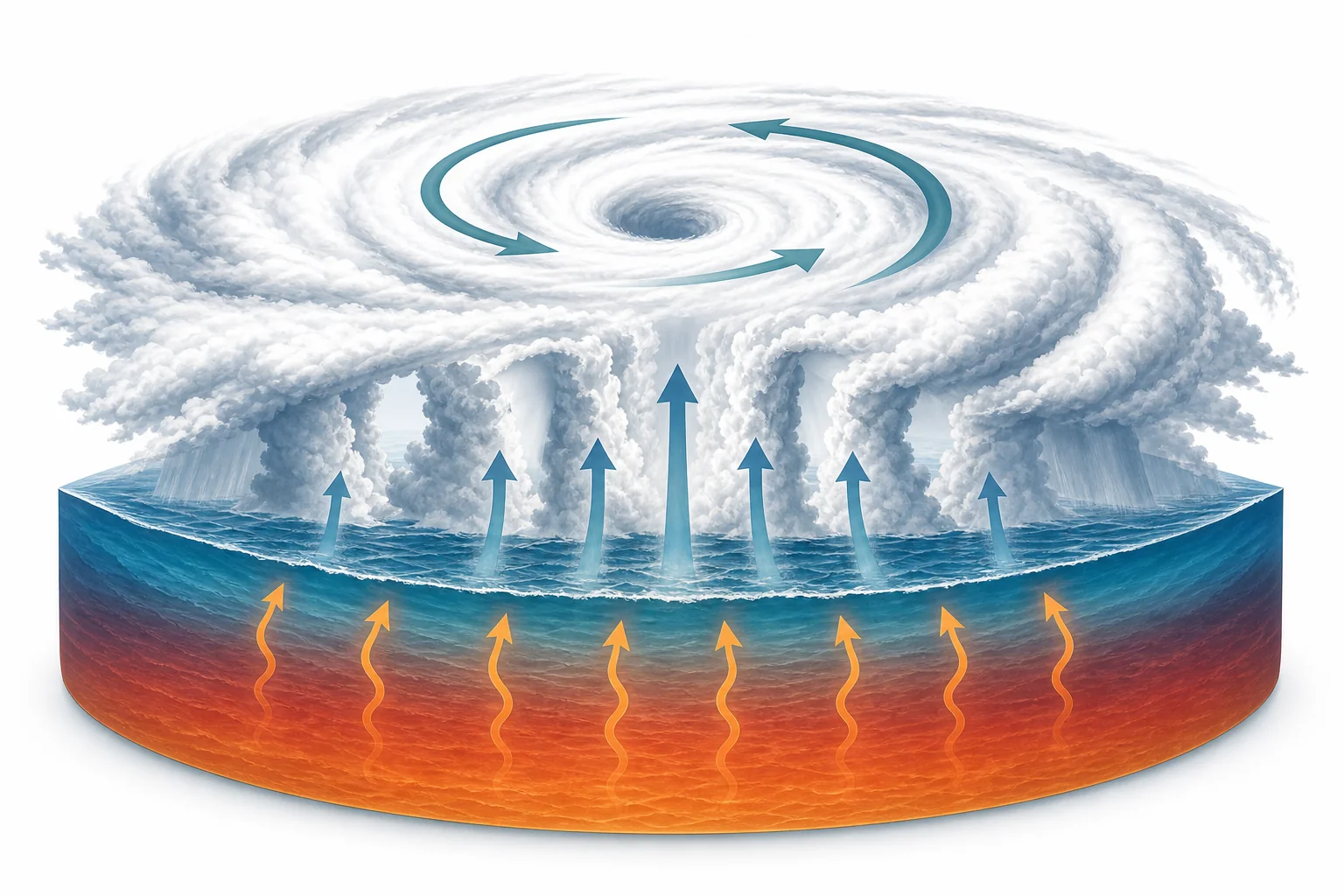
A hurricane viewed from above warm ocean water, with spiral rain bands around a clear eye

Hurricanes form over warm ocean water when moist air rises and leaves lower pressure below. Water vapor cools and turns into cloud droplets, which releases heat and helps the storm grow. Earth’s rotation makes the moving air curve, so the storm begins to spin.

Big Idea. NGSS MS-ESS2-5 connects hurricane formation to how water, air, energy, and Earth’s rotation interact in weather systems.

A hurricane is not just a big storm. It is a moving heat engine that takes energy from warm ocean water and moves that energy into the atmosphere. In the tropics, sunlight can warm the top layer of the ocean for weeks. Some of that water evaporates into the air. Warm, moist air is less dense than cooler air, so it rises. As it rises, air pressure near the ocean surface drops. More air flows inward to replace it. The rising air cools, and water vapor condenses into tiny cloud droplets. That change releases heat, which makes the air rise even more. If the storm is far enough from the equator, Earth’s rotation bends the inflowing air and the storm starts to spin. A hurricane forms when these parts work together for long enough over warm water.

Warm water starts the engine
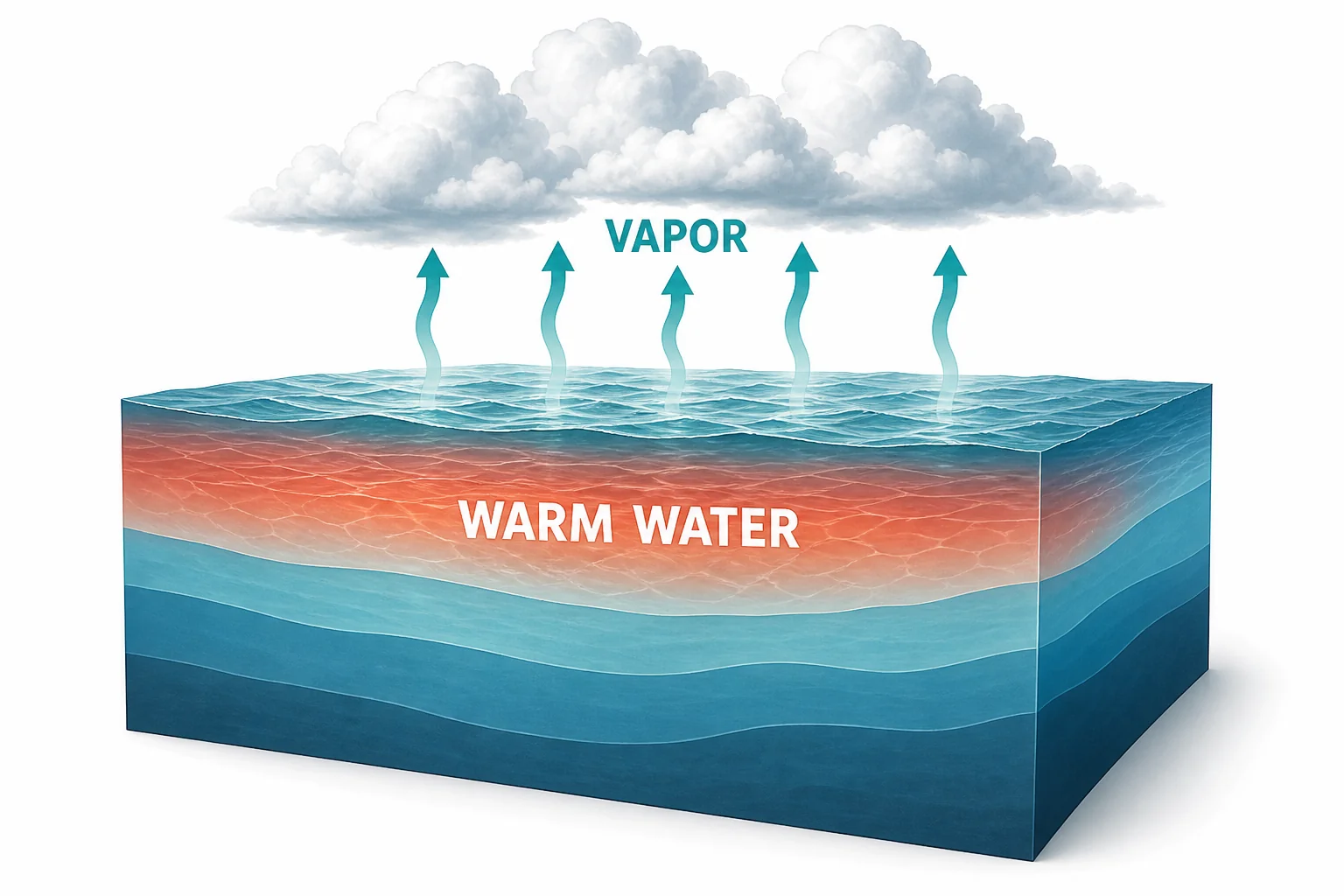
Warm ocean water evaporating into humid air that rises above the sea surface
Warm water adds water vapor to the air
Most hurricanes begin over tropical oceans where the surface water is very warm. A common guide is about 26.5°C, or 80°F, over a deep enough layer of water. Warm water matters because evaporation moves water from the ocean into the air as water vapor. This takes energy from the ocean surface. The air above the water becomes warmer and more humid. That air can rise more easily than cooler, drier air around it. A small area of disturbed weather, such as a cluster of thunderstorms, can use this moist air as fuel. Warm water alone does not guarantee a hurricane. The storm also needs light winds high in the atmosphere and enough distance from the equator. Still, without warm ocean water, a hurricane cannot keep feeding itself for long.

Warm water supplies both moisture and energy.

Rising air lowers pressure
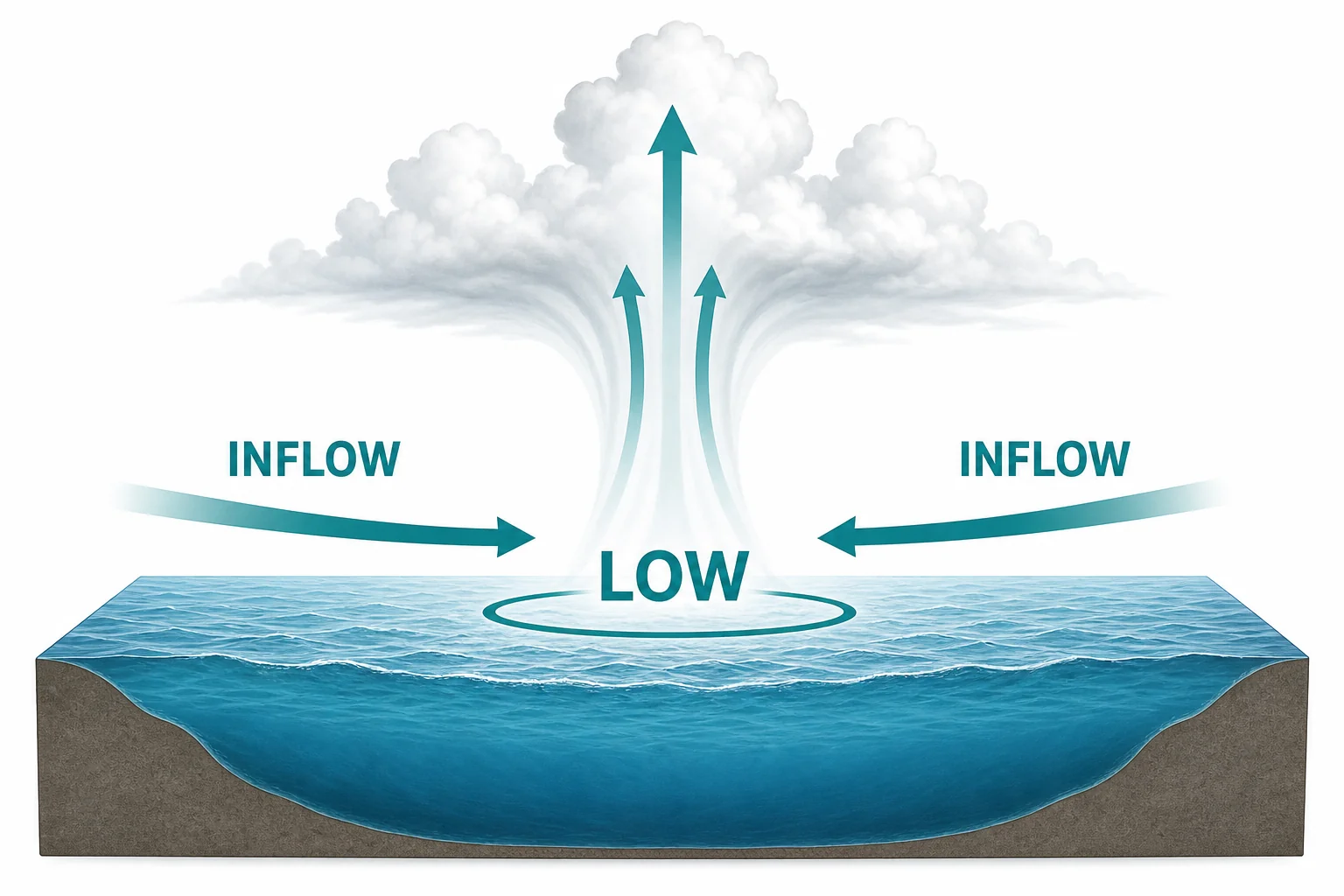
Air flowing toward a low-pressure center while warm air rises into storm clouds
Air flows toward lower pressure
When warm, moist air rises, it leaves fewer air molecules near the surface. That creates an area of lower pressure. Air moves from higher pressure toward lower pressure, so surrounding air begins to flow inward. This inflow brings in even more warm, moist air from the ocean. The rising air can build tall storm clouds. Inside those clouds, air keeps moving upward, while rain-cooled air may sink in nearby areas. A hurricane needs a large, organized low-pressure center. The lower the pressure becomes, the faster air can rush inward. Fast-moving air near the surface is what we feel as strong wind. The storm is not pulling air like a vacuum. Instead, pressure differences push air from place to place. The stronger the pressure difference, the stronger the wind can become.

Low pressure organizes the storm and pulls in more air.

Condensation releases heat
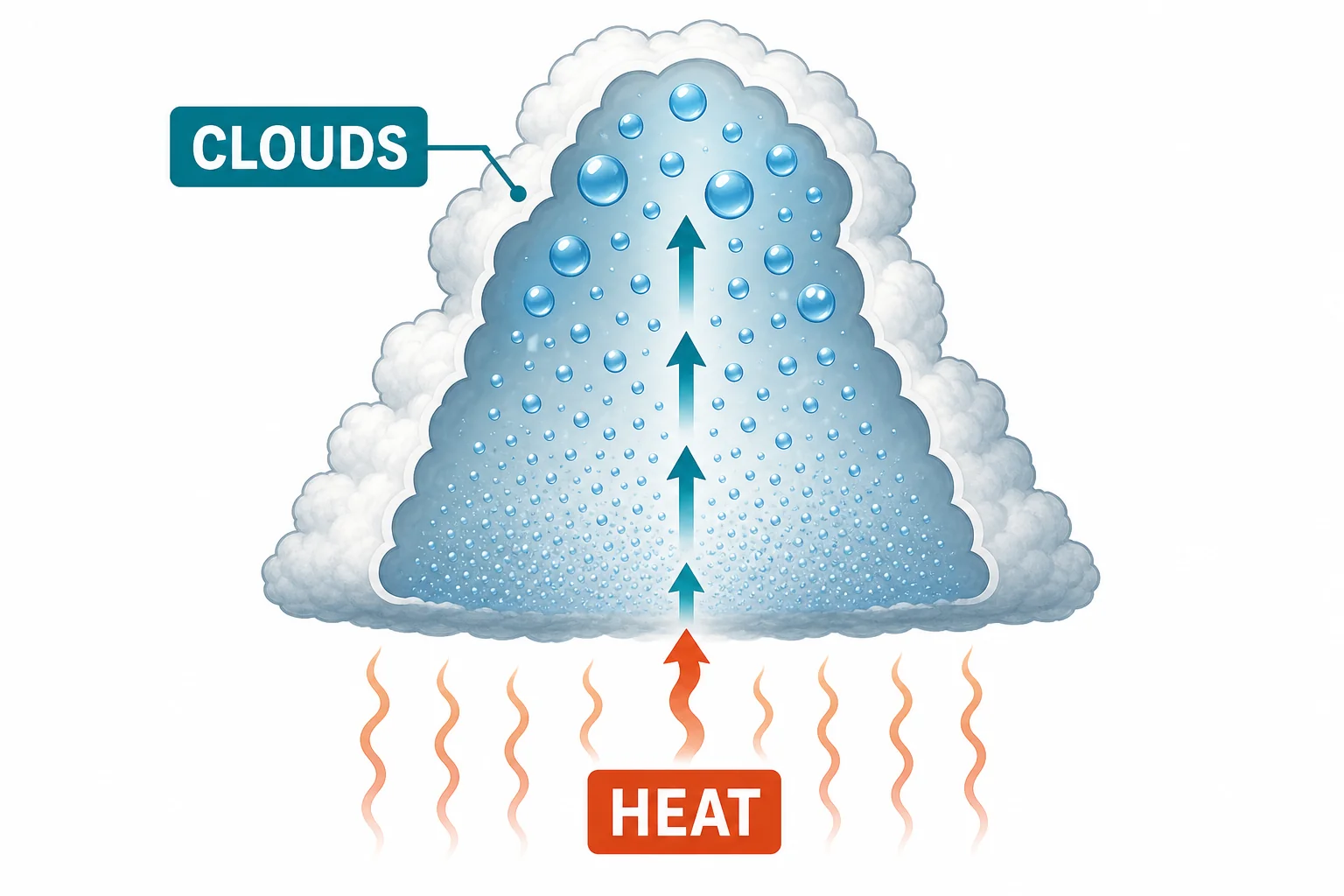
Water vapor condensing into cloud droplets inside a rising storm column and releasing heat
Condensation adds heat to the storm
As air rises higher in the atmosphere, it expands and cools. Cooler air cannot hold as much water vapor, so some vapor condenses into liquid droplets. Those droplets make clouds and rain. Condensation also releases stored energy as heat. That heat warms the surrounding air inside the storm. Warmer air rises faster, which can lower the surface pressure even more. This creates a feedback loop. Rising air leads to condensation, condensation releases heat, and released heat helps more air rise. This is why hurricanes can grow quickly when ocean water is warm and the surrounding air is moist. The energy does not come from wind at first. It comes from the ocean and from the phase change of water vapor into liquid water. Condensation is a key step that turns a group of thunderstorms into a stronger system.

Cloud formation releases heat that helps the storm intensify.

Rotation makes the storm spin
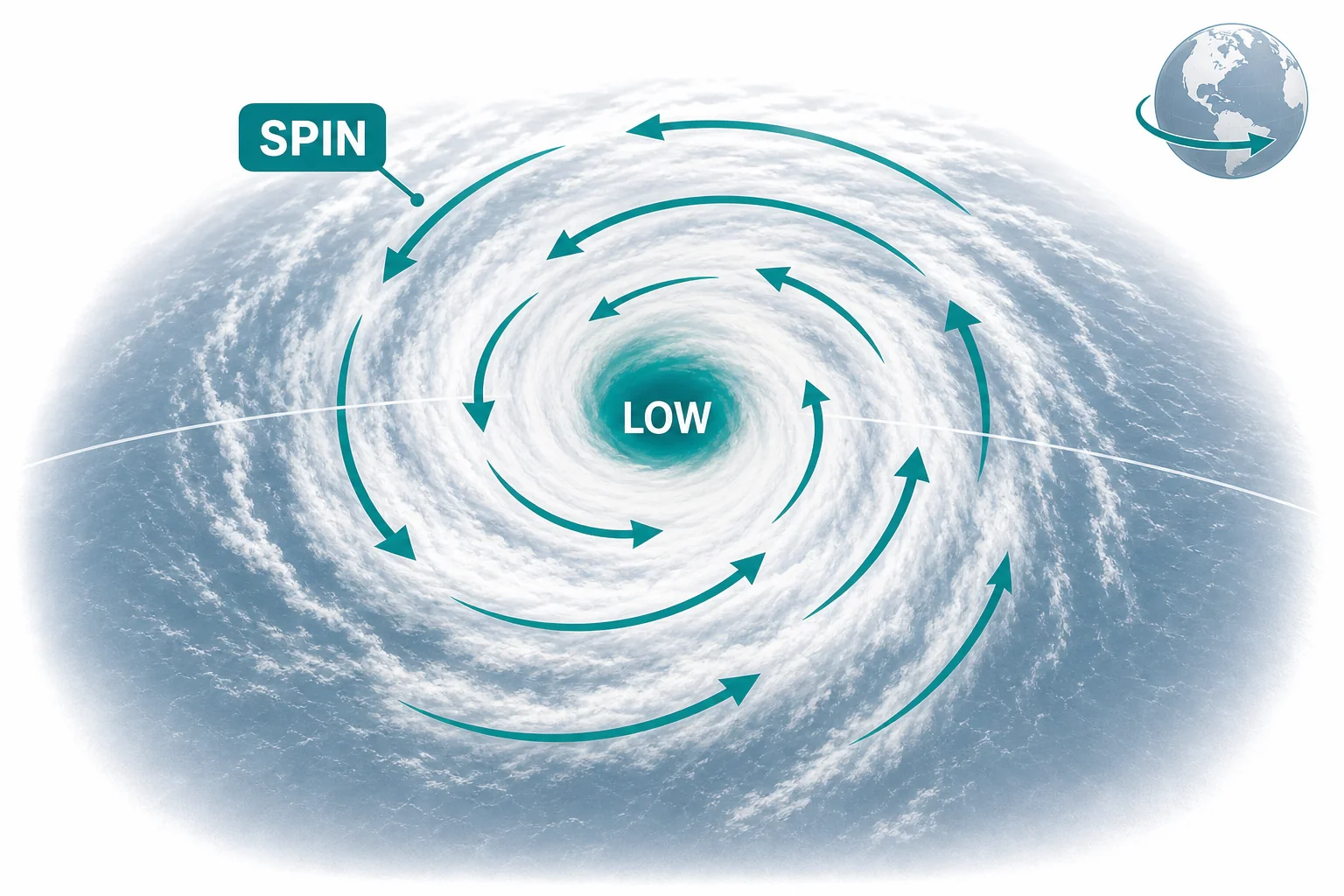
Curved airflow spiraling around a low-pressure center because of Earth’s rotation
Earth’s rotation bends moving air
Earth rotates once each day. Because of that rotation, moving air appears to curve as it travels across Earth’s surface. This effect is weak at the equator and stronger farther north or south. Hurricanes usually form at least a few degrees away from the equator because they need this turning effect. In the Northern Hemisphere, air curves to the right of its path. In the Southern Hemisphere, it curves to the left. As air flows toward low pressure, the curve makes it spiral instead of moving straight inward. The result is a rotating storm with bands of clouds and rain. Rotation does not create the storm’s energy. It helps organize the moving air into a spinning system. Without enough rotation, thunderstorms may grow, but they usually do not become hurricanes.

Rotation turns inward-flowing air into a spiral.

A hurricane needs balance
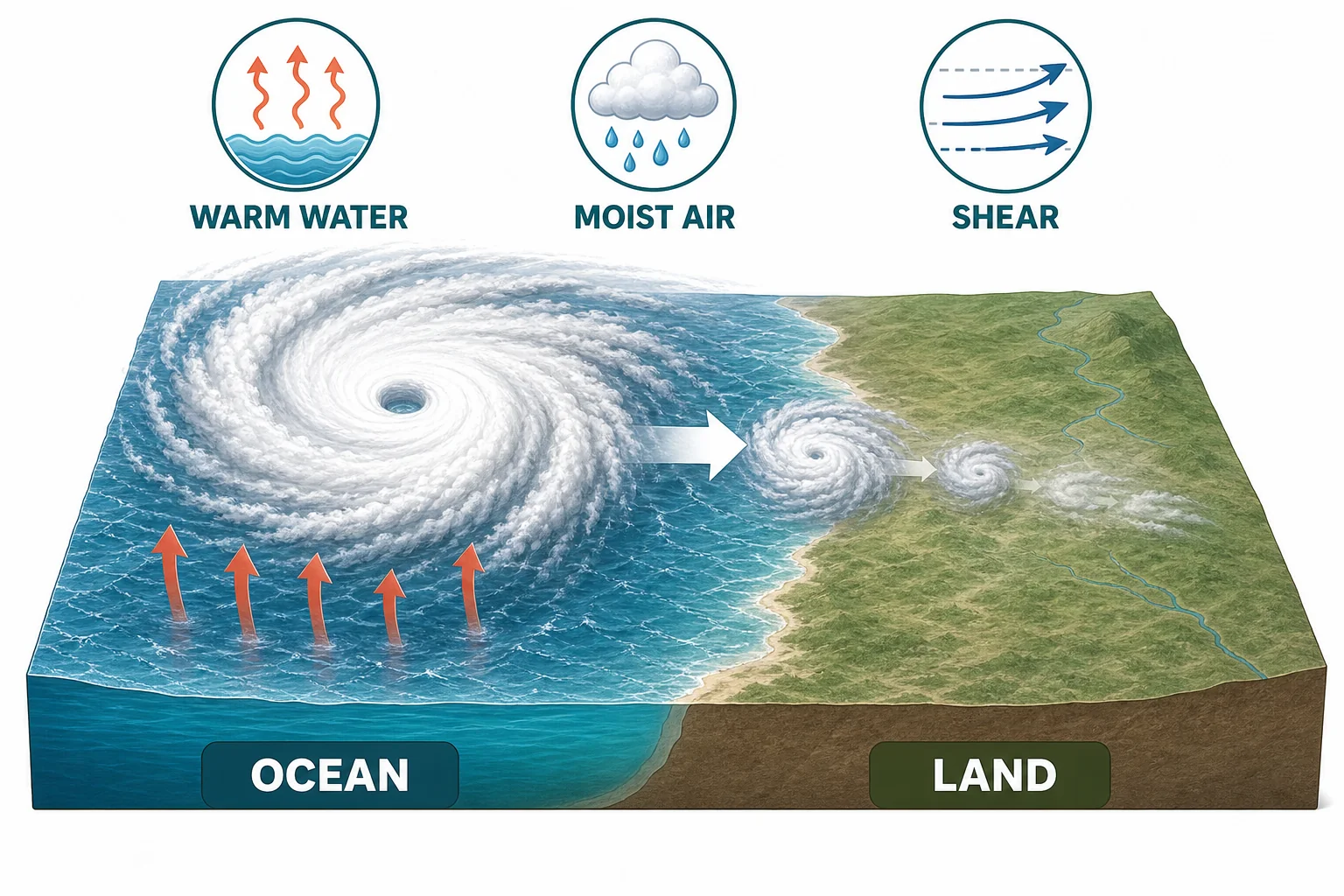
A hurricane weakening as it moves from warm ocean water toward land and cooler conditions
Storm strength depends on conditions
A hurricane can only keep growing when several conditions stay in place. The ocean must remain warm enough to replace energy lost to wind and rain. The air must stay moist so rising air can keep forming clouds. Winds high above the storm must not be too strong or change direction too much. Strong wind shear can tilt the storm and separate the rising air from the low-pressure center. That weakens the feedback loop. Hurricanes often weaken when they move over land because they lose their warm-water fuel. They also weaken over cooler water or when dry air enters the storm. This is why forecasters watch ocean temperature, moisture, pressure, and upper-level winds. A hurricane is powerful, but it depends on a narrow set of Earth system conditions.

Remove warm water or disrupt the airflow, and the storm weakens.

Vocabulary

Hurricane
A large rotating tropical storm with very strong winds and organized thunderstorms.
Evaporation
The process in which liquid water changes into water vapor and enters the air.
Condensation
The process in which water vapor cools and changes into liquid droplets.
Low pressure
An area where air pressure is lower than nearby areas, causing air to move inward.
Wind shear
A change in wind speed or direction with height that can disrupt a growing storm.

In the Classroom

Model a low-pressure center

20 minutes | Grades 6-8

Students draw arrows from high pressure toward low pressure on a simple weather map. Then they add curved arrows to show how rotation changes the path of the air.

Condensation and heat demo

25 minutes | Grades 6-8

Use a sealed clear container with warm water and a cool lid to observe droplets forming. Students connect the droplets to condensation inside storm clouds and explain why phase changes matter.

Hurricane condition sort

15 minutes | Grades 6-8

Give students cards with conditions such as warm water, dry air, strong wind shear, and moist air. Students sort each card into helps formation or weakens formation, then defend one choice with evidence.

Key Takeaways

  • Hurricanes need warm ocean water to supply energy and moisture.
  • Rising warm air creates lower pressure near the ocean surface.
  • Condensation releases heat, which helps more air rise.
  • Earth’s rotation makes inflowing air curve into a spiral.
  • Hurricanes weaken when they lose warm water or face strong wind shear.