Sign in to save

Bookmark this page so you can find it later.

Sign in to save

Bookmark this page so you can find it later.

Physics high-school May 24, 2026

How Do Solar Panels Turn Sunlight Into Electricity?

Light energy becomes moving charge
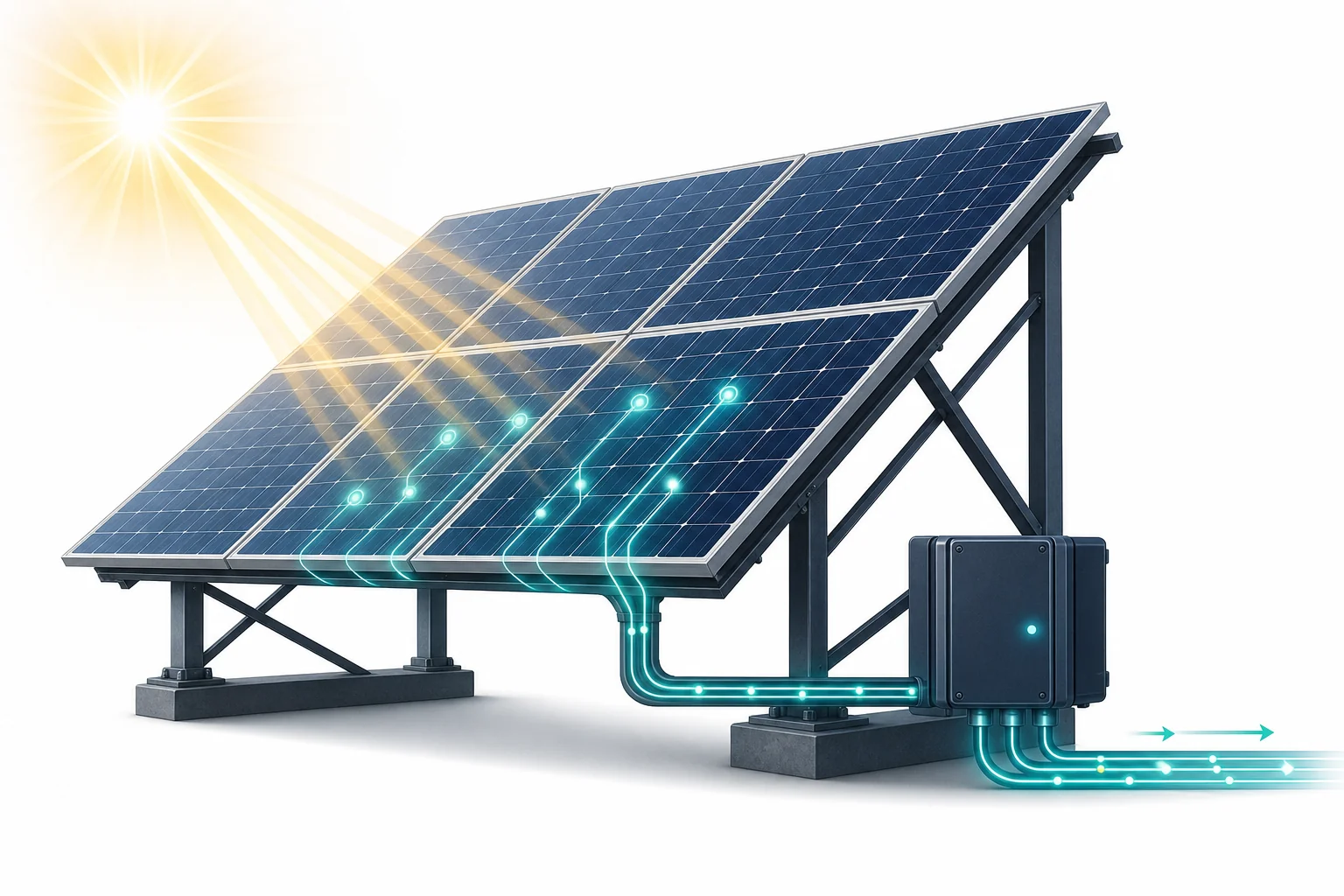
Cutaway educational diagram of sunlight striking a solar panel and producing electric current through semiconductor layers

A solar panel uses special materials that release electric charges when sunlight hits them. Built-in layers push those charges in one direction, so they can flow through wires. That moving charge is electricity that can power devices or charge a battery.

Big Idea. NGSS HS-PS3-3 connects solar panels to the design of devices that convert one form of energy into another.

A solar panel does not burn fuel, spin a turbine, or store sunlight inside itself. It changes energy from light into electrical energy by using the behavior of electrons in a solid. The key idea is that light arrives in packets called photons. Each photon carries energy given by $E=hf$, where $h$ is Planck's constant and $f$ is frequency. If that energy is large enough, it can free an electron inside a semiconductor such as silicon. The panel is built so freed charges are separated before they simply fall back into place. Once charges are separated, wires give them a path. A current flows through the circuit, and the load gets energy. This is the photovoltaic effect. It links wave behavior, energy transfer, and electric circuits in one device that students can test in sunlight or under a lamp.

Light arrives as photons
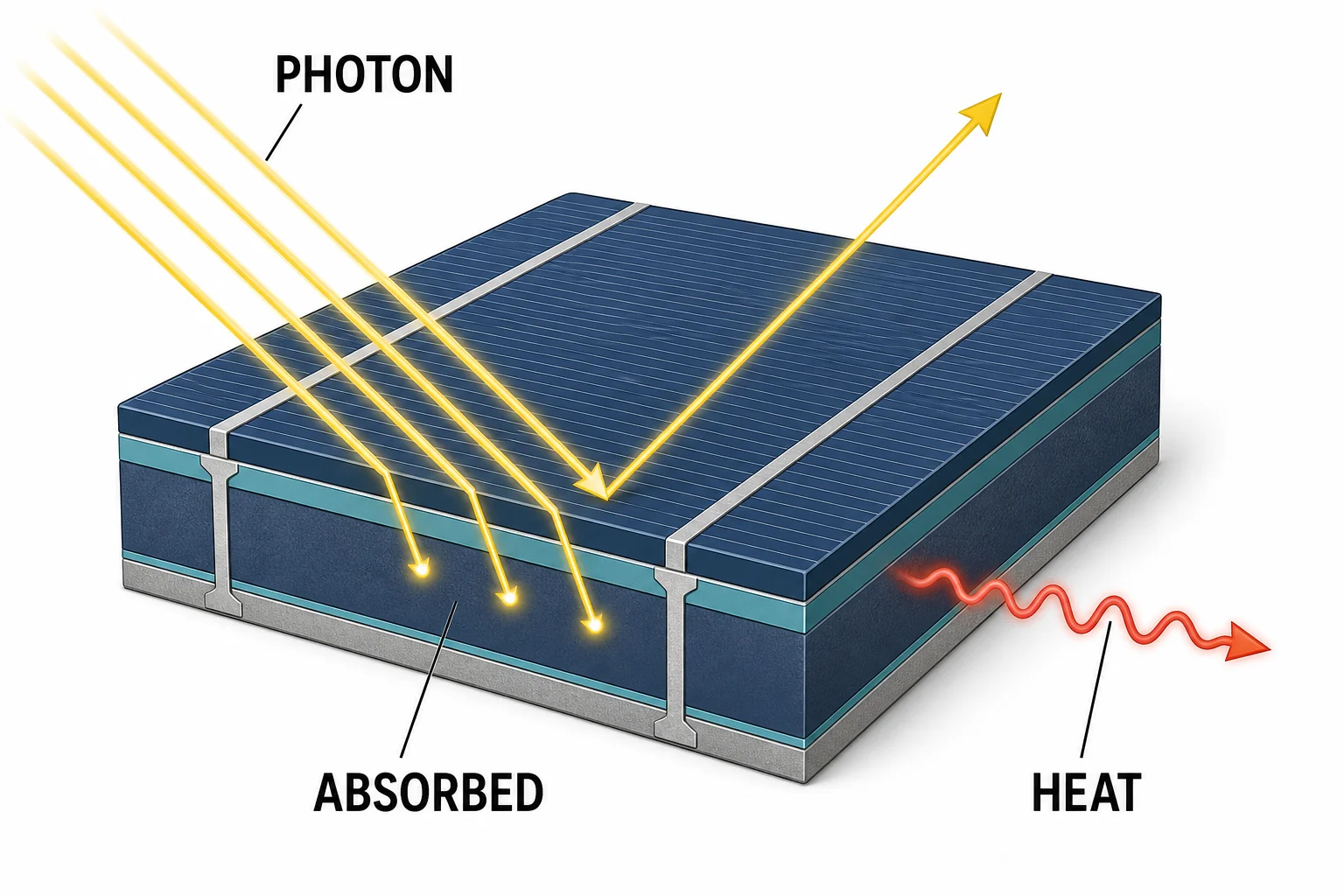
Diagram showing sunlight photons with different energies striking a silicon solar cell, with some absorbed and some reflected or lost as heat
Photons must have enough energy to free charges
Sunlight is made of electromagnetic waves, but it can also be counted as packets of energy called photons. Each photon has an energy that depends on its frequency. Higher frequency light has more energy per photon. A solar cell only uses photons that can give enough energy to electrons in the material. Some low energy infrared photons pass through or warm the panel. Some very high energy photons free electrons, but extra energy often becomes heat. This is one reason a solar panel cannot turn all incoming sunlight into electricity. The panel is selective because the atoms in the semiconductor have allowed energy levels. The match between photon energy and those levels controls what happens next. In high school physics, this connects wave models of light with energy transfer.

Photon energy decides whether sunlight can start an electric current.

The band gap sets the threshold
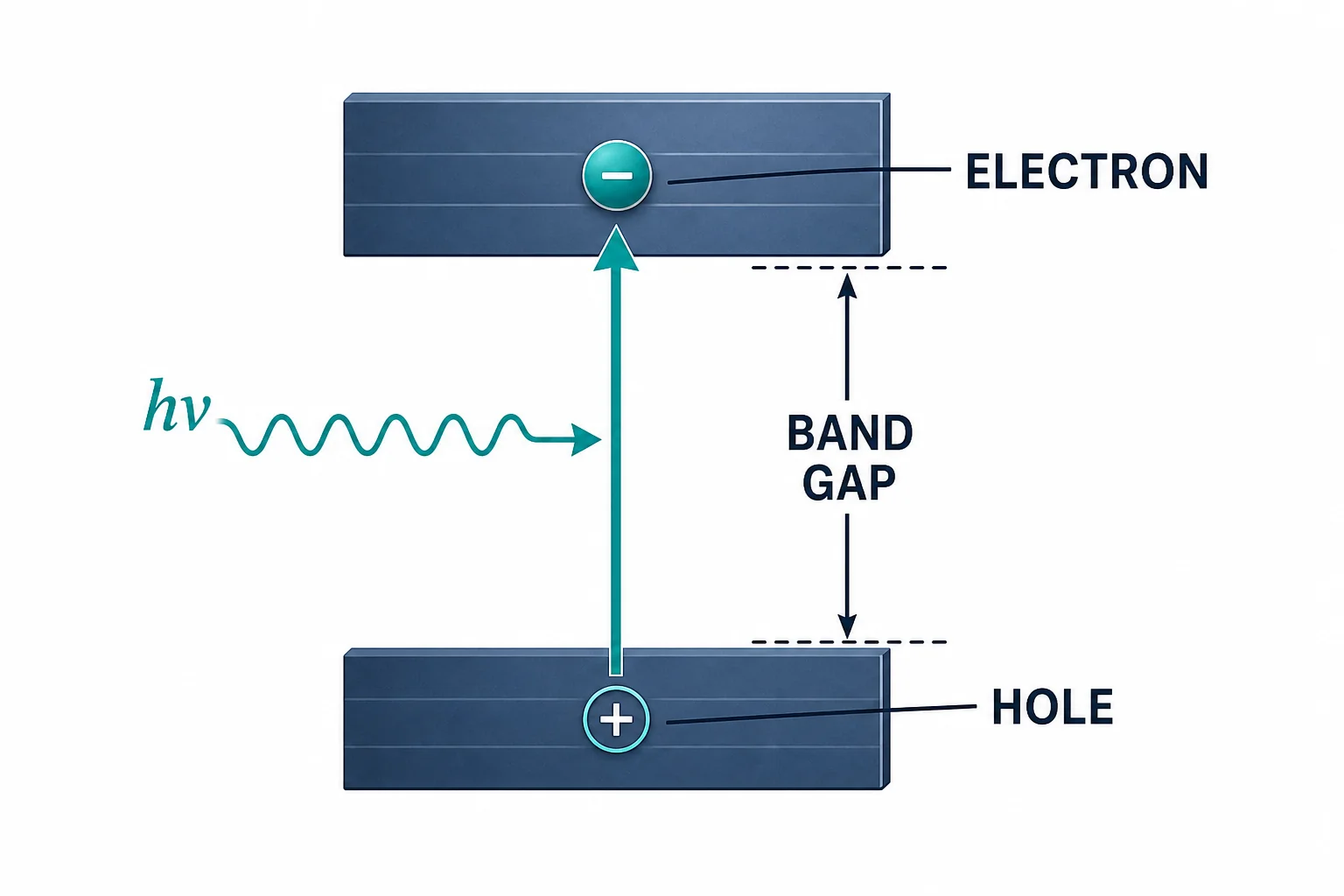
Energy band diagram showing an electron lifted across the band gap by an incoming photon, leaving a hole behind
A photon must cross the band gap threshold
In a metal, many electrons can move easily. In a pure semiconductor, most electrons are stuck in lower energy states unless they get a boost. The energy gap between stuck states and mobile states is called the band gap. Silicon has a band gap that fits part of the sunlight reaching Earth. A photon with less energy than the band gap cannot free an electron for current. A photon with enough energy can lift an electron into a state where it can move through the solid. The missing electron acts like a positive charge called a hole. The electron and hole form a pair. If the cell separates them quickly, they can do useful work in a circuit. If not, they recombine and the energy is lost as heat.

The band gap is the energy doorway that sunlight must open.

A pn-junction separates charge
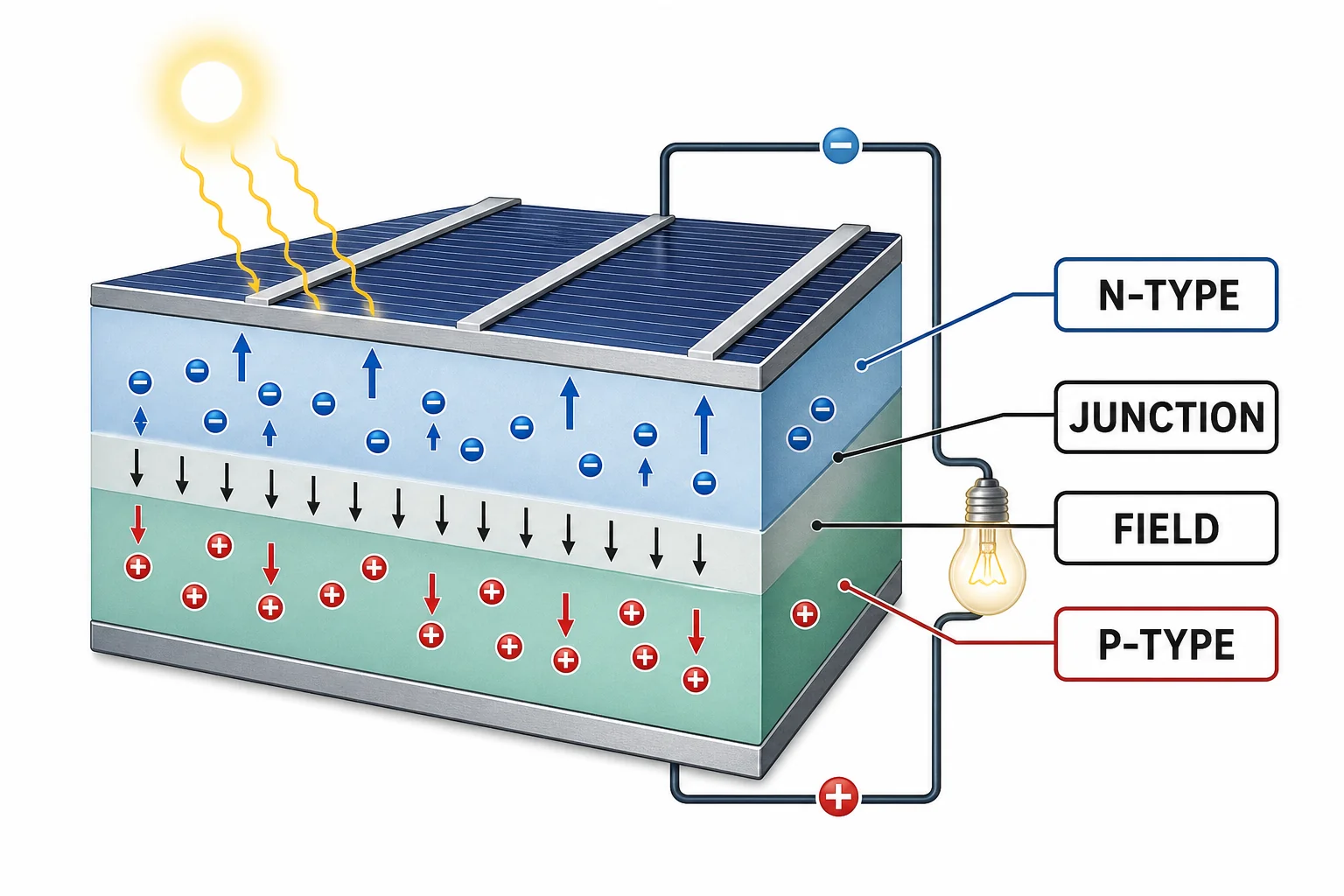
Cutaway of a pn-junction solar cell showing p-type and n-type silicon layers, the internal electric field, and separated electrons and holes
The pn-junction builds in a charge-separating field
A useful solar cell is not just plain silicon. It has two treated regions called p-type and n-type silicon. The n-type side has extra electrons available. The p-type side has extra holes available. Where the two regions touch, charges move and create an internal electric field. This boundary is the pn-junction. The field acts like a one-way push for newly created electron and hole pairs. Electrons are pushed toward the n-type side. Holes are pushed toward the p-type side. That separation creates a voltage across the cell. Voltage is not the same as current. It is the energy push per unit charge. Current begins when an outside path lets charges move through a load.

The junction turns freed charges into separated charges.

A circuit lets current flow
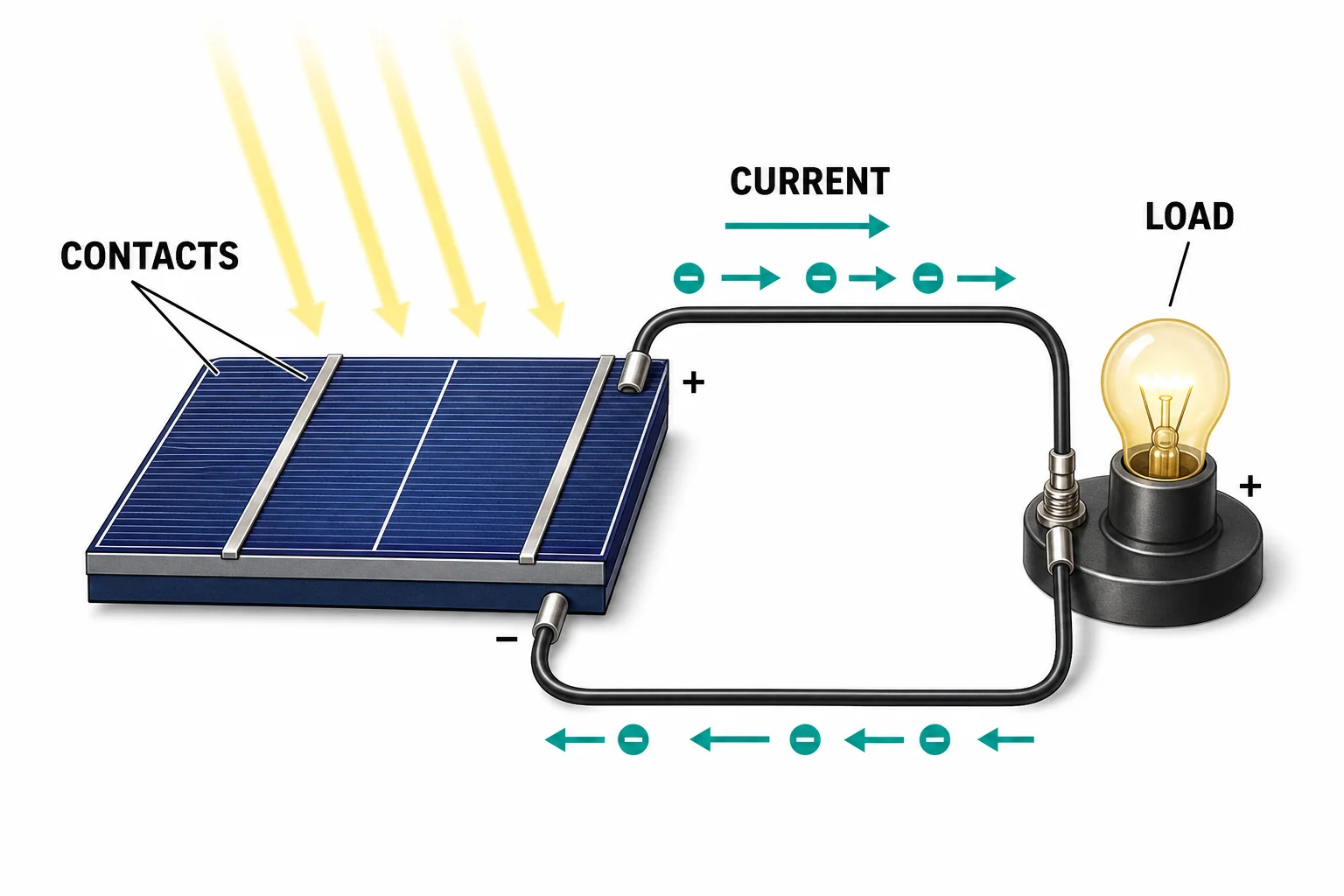
Solar cell connected to a simple circuit with wires and a small load, showing electron flow through the external wire
Separated charge becomes current in a closed circuit
Once charges are separated, the solar cell has a voltage across its contacts. Metal strips on the front and back collect charge. When the panel connects to a closed circuit, electrons travel through the wire to the device. The device could be a light, a motor, a charger, or an inverter. As electrons move through the device, electrical energy is transferred to it. Inside the cell, new photon hits keep replacing separated charges. This steady process maintains current as long as light is available and the circuit is closed. If the circuit is open, voltage can still be present, but charge does not keep flowing through the outside path. That is why a panel needs both sunlight and a completed circuit to deliver power.

Voltage provides the push, but a closed circuit allows current.

Power depends on conditions
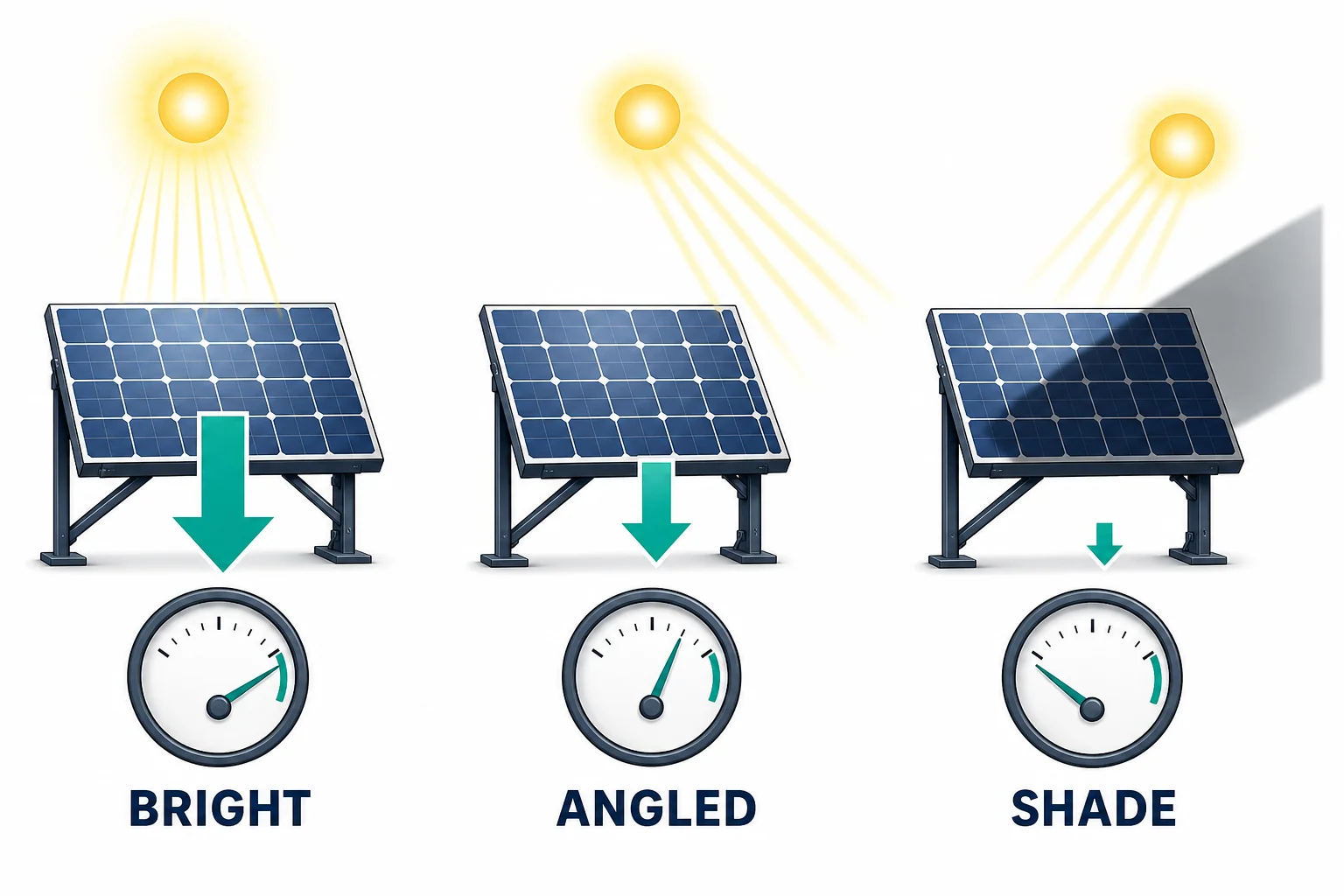
Panel output comparison showing bright direct light producing more current than weak angled light or partial shade
Light level, angle, heat, and shade affect output
A solar panel's power depends on both voltage and current. The relationship is $P=IV$, where power equals current times voltage. Brighter light usually creates more electron and hole pairs each second, so current can rise. Temperature matters too. Hot panels often produce slightly lower voltage because heat changes how charges behave in the semiconductor. The angle of sunlight matters because tilted light spreads over more area. Shadows matter because solar cells are connected together, and one shaded part can limit the current in a string. Engineers improve performance with anti-reflection coatings, textured surfaces, bypass diodes, and maximum power point tracking. The basic physics stays the same. Light frees charges, the junction separates them, and the circuit carries energy away.

Real panel output changes because light, heat, and circuits change.

Vocabulary

Photon
A packet of light energy. Its energy depends on the light's frequency.
Semiconductor
A material whose ability to conduct electricity can be controlled. Silicon is the most common solar cell semiconductor.
Band gap
The energy difference an electron must gain to move from a bound state into a mobile state in a semiconductor.
pn-junction
The boundary between p-type and n-type semiconductor regions. It creates an internal electric field that separates charge.
Photovoltaic effect
The process in which light creates voltage and current in a material.
Power
The rate of energy transfer. In a circuit, power is current times voltage.

In the Classroom

Measure panel output versus angle

25 minutes | Grades 9-12

Connect a small solar cell to a multimeter and shine a lamp on it from different angles. Students graph voltage or current against angle and explain why direct light gives a larger output.

Model the band gap with steps

20 minutes | Grades 9-12

Use a staircase or drawn energy levels to model electrons needing a minimum energy boost. Students compare low energy and high energy photon cards and decide which ones can free an electron.

Build a solar circuit

30 minutes | Grades 9-12

Students connect a mini solar panel to a motor or LED, then test open and closed circuits. They identify where energy enters, where charge moves, and where energy is transferred to the load.

Key Takeaways

  • Solar panels convert light energy into electrical energy through the photovoltaic effect.
  • Photon energy must be high enough to cross the semiconductor band gap.
  • A pn-junction creates an internal electric field that separates electrons and holes.
  • A closed circuit lets separated charges flow through a load as electric current.
  • Panel power changes with light intensity, angle, temperature, shading, and circuit design.