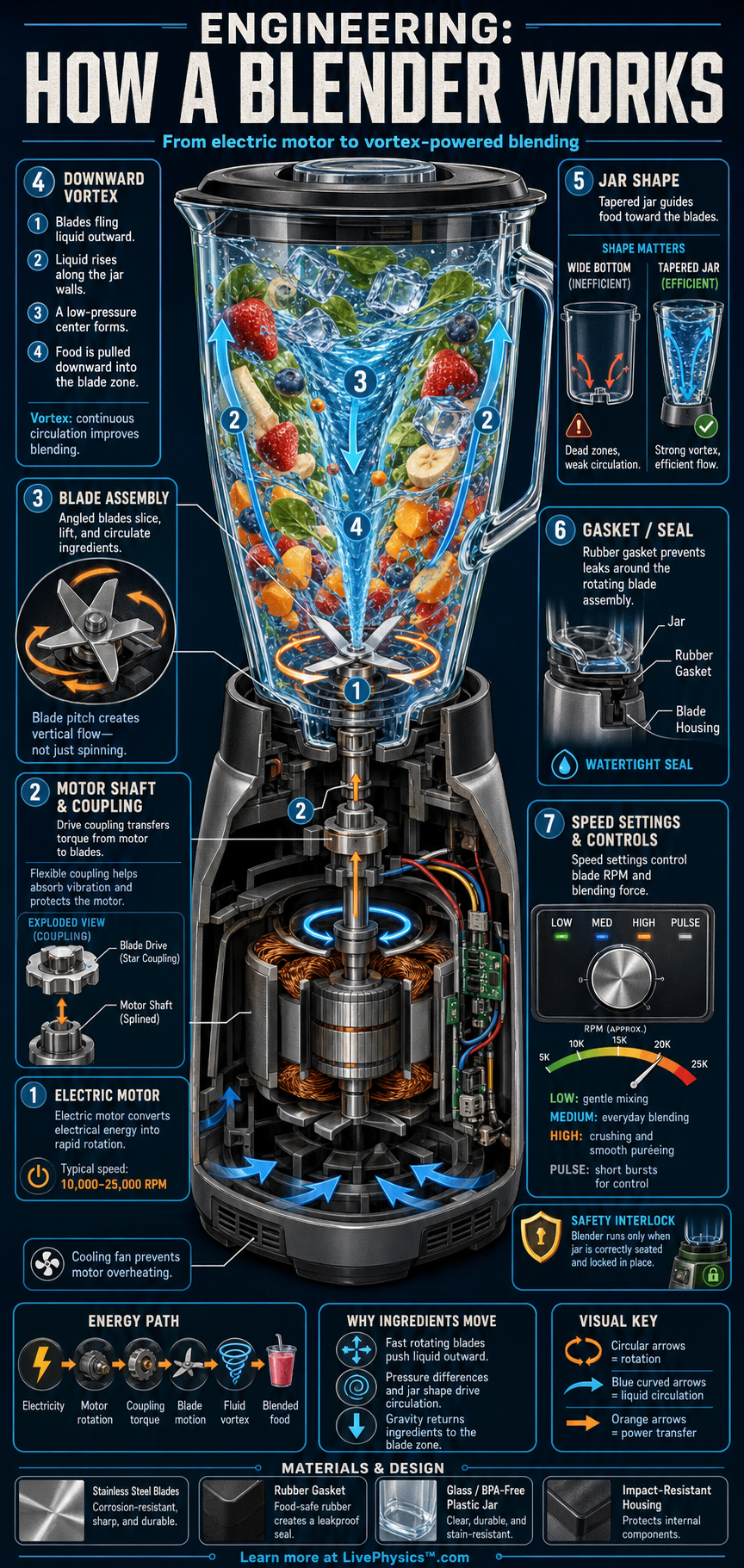
A countertop blender converts electrical energy into the fast mechanical rotation needed to chop, mix, and circulate food. Its main parts are the jar, blade assembly, gasket, drive coupling, electric motor, control settings, and base. The motor can spin the blades thousands of times each minute, producing strong fluid motion inside the jar.
Understanding this system connects electric motors, rotational motion, fluid dynamics, and practical product design.
Understanding Engineering, How a Blender Works
Many household blenders use a universal motor, a type that can run from the alternating current supplied by a wall outlet. Electric current creates magnetic fields in the stationary part of the motor and in the rotating armature. These fields push against each other, turning the shaft.
A commutator repeatedly changes the current direction in the armature at the right moment, so the turning force continues in one direction. The motor does not keep exactly the same speed under every condition.
Thick mixtures resist motion more than water, so the motor needs more turning force and usually slows down. This is why a blender can sound lower pitched when crushing ice or processing a heavy paste.
The blade does more than act like a small knife. Its leading edges create shear, which means nearby layers of food move at different speeds and pull apart. Hard pieces are broken by impacts with the blade, the jar, and other pieces.
Softer foods are torn and sheared. The ends of the blades move much faster than points close to the center. This makes the outer region especially important for crushing and mixing.
Blade shape matters because a blade must both cut material and push liquid through the jar. Blades that are too flat may mostly spin the liquid in circles. Blades with carefully chosen angles produce stronger movement through the full volume.
A visible vortex forms because spinning liquid is pushed outward by its circular motion. The liquid level becomes higher near the wall and lower near the middle. The lower-pressure region near the center can pull material toward the blades, but it can create problems too.
If the mixture is too thick, it may form an air pocket around the blades. Then the motor runs while little food reaches the cutting edges. Adding some liquid, stopping to scrape the sides, or using a tamper on a blender designed for one can restore flow.
Jar shape helps control this motion. Ribs, a narrower base, and a suitable blade position can prevent food from simply rotating as one mass.
Several less visible design choices protect the machine. A flexible seal keeps liquid out of the lower bearing area. If liquid reaches that area repeatedly, friction rises and the blade assembly can fail.
The drive connection is often made from materials that can wear before the motor shaft is damaged. This makes the connection a deliberate weak point. The base needs enough mass and grip to resist vibration.
It may include a thermal protector that cuts power if the motor becomes dangerously hot. Heat is produced in the windings, bearings, and food itself, especially during long runs.
When studying a blender, track energy losses as carefully as useful output. Electrical energy becomes rotation, while some becomes sound, vibration, and heat. Notice the difference between speed and turning force.
A fast blade is not automatically effective if the mixture cannot circulate toward it. Pulse settings are useful because brief starts can shift large pieces into a better position without heating the food as much. Good engineering balances performance, cleaning, safety, noise, cost, and reliability rather than maximizing only blade speed.
Key Facts
- The electric motor changes electrical energy into rotational mechanical energy.
- Angular speed relates to rotation rate by omega = 2pi f, where f is in revolutions per second.
- Rotational power is P = tau omega, where tau is torque and omega is angular speed.
- A blade tip moves at v = r omega, so a larger blade radius or faster rotation gives a higher tip speed.
- The drive coupling transfers torque from the motor shaft to the removable blade assembly.
- Angled blades create circulation, material moves down near the jar wall and is pulled upward near the center vortex.
Vocabulary
- Torque
- Torque is the turning effect of a force that causes an object, such as a motor shaft, to rotate.
- Angular speed
- Angular speed is the rate at which an object rotates, commonly measured in radians per second or revolutions per minute.
- Drive coupling
- A drive coupling is the connector that transfers rotation from the motor in the base to the blade shaft.
- Vortex
- A vortex is a spinning flow of fluid that forms a low-pressure center and circulates material through the jar.
- Gasket
- A gasket is a flexible sealing ring that prevents liquid from leaking through a joint between two parts.
Common Mistakes to Avoid
- Assuming the blades alone pull all food downward is incorrect because the full circulation pattern in the jar, including flow near the walls and center, moves food toward the blades.
- Confusing speed with torque is incorrect because speed describes how fast the shaft turns, while torque describes the motor's turning force, especially important for thick mixtures.
- Using rpm directly as angular speed in P = tau omega is incorrect because omega must be in radians per second when power is calculated in watts.
- Thinking a gasket makes the jar permanently fixed to the base is incorrect because the gasket seals the blade assembly, while the drive coupling is designed to engage and disengage when the jar is placed on the base.
Practice Questions
- 1 A blender blade rotates at 18,000 rpm. Calculate its rotation frequency in revolutions per second and its angular speed in rad/s.
- 2 A motor supplies 0.40 N m of torque to blades rotating at 500 rad/s. Calculate the mechanical power delivered to the blades.
- 3 A thick smoothie mixture stops circulating and a pocket of food remains above the blades. Explain how changing the speed, adding liquid, or briefly stopping to redistribute ingredients could improve the vortex and blending.