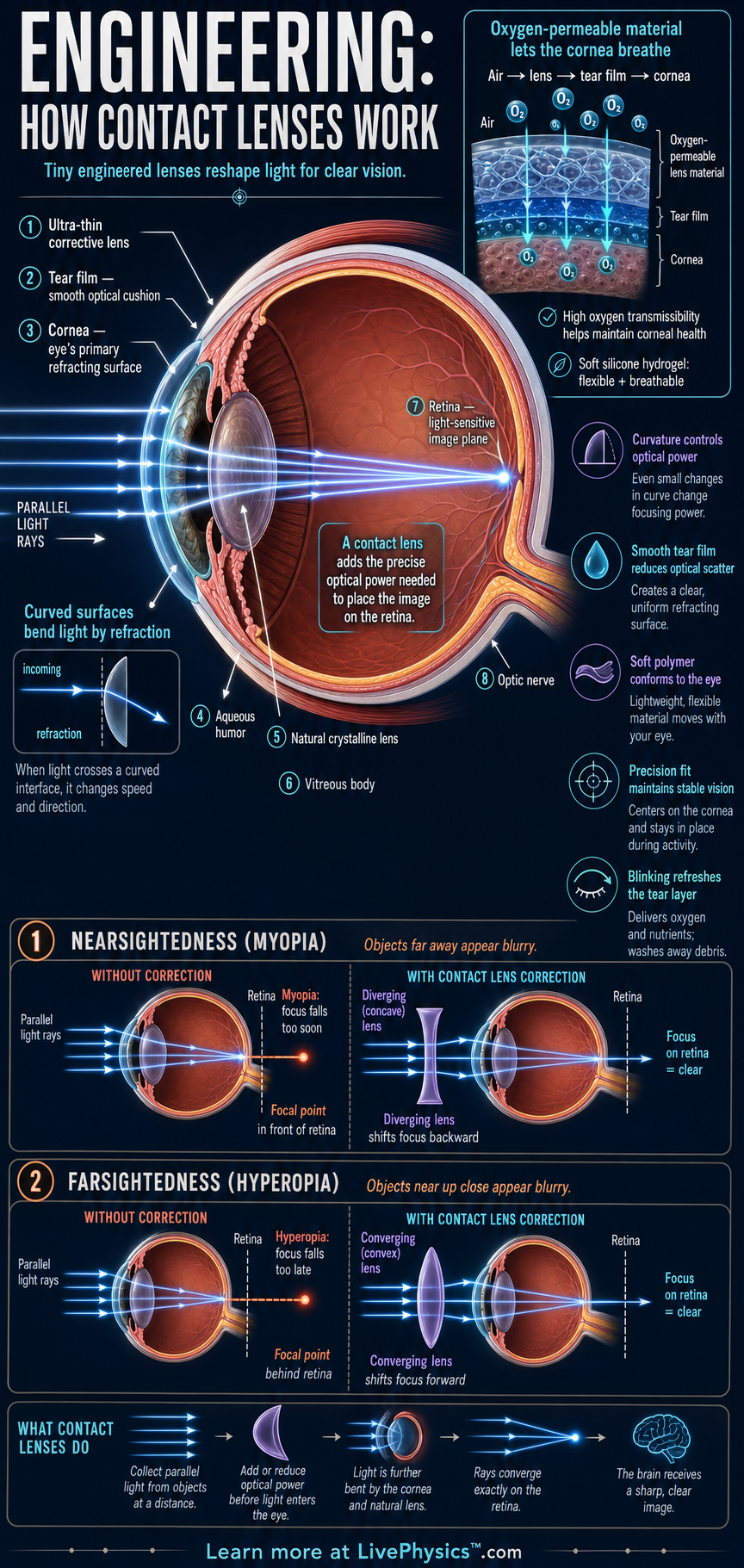
Contact lenses are thin, curved optical devices that sit on the tear film covering the cornea, the clear front surface of the eye. Their engineered shape changes how incoming light bends before it reaches the eye's natural lens and retina. This allows contact lenses to correct common refractive errors such as nearsightedness and farsightedness.
A well-fitted lens must provide sharp vision while remaining comfortable and safe for the cornea.
The contact lens, tear film, cornea, aqueous humor, crystalline lens, and vitreous body form a connected optical path. A concave lens diverges light to correct nearsightedness, while a convex lens converges light to correct farsightedness. Lens materials are designed to transmit oxygen from air through the lens so the cornea can maintain healthy metabolism.
The tear film also lubricates the lens, reduces friction during blinking, and helps create a smooth refracting surface.
Understanding Engineering, How Contact Lenses Work
Clear vision depends on placing the image at one precise layer of nerve cells at the back of the eye. If the eye is too long from front to back, light from distant objects comes to a focus before that layer. By the time it reaches the retina, the light has begun spreading out again.
This makes distant signs or classroom boards look blurred. If the eye is too short, the focus would fall behind the retina. Near print can then require extra effort to see clearly.
A prescription changes the path enough to move the focus to the needed position. Small changes in lens power can make a noticeable difference because the lens sits very close to the eye.
Not every vision problem is caused by the eye being too long or too short. In astigmatism, the cornea or natural lens has different curvatures in different directions. Light passing through one direction may focus at a different location from light passing through another.
Ordinary round lenses have the same power all around, so they cannot fully correct this pattern. A toric contact lens has different powers across its surface. It must keep the correct orientation while the eye moves and blinks.
Engineers use small thickness changes, shaped edges, or a slightly heavier lower region to limit unwanted rotation. Even a small turn can reduce sharpness.
The material creates an important engineering tradeoff. A lens needs to hold its shape well enough to give the planned optical power. It must still flex with the curved eye and feel smooth under the eyelid.
The living cornea has no blood vessels. It gets much of its oxygen from the air through the tear layer. Modern soft lenses often use silicone hydrogel materials because they allow more oxygen to pass through than older hydrogels.
A material that passes oxygen well is not automatically the best fit. Its surface must stay wettable, resist deposits from tears, and avoid drying out during a long day. Lens edges are carefully rounded because an edge that rubs the eyelid can cause irritation.
Fitting a lens is more than matching the number on a prescription. The base curve describes how curved the back surface is. The diameter affects where the lens rests and how it moves with each blink.
A lens that is too tight may not exchange tears efficiently underneath it. A lens that is too loose can move too much, causing unstable vision or discomfort.
Eye care professionals check lens movement, surface condition, and the health of the cornea after the lens is worn. They may use colored dye and blue light to reveal dry patches or tiny areas of damage.
Students can see the same optical ideas in glasses, camera lenses, microscopes, and phone cameras. All of these systems control where light forms an image. Contacts add the challenge of working on a warm, wet, moving surface.
Safe use matters because a lens can trap microbes against the cornea if it is dirty or worn longer than intended. Washing hands, using the recommended solution, and following the replacement schedule protect the eye.
Sleeping in lenses is only safe when a specific lens and medical guidance allow it. Redness, pain, light sensitivity, or suddenly blurred vision need prompt professional attention.
Key Facts
- A contact lens floats on the tear film rather than directly attaching to dry corneal tissue.
- The cornea provides most of the eye's refractive power because light changes speed strongly when entering it.
- Lens power is measured in diopters, P = 1/f, where P is in m^-1 and f is focal length in meters.
- For thin lenses, 1/f = 1/do + 1/di, where do is object distance and di is image distance.
- A negative-power concave contact lens corrects myopia by causing incoming rays to diverge before entering the eye.
- A positive-power convex contact lens corrects hyperopia by adding convergence so light focuses on the retina.
Vocabulary
- Cornea
- The transparent, curved front surface of the eye that bends much of the incoming light.
- Tear film
- A thin liquid layer over the cornea that lubricates the eye and supports the contact lens.
- Retina
- The light-sensitive layer at the back of the eye that converts focused light into nerve signals.
- Diopter
- A unit of optical power equal to the reciprocal of focal length in meters.
- Oxygen permeability
- A material property describing how readily oxygen can pass through a contact lens to the cornea.
Common Mistakes to Avoid
- Thinking a contact lens replaces the eye's natural crystalline lens is incorrect because the contact lens only adds optical power at the front of the eye. The natural lens still changes shape to help focus at different distances.
- Assuming every vision correction lens is convex is wrong because myopia requires a concave, negative-power lens. Its diverging action moves the focal point backward onto the retina.
- Treating the contact lens as if it sits directly on the cornea ignores the tear film. The tear film provides lubrication, optical smoothness, and a small fluid layer between the lens and cornea.
- Ignoring oxygen transport when considering lens design is unsafe because the cornea has no blood vessels. A lens with low oxygen permeability can reduce oxygen supply to corneal tissue.
Practice Questions
- 1 A contact lens has a focal length of -0.50 m. Calculate its optical power in diopters.
- 2 A farsighted eye is corrected using a contact lens with power +2.0 D. Calculate the focal length of the lens in meters.
- 3 Explain why a person with myopia needs a diverging contact lens even though the cornea and natural lens already converge incoming light.