Understanding Wave Interference Simulator
A wave is not a moving object that carries a fixed amount of height from place to place. It is a repeating disturbance, and each location has a displacement that can be positive, negative, or zero at a particular instant. When disturbances meet, the local displacement is found by adding their values.
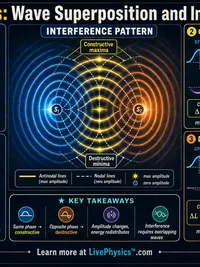
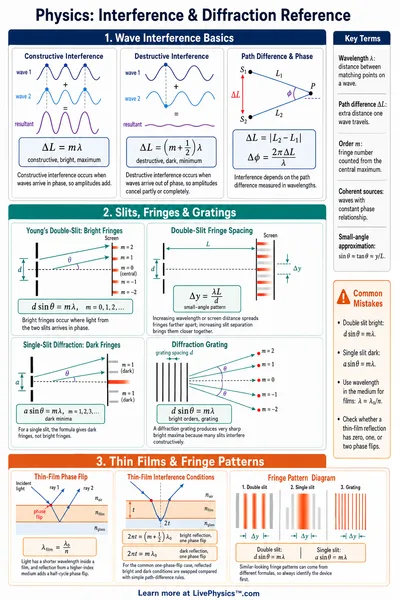
The timing of a wave cycle is called its phase. Two crests arriving together have matching phase, while a crest meeting a trough has opposite phase. This timing matters more than the distance from either source alone.
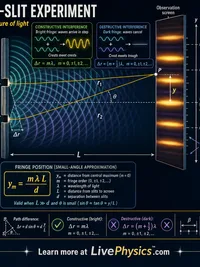
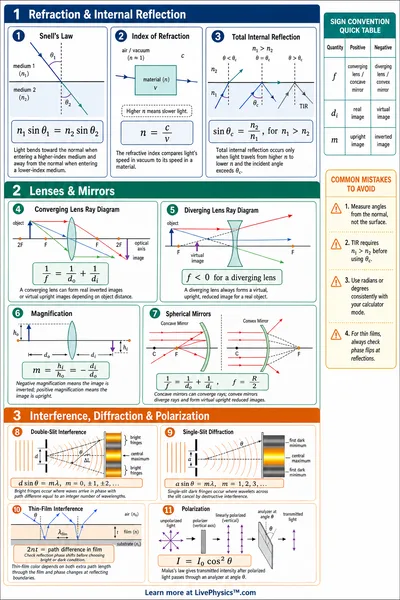
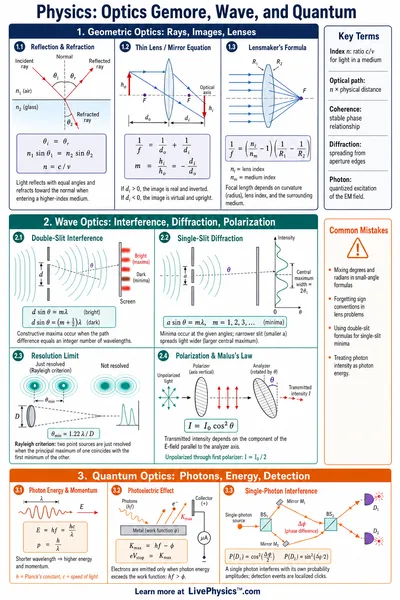
For two sources producing the same frequency, compare the lengths of their routes to one observation point. A route difference equal to a whole number of wavelengths keeps the waves in step. A route difference equal to an odd number of half wavelengths puts them out of step.
Bright and dark regions in a water or sound pattern are not places where waves stop travelling. Energy is redistributed across the pattern. Strong motion occurs in some directions, while cancellation makes motion much smaller in other directions.
The spacing of visible fringes depends on wavelength and source separation. Longer wavelengths tend to spread their fringes farther apart. Moving the sources closer together changes the angle at which matching or opposite phases occur.
Real sources must stay synchronized for a stable pattern. If one source drifts in frequency or starts with a changing timing offset, the fringes move or blur. Laser light and electronic signal generators can be made coherent enough to show clear interference.
Sound interference is easy to meet in daily life. Two speakers playing the same low note can create spots where the sound is loud and nearby spots where it is weak. Moving only a short distance can change the listening level because the path difference changes.
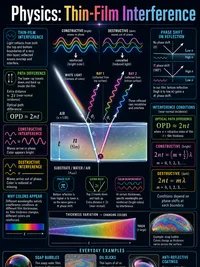
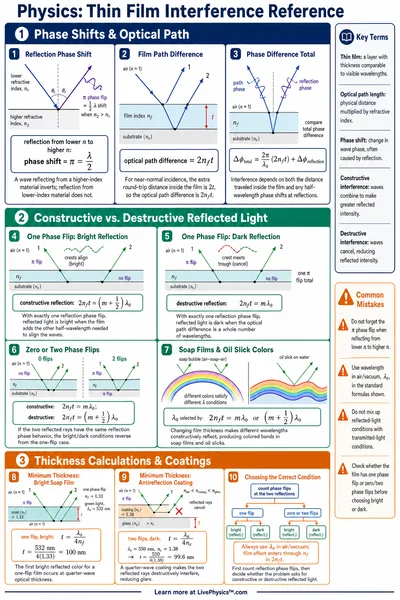
Thin-film colors come from light reflected at the top and bottom surfaces of a very thin layer. Soap bubbles, oil films, and some insect wings show this effect. Different colors have different wavelengths, so each color strengthens or weakens at different film thicknesses.
Reflection can add an important phase change that is easy to miss. Light reflecting from a boundary toward a material where it travels more slowly undergoes a half-cycle reversal. The other reflected ray may not reverse, so the thickness rule must include this difference.
A thin film does not need to have a perfectly uniform thickness. A gradual thickness change makes bands of color, since each location selects a different set of wavelengths for strong reflection. Viewing angle changes the path inside the film, which is why colors can shift as an object is tilted.
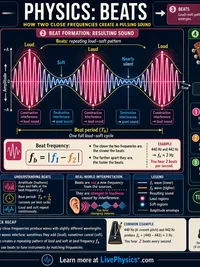
Beats occur when two waves have nearly equal frequencies. Their combined amplitude rises and falls because their phase relationship slowly changes from matching to opposing. The beat rate equals the difference between the two frequencies.
Musicians use beats when tuning instruments. A slow pulsing sound means two notes are close in pitch, and the pulsing disappears when their frequencies match closely enough. When using a simulator, watch both the moving wave shapes and the measured path or timing difference, since the pattern is the result of both.