Antibiotic Resistance Evolution Lab
Watch natural selection play out inside a bacterial infection. The antibiotic kills the susceptible bacteria, while resistant survivors and new mutants multiply and take over. Change the dose, the treatment course, the starting resistance, the mutation rate, and the fitness cost, then run the simulation to see whether the infection is cleared or resistance evolves.
Guided ExperimentNo treatment, who wins, susceptible or resistant?
Without any antibiotic, will the resistant strain or the susceptible strain dominate the population? Think about the fitness cost of resistance.
Write your hypothesis in the Lab Report panel, then click Next.
Bacterial Population Over Time
Controls
Current Readings
Data Table
(0 rows)| # | Dose(x MIC) | Course | Start resistant(%) | Final total | Final resistant(%) | Outcome |
|---|
Reference Guide
Natural Selection and Antibiotic Resistance
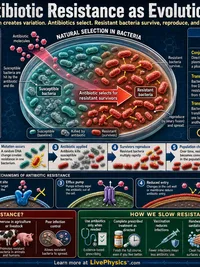
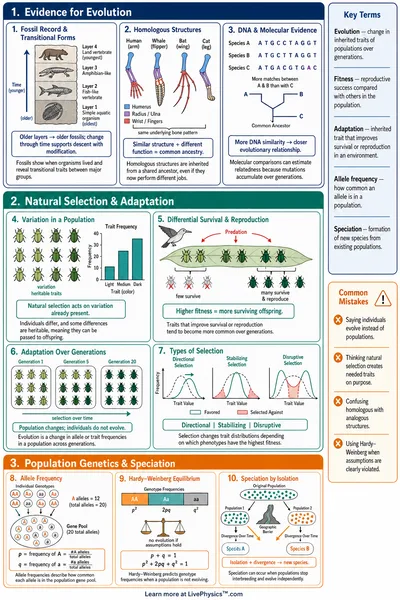
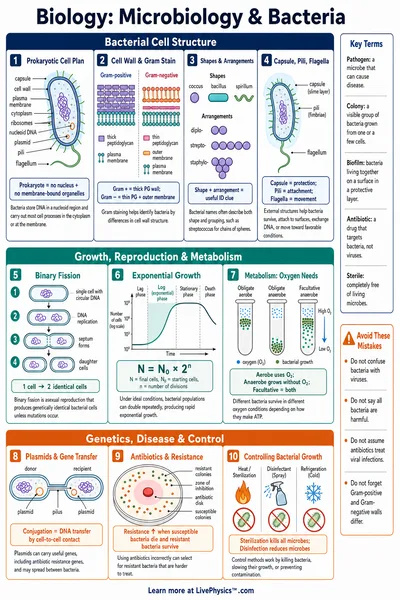
Antibiotic resistance is evolution in action. A bacterial population is not all the same. A few cells may already carry genes that let them survive a drug. When an antibiotic is used, it kills the cells that cannot resist and spares the ones that can.
The survivors reproduce and pass their resistance to the next generation. Over time the resistant cells make up more and more of the population. The antibiotic did not create the resistance. It selected for cells that already had it.
Susceptible vs Resistant and the Fitness Cost
Susceptible bacteria are killed by normal doses of an antibiotic. Resistant bacteria can survive much higher concentrations because of a protective trait, such as a pump that removes the drug or an enzyme that breaks it down.
Resistance is not free. Making those extra proteins costs energy, so resistant cells often grow more slowly than susceptible cells when no antibiotic is present. This fitness cost is why resistance usually stays rare until a drug gives the resistant cells an advantage.
Why Finishing the Full Course Matters
Doctors stress finishing a full course of antibiotics for a reason. The first cells to die are the most susceptible. The hardier and partly resistant cells take longer to kill. If you stop early, those tougher survivors are still alive.
Once the drug clears from the body, the survivors rebound. The infection can return, and the bacteria that grow back are the ones that were hardest to kill in the first place. A full course keeps the drug present long enough to finish the job.
Mutation, MIC, and How Resistance Spreads
New resistance can also appear by random mutation as bacteria copy their DNA. Most mutations do nothing or are harmful, but a rare one can protect against a drug. The more cells divide, the more chances there are for such a mutation to appear.
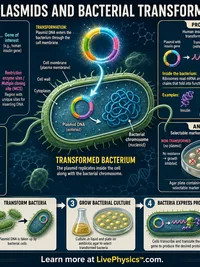
The minimum inhibitory concentration, or MIC, is the lowest drug level that stops a strain from growing. Resistant strains have a much higher MIC. Resistance genes can also pass between bacteria directly, which lets it spread quickly through a population.