Natural Selection Simulator
Watch a population evolve over generations as selection pressure changes which traits survive. Adjust mutation rate, selection strength, and scenario to see how natural selection shapes a population.
Trait frequency by bin over generations (colored lines) + mean trait (dashed)
How natural selection works
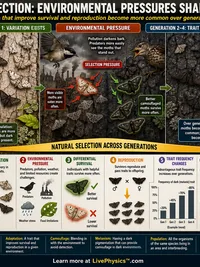
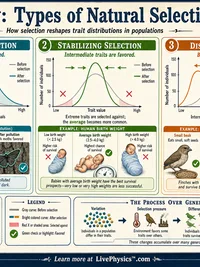
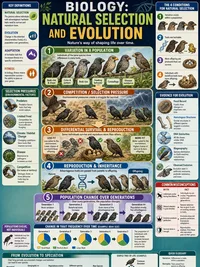
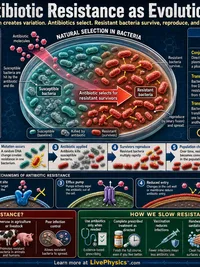
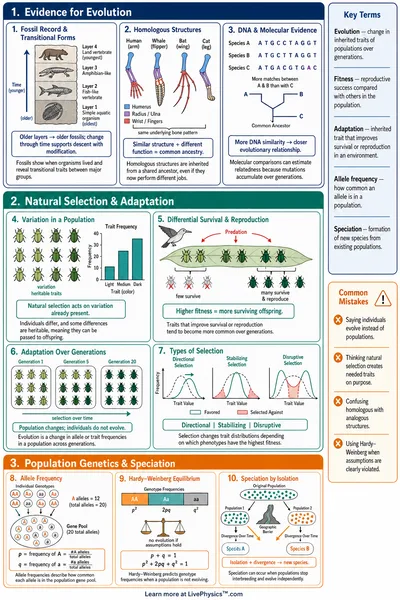
Populations carry natural variation. When the environment favors certain traits, individuals with those traits are more likely to survive and reproduce. Over generations, the favored traits become more common and the population's average trait value shifts. This is the core mechanism of Darwinian evolution.
NGSS alignment
Supports MS-LS4-4 and MS-LS4-6 (natural selection across generations), and HS-LS4-2 through HS-LS4-4 (mechanisms of evolution and inheritance of acquired adaptations).
Key concepts
- Fitness. A measure of how well a trait matches environmental demands. Higher fitness means higher survival and reproduction rates.
- Selection pressure. The strength of the environmental force acting on the population. Higher pressure accelerates trait shifts.
- Mutation. Random changes in inherited traits that introduce new variation each generation.
- Genetic drift. With small populations, random chance can override selection - try population size 50 vs 500.
Try these experiments
- Zero selection. Set selection strength to 0.0. Notice the population drifts randomly due to mutation alone.
- Strong vs weak pressure. Compare how fast the mean trait shifts at strength 0.2 vs 0.9 in the Camouflage scenario.
- Small population drift. Use 50 individuals and watch genetic drift cause unpredictable outcomes even with selection.
- No mutation. Set mutation rate to 0.0. Once traits are fixed they cannot change - the population stagnates.