Population Growth Simulator
Simulate and compare population growth models. Explore exponential (unlimited) growth, logistic (carrying capacity) growth, and Lotka-Volterra predator-prey dynamics with interactive graphs, real-time calculations, and ecological presets.
Parameters
Results
Exponential Growth Curve
Reference Guide
Exponential Growth
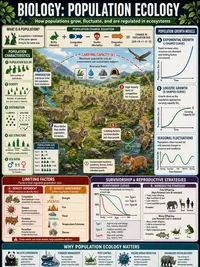
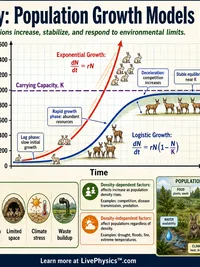
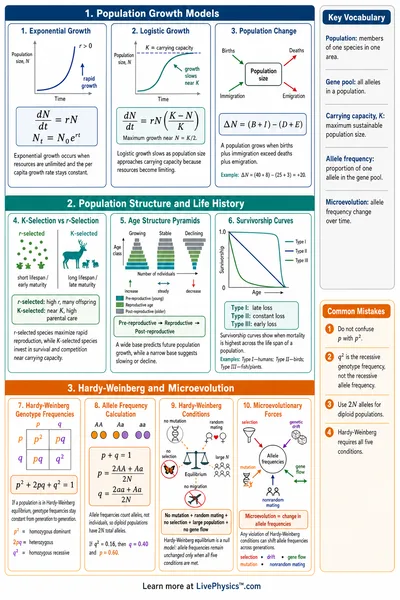
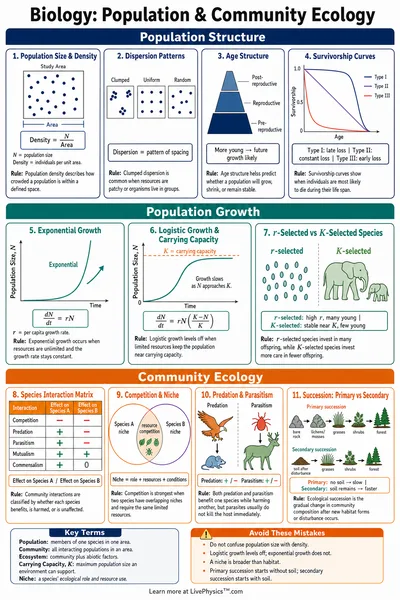
When resources are unlimited, populations grow at a constant rate proportional to their size. This produces a J-shaped curve that accelerates over time.
In reality, no population grows exponentially forever. Resource limits, disease, and competition eventually slow growth.
Logistic Growth
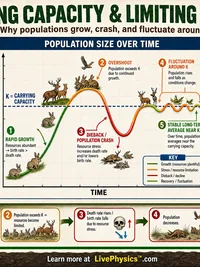
Logistic growth accounts for limited resources by introducing a carrying capacity K. Growth slows as the population approaches K, producing an S-shaped (sigmoid) curve.
Carrying Capacity and Inflection
The carrying capacity K is the maximum population an environment can sustain indefinitely. At K, birth rate equals death rate and population growth stops.
The inflection point of the logistic curve occurs at N = K/2. Below K/2, growth is accelerating. Above K/2, growth is decelerating as the population approaches its limit.
Predator-Prey Dynamics
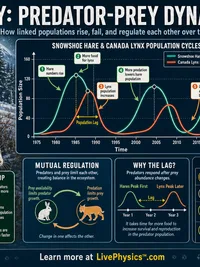
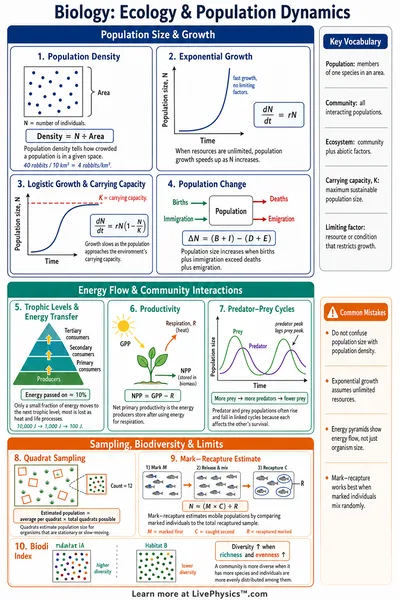
The Lotka-Volterra equations model how predator and prey populations interact. Prey grow naturally but are consumed by predators. Predators depend on prey for reproduction and die without food.
The result is oscillating populations. When prey are abundant, predators thrive and increase. As predators grow, prey decline. Fewer prey cause predator decline, allowing prey to recover.