Doppler Sound Lab
Watch a train approach, pass, and move away while sound waves compress in front and stretch behind. Discover why sirens sound higher when coming toward you and lower when moving away.
Guided ExperimentTrain Approaching and Receding
What do you predict will happen to the pitch of the train horn as it approaches you? What about after it passes?
Write your hypothesis in the Lab Report panel, then click Next.
Controls
Difficulty
Slow train, labels always visible
Sound Source
Pitch Meter
Sound Wave Pattern
Wavelength 6% shorter
= Higher pitch
Wavelength 6% longer
= Lower pitch
Capture this trial
Record the current source, speed, and observed frequency
Data Table
(0 rows)| # | Trial | Source | Speed(m/s) | Source Freq(Hz) | Observed Freq(Hz) | Pitch Change |
|---|
Reference Guide
The Doppler Effect
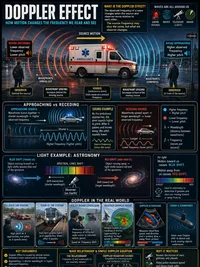
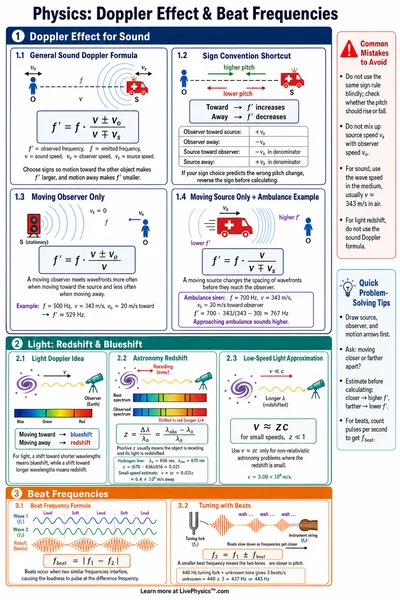
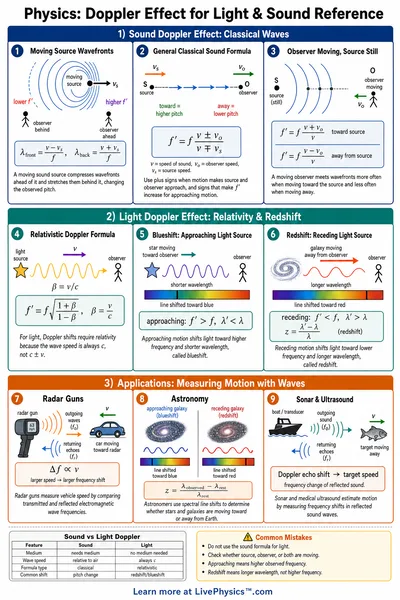
The Doppler effect is the change in pitch you hear when a sound source moves toward or away from you. When a source approaches, its sound waves bunch together in front of it. More waves reach your ear each second, so you hear a higher pitch.
When the source moves away, the waves spread out behind it. Fewer waves reach your ear each second, so you hear a lower pitch. The source itself does not change the sound it makes - only your perception changes.
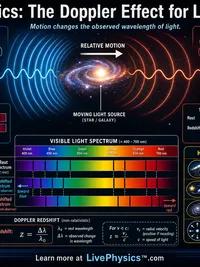
Austrian physicist Christian Doppler described this effect in 1842. It applies to light waves (redshift/blueshift) as well as sound.
Sound Waves
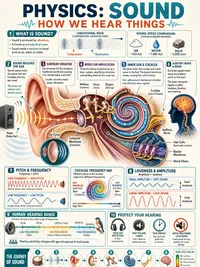
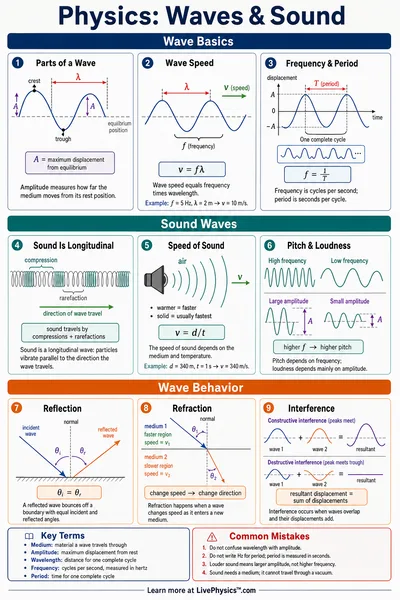
Sound travels as pressure waves through air at about 343 m/s at room temperature. Each complete back-and-forth pressure cycle is one wavelength.
Frequency is the number of complete waves that reach your ear per second, measured in Hertz (Hz). Higher frequency means higher pitch. Middle C on a piano is 262 Hz. A train horn is typically 300-500 Hz.
Wavelength times frequency equals wave speed. When frequency goes up, wavelength goes down (they are inversely proportional at fixed wave speed).
Frequency and Pitch
The Doppler formula gives the frequency you actually hear when a source moves. If the source moves toward you at speed v_s and you stand still
When the source moves away, the minus sign becomes a plus. A train at 50 m/s (about 180 km/h) raises the approaching pitch by about 17% and lowers the receding pitch by about 15%.
Real-World Examples
- Ambulance and fire truck sirens. You hear the siren change pitch as the vehicle passes. Emergency dispatchers use consistent siren frequencies so the Doppler shift helps bystanders estimate approach speed.
- Weather radar. Doppler radar measures how much the frequency of reflected radio waves changes to calculate storm wind speeds.
- Astronomy. Stars moving away from Earth show redshifted light (lower frequency). This is how astronomers discovered the universe is expanding.
- Speed guns. Police radar and sports ball-speed trackers both rely on the Doppler shift of reflected microwave signals.