Flame Test & Cation Identification Lab
Heat a metal salt in a flame and the excited electrons emit light at colors unique to each element. Choose a known salt to learn its signature color, or switch to the unknown challenge and identify the metal cation from the flame alone. Every observation is recorded in the data table for your lab report.
Guided Experiment Identifying Metal Cations by Flame Color
When a clean wire loop dipped in a metal salt solution is held in a hot flame, what do you predict will happen to the flame color, and why might different metals give different colors?
Write your hypothesis in the Lab Report panel, then click Next.
Controls
Explore Known Salts
Pick a metal salt, light the flame, and observe the characteristic color.
Data Table
(0 rows)| # | Trial | Sample | Observed Color | Identified Cation | Correct? |
|---|
Reference Guide
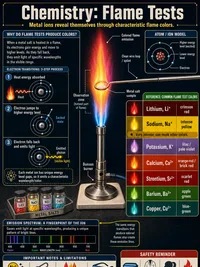
The Flame Test Procedure
Clean a nichrome or platinum wire loop by dipping it in concentrated hydrochloric acid and holding it in the flame until it no longer changes the flame color. Dip the clean loop into the metal salt solution, then hold it in the hottest part of a non-luminous Bunsen burner flame.
Observe the color of the flame immediately. Clean the loop again between samples so a leftover salt does not contaminate the next test. Record the color you see for each sample.
Color to Cation Reference
Lithium (Li). Crimson red, near 671 nm.
Sodium (Na). Intense yellow, near 589 nm.
Potassium (K). Lilac or violet, near 766 nm.
Calcium (Ca). Orange-red or brick red.
Strontium (Sr). Scarlet red.
Barium (Ba). Pale yellow-green, near 524 nm.
Copper (Cu). Blue-green, near 526 nm.
Boron (B). Bright green.
Rubidium (Rb). Red-violet.
Cesium (Cs). Blue-violet.
Why the Colors Differ
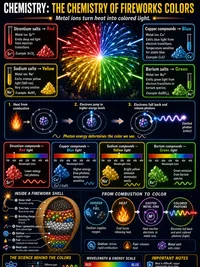
Heat from the flame gives electrons in the metal atom enough energy to jump to higher energy levels. These excited electrons are unstable, so they fall back to lower levels and release the energy difference as a photon of light.
Because each element has a unique set of allowed energy levels, the photons it emits have specific wavelengths. The combination of those wavelengths in the visible range produces the characteristic flame color, which is the basis of atomic emission spectroscopy.
Limitations of the Flame Test
Sodium contamination is the biggest problem. Even a trace of sodium gives a strong yellow flame that masks the fainter colors of other metals. A cobalt-blue glass filter absorbs the sodium light so the lilac of potassium can be seen behind it.
Some colors are also hard to tell apart by eye, such as the reds of lithium, calcium, and strontium, or the greens of barium, copper, and boron. The flame test identifies a metal but cannot tell you the amount, and it does not work for every element. Quantitative work uses a flame photometer or an emission spectrometer instead.