Empirical & Molecular Formula Calculator
Three tools in one. Compute the empirical formula from percent composition or measured masses, find the molecular formula from the empirical formula and molar mass, or calculate the percent composition of any chemical formula. Every calculation shows full working.
Calculator Mode
Presets
Element Composition
Tip, percentages do not need to sum to exactly 100.
Results
Empirical Formula
Empirical molar mass 30.026 g/mol
Step-by-Step Working
| Element | Mass % | Atomic Mass | Moles | Ratio | Subscript |
|---|---|---|---|---|---|
| C | 40.000 | 12.011 | 3.33028 | 1.0000 | 1 |
| H | 6.700 | 1.008 | 6.64683 | 1.9959 | 2 |
| O | 53.300 | 15.999 | 3.33146 | 1.0004 | 1 |
Reference Guide
What is an Empirical Formula
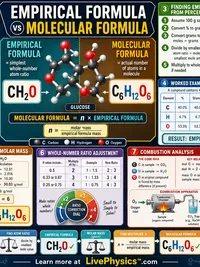
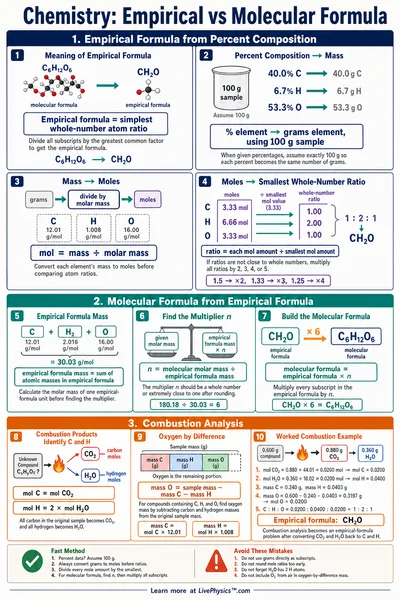
An empirical formula shows the simplest whole-number ratio of atoms in a compound. It tells you the relative proportions of elements but not the actual count of atoms.
Glucose (C6H12O6) and acetic acid (C2H4O2) both have the empirical formula CH2O because all three have C:H:O in a 1:2:1 ratio.
Steps to Find the Empirical Formula
- Convert each mass percent (or gram amount) to moles by dividing by the atomic mass.
- Divide all mole values by the smallest mole value.
- If the ratios are not whole numbers, multiply by the smallest integer that clears all fractions (e.g. multiply 1:1.5 by 2 to get 2:3).
- Write the formula with the whole-number subscripts.
Empirical vs Molecular Formula
The molecular formula gives the actual number of each atom in one molecule. It is always a whole-number multiple n of the empirical formula.
For glucose, empirical is CH2O (M = 30.03 g/mol), molecular is C6H12O6 (M = 180.16 g/mol), so n = 6.
Percent Composition
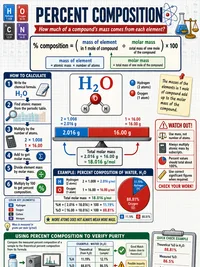
Percent composition is the mass fraction of each element in a compound, expressed as a percentage. It is determined experimentally by combustion analysis or other methods.
All percentages in a compound add to 100%.
Worked Example, Glucose
Empirical formula from composition
Glucose has 40.0% C, 6.7% H, 53.3% O. Assume 100 g sample.
- C: 40.0 / 12.011 = 3.330 mol
- H: 6.7 / 1.008 = 6.647 mol
- O: 53.3 / 15.999 = 3.332 mol
- Divide by 3.330: C=1.00, H=2.00, O=1.00
- Empirical formula, CH2O
Molecular formula from empirical
Molar mass of CH2O = 12.011 + 2(1.008) + 15.999 = 30.026 g/mol.
Measured molecular mass = 180.16 g/mol.
n = 180.16 / 30.026 = 5.999 which rounds to 6.
Molecular formula = (CH2O)6 = C6H12O6.